

A group of protesters shouting at the gate, a potentially explosive device in an abandoned car and an active shooter event all happening in short order are exactly what they sound like — a recipe for a perfect storm. This was precisely what happened Feb. 1 at Naval Support Facility (NSF) Indian Head as Naval Support Activity South Potomac (NSASP) Security Forces and emergency responders participated in training events that tested their skills during the Navy’s annual Solid Curtain/Citadel Shield training exercise.
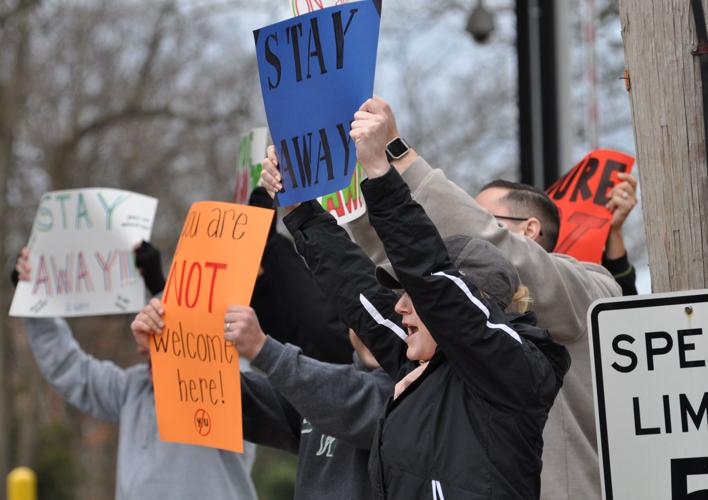
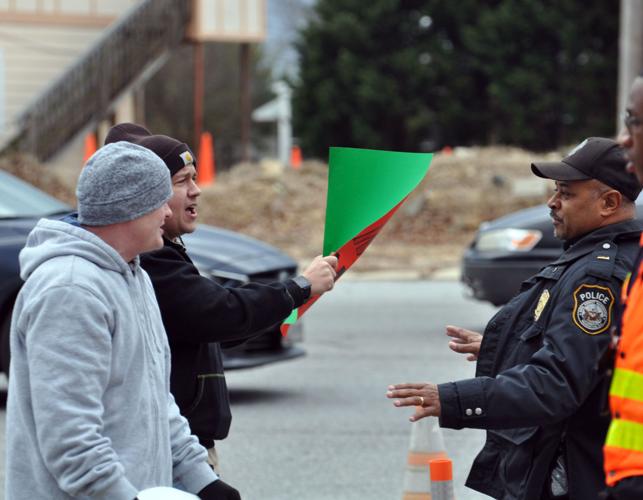
About eight mock protesters arrived at NSF Indian Head Main Gate to rail against the arrival of “Mr. Bluefish.” The protesters clashed with gate personnel as they chanted loudly, waved protest signs and attempted to interfere with traffic. NSASP security forces calmly but assertively held the mock protesters at bay, even simulating an arrest with one overzealous participant who took his disruptive antics onto base property.
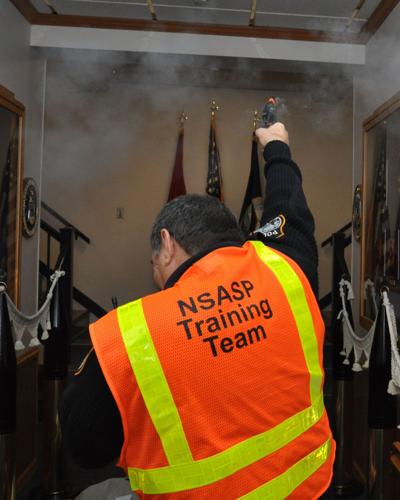
During the entire process, a number of trainers in orange safety vests emblazoned with “NSASP Safety Assessment Team” observed the event and took notes on how the officers handled the situation.
Simultaneously, other NSASP Police Officers were investigating and clearing a mock abandoned vehicle that contained a suspicious package. The officers were able to examine the vehicle and package to determine whether they posed a threat to the base.
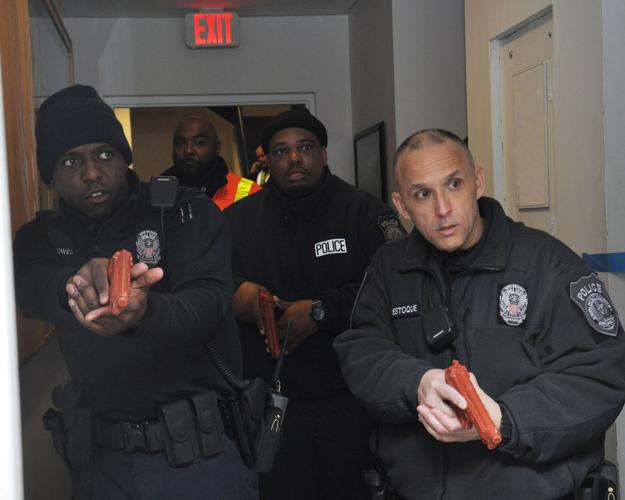
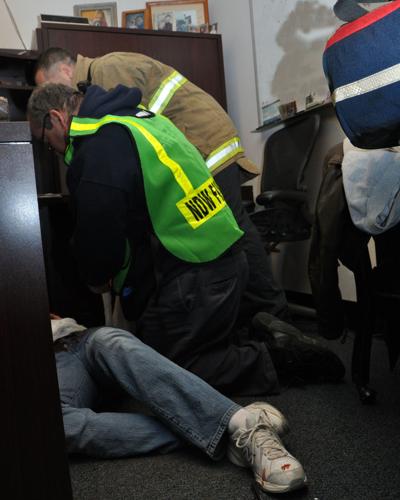
The third major event that rounded out this perfect training storm was an active shooter drill that took place at the Naval Ordnance Safety and Security Activity (NOSSA) building. A member of the security forces portrayed a disgruntled employee; he entered the building and left a path of mock injuries and deceased in his wake. Employees of NOSSA participated in the event, some replete with full moulage, or mock injuries, that included gushing wounds, dislocated joints and multiple gunshots. Those who weren’t actively involved in the drill practiced exiting the building and rallying at their predetermined location to ride out the remainder of the event in a safe location.
Police officers entered the simulated crisis to assess the situation, neutralize the shooter and clear the building, making it safe for Emergency Medical Services (EMS) personnel to enter and treat the “injured.” In the scenario, the mock shooter committed suicide; however, the officers weren’t sure if the individual acted alone and this uncertainty created a tense few moments as the officers cleared the building room by room, evaluating the injured to report back to dispatch, ensuring that NOSSA employees who sheltered in place were accounted for. In some cases, the simulated victims refused to come out, feigning fear that perhaps the officers were not really members of the NSASP Security Forces but more of the mock assailants.
Officers had to test their communication skills during these purposely intense moments and coordinate with dispatch to verify their identities and establish the safety of those employees who remained in the NOSSA building.
Several of those who remained behind felt the training event helped them practice their own plans and that the drill was good preparation for a potential real-life scenario.
“It was pretty much what I had expected it to be,” Marie Clarke, one of those who sheltered in place said. “They prepared us for what was going to happen. I did think of a few things that I wish I might have done differently, but I think overall, it was a good experience.”
Christopher Batchelor, another role-player from NOSSA who sheltered in place agreed that the experience was beneficial.
“I think it was a good drill,” Batchelor said. “It provided a lot of good training for all of us.”
NSASP Police Chief Robert Brooks views the event with a more critical eye - lives depend on him and his team performing these drills with the expertise they train for. Brooks sees the flaws in execution that a typical bystander might miss and it’s his job to ensure that the officers who are training are aware of where the mistakes were made, and most importantly that the officers learn the lessons while in practice and not during an actual event.
“We’ll capture all of the things that went well and all of the things that weren’t executed quite as well,” Brooks said. “From there we will be able to practice those skills sets and then incorporate those lessons learned during future exercises.”
NSASP Commanding Officer Capt. Mary Feinberg also participated in the exercise at the Emergency Operations Center (EOC), along with the heads of various commands aboard the facility to practice how each will participate during such an event.
“These type of drills are always good for not only the host command to figure out where their shortfalls are, but to reinforce to the tenant commands how it is a group effort in response to an incident,” Feinberg said. “Having the NOSSA CO [Commanding Officer Capt. JamesBeene] here was very beneficial. It allowed him to see how we work and for him to demonstrate to us how NOSSA will muster and then figure out where we can improve on any shortcomings. I would rather find these shortcomings in a drill then find them out in a real-life activity.”
A second, smaller training event took place aboard NSF Dahlgren the following day.