



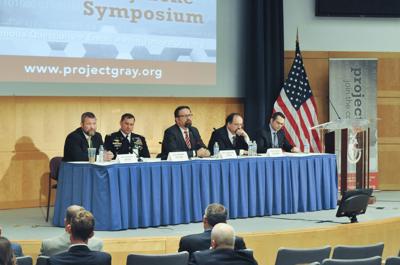
Editor’s Note: The Pentagram prints work by published writer and JBM-HH Commander Col. Patrick Duggan. This is the second in a two-part series of an article written by Duggan, reprinted with permission from Cyber Defense Review, a professional forum for current and emerging research on cyber operation. The content of this article is directly related to a recent National Defense University- and U.S. Army Special Operations Center of Excellence-hosted Project Gray symposium entitled “Russian Engagement in the Gray Zone.” See www.cyberdefensereview.org for details and see www.army.mil/jbmhh for part one of the series: ‘Cyberspace is a human space, as dynamic and uncertain as human nature.’ At the end of this article, a link to the full article will be provided.
Special Operations Forces are Dynamic
With every passing day, our hyper-connected landscape seems to produce a new class of threats, more technologically evolved than the last, harnessing the explosion of technology, information proliferation and network connectivity for ambiguous warfare. [7]
This means that, “in the not too distant future, every Special Operations Forces practitioner will be required to understand the basics of cyberspace, computers and coding; not because they’re expected to be programmers, but because they’ll need those skills to conduct special operations in an era vastly more interconnected than now.” [8]
USSOF must rapidly adapt and evolve, as they increasingly find themselves pitted against tech-savvy adversaries in dynamic situations, where they must employ some of the same cyber-technologies in unconventional ways. From high-tech to low-tech, and from human-centric to techno-centric, USSOF will employ cyber-technologies as a means to directly or indirectly strengthen our global network of partners and amplify our unique capabilities exercised through a wide array of options.
USSOF will employ cyberspace as a means to better understand the passions which drive human action and behavior, and will use cyberspace as a vehicle to identify conflicts earlier, seize opportunities to steer, and potentially, tamp down violence. [9]
Synthesizing objective technical data with subjective human understanding, USSOF will develop a deeper nuanced understanding of global and regional situations. USSOF will also generate new thinking and unconventional approaches to recruit people to noble causes, and use cyberspace as a means to engender the positive aspects of human behavior, such as decentralized and participatory action. Using their access, placement and most importantly their influence, USSOF will help build holistic networks, which support national cyber-strategies and assist in weighing psychological and technical acts against the competing needs for secrecy and credible action.
Just like cyberspace, USSOF operations are not a monolithic enterprise dependent upon one tightly woven centralized system. Instead, USSOF operations resemble cyberspace itself, resiliently designed to leverage global networks riding across open architectures. Meaning, USSOF can assemble, swarm, disaggregate or even replace one another, without disrupting the rest of the system.
As with cyberspace, USSOF networks are a heterogeneous mix of joint, coalition and other partners whose operations can be scaled up or down to attack and defend human and information networks.
Similar to cyberspace, USSOF operations are not dependent on just a handful of brittle nodes, but operate across vibrant, expansive and living global networks. Most importantly, just like cyberspace, the true power of USSOF operations are the humans behind them.
SOF thrives in uncertainty
In a recent speech, Director of National Intelligence (DNI), James Clapper, stated that cyber threats to US national security are increasing in frequency, scale, sophistication and severity, and that since 2013, have “bumped terrorism out of the top spot on our list of national threats.” [10] Adding that the trend will continue, the DNI underscored the importance of having “the best minds of our nation working this range of cyber problems.” [11]
Making matters particularly acute for USSOF, is that global terrorism and weapons of mass destruction (WMD) and proliferation perennially top the list of national security threats. This dangerous mix of cyberspace threats, terrorism and WMD is a volatile brew and poses serious dangers to the nation in which USSOF must not fail.
Although these are serious challenges, it is in adversity where USSOF best excel. USSOF is specially trained for ambiguous conflict, and thrive in complex challenges, which do not always lend themselves to obvious approaches. [12]
With no clear decisive points or geometries in battle to guide them, USSOF must blaze new trails in an ever expanding wilderness of dangerous and complex problems.
Our national defense requires unconventional approaches to counter unconventional problems, so USSOF will not only employ new cyber-technologies, but more importantly, innovate new concepts and tactics to do it. USSOF will fuse emerging capabilities into time-tested practice to create new solutions and provide new strategic opportunities for the nation.
One example is envisioning options for future command and control relationships, such as the creation of a Special Operations Command-Cyberspace (SOC-CYBER) as a means to provide national strategic capabilities and specialized expertise no other DoD service can provide. [13]
A SOC-CYBER could enrich perspectives during the development of national cyber-strategies, and infuse unconventional insights and asymmetric options during the process. [14]
USSOF could also relay observations from the field, derived from their global footprint, to add nuance and context to some of the human-complexities of psychological, cultural and societal dynamics; then, discreetly tie back into ongoing operations. [15]
Ultimately, investing USSOF in cyber-organizations mixes some of the best and brightest U.S. talent and expertise, and the diversity of its spirit is in the best interest of our nation.
Keys to a Human Space
USSOF operations provide keys to unlocking deeper understanding of human interactions in cyberspace and a means to contextualize the sociocultural, political and historical factors which all too frequently fuel strife. [16]
Cyberspace provides USSOF new opportunities to leverage culture to build relationships and deter our adversaries with a wide array of lethal and non-lethal options. Cultural intelligence equates to influential power, [17] and its instrumentality is driven by humans in cyberspace.
Successfully navigating our hyper-connected world means better understanding its cultural landscape and requires blending emerging cyber-technology with unconventional approaches.
Using cultural intelligence as an emerging tool, USSOF can better target, influence, degrade and destroy our nation’s shadowy adversaries. [18] Whether they operate virtually via social media or through digital communications, an adversary’s human networks remain physical and are susceptible to cross-cultural and transnational targeting. Despite attempts to conceal their actions, USSOF can find points of leverage in the cultural details to influence strategic outcomes with cyber capabilities. [19]
Providing persistent partner engagement is increasingly dynamic, as the convergence of cyberspace and the physical world cause both partners and adversaries to assume different roles depending on the circumstance.
It is increasingly important to correctly interpret events, information and disinformation, so that USSOF can more accurately influence outcomes in any environment, in any situation, no matter the actor. [20] This will require USSOF’s unique access and placement, and most of all, their influence, to better understand the increasingly complex cultural cross-sections of human and digital interaction.
Although it is clearly an uncertain world, USSOF will use their cultural expertise in building cyber-partnerships to better assess partner realities, strengths and vulnerabilities, [21] and ensure USSOF provide culturally attuned security assistance.
Additionally, USSOF will evaluate the social and economic factors shaping partner circumstance, to ensure they provide culturally compatible means and solutions for partners to solve their own problems, once USSOF depart.
USSOF will also use cyberspace to understand better their partners’ cultural values and examine where and how our nation’s values square against the enduring viability of potential relations, [22] and better calibrate U.S. support accordingly.
Cyberspace is rapidly changing the world’s cultural landscape and will increasingly challenge and redefine traditional concepts of society and national identity. [23] The proliferation of cyber-technology pressures cultures to change, and requires USSOF to keenly monitor cultural trends, as cultural dynamics steadily shape world events and competing perspectives. Cultural intelligence is a part of USSOF’s approach to understand better evolving cultural dynamics, and cyber is the indispensable space to harnessing new strategic opportunities for the nation.
Conclusion
The contradictory nature of cyberspace will continue to shape our lives, as it does our national security. Just like the human’s cyberspace emulates, cyber is dynamic and uncertain, and presents both serious challenges and unrealized opportunities for USSOF and our nation.
The U.S. must continue to work together to confront our vast cyber challenges by increasing our collective institutional efforts, as well as challenging our respective organizations on ways to improve what we individually bring to the table. Although cyberspace’s future impact on national security is yet to be determined, it is increasingly clear that USSOF will have an expanding role in shaping the outcome.
Ultimately, cyberspace is a human space; and, it is exactly where USSOF needs to be.
See the full article, complete with cited references, here: www.cyberdefensereview.org/2016/10/13/special-operations-forces-in-cyberspace.