



Between long deployments, continuous changing of locations, and Family circumstances, it is hard for military spouses to develop their own career alongside their service member.
However, Joint Base Myer-Henderson Hall Employee Readiness Program Manager Judy Joyner stated that military spouses make phenomenal employees.
“(Military spouses) are super,” she said. “They come to work one time, they are very committed, they learn so much from traveling around the world, and they have skills that other people who have just grown up in this town don’t always have.”
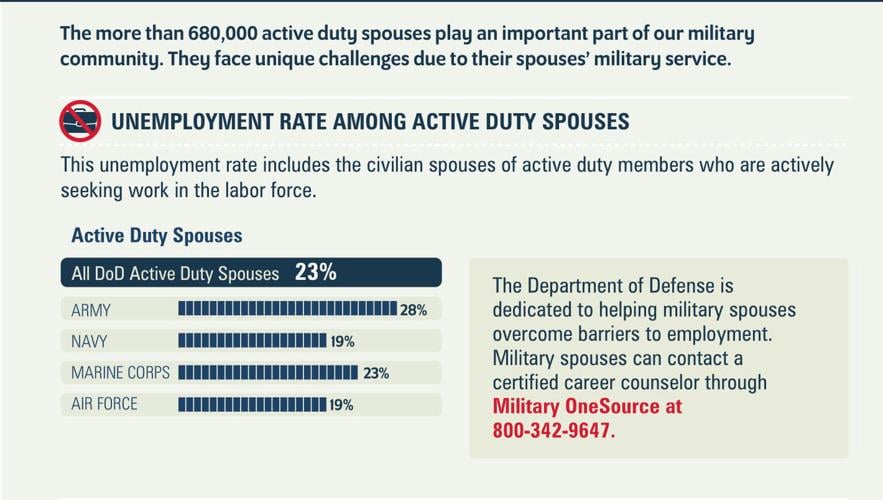
According to a survey done by Hiring Our Heroes in 2017, The U.S. Chamber of Commerce Foundation stated that at 16 percent, the unemployment rate for military spouses is four times higher than the national average.
Not only is it difficult for the spouse, but it can be said that spouse unemployment impacts military readiness and retention. Eighty-one percent of military Families have discussed leaving the service, with one of the top deciding factors on staying in is the availability for both spouses having career opportunities.
Military Families make sacrifices for their service member and America’s security. Still, when spouses continually become unemployed and underemployed, they begin to struggle. Family Member Employment Assistance Program Coordinator Dionne Vassell on Henderson Hall said spouses serve too.
“Spouses are often overlooked, and they serve just as much as a service member in some cases,” Vassell said.
A Unique Population
According to Department of Defense data reported in the 2017 report, 87 percent of the 641,639 spouses of active duty service members are civilians. Military spouses in the working age range, defined as 18 to 65 years old, is 92 percent female and an average age of 31 years old.
Most military spouses are more educated than their civilian counterparts. Military spouses have more higher education than most civilian employees. The survey shows that almost 34 percent have college degrees and 15 percent have post-graduate degrees. The White House Council of Economic Advisers in a 2018 report about Military Spouses in the Labor Market stated that in the civilian, noninstitutionalized population only 29.7 percent have a college degree. However, spouses’ periods of unemployment increased as their level of education rose. While 51 percent of spouses with a high school education or less faced unemployment, it happens to 70 percent of spouses with post graduate degrees.
In other ways, military Families are not drastically different from civilians families, as they both face similar struggles. Just as those in the civilian workforce, 77 percent of military Families believe it is critical to have two incomes to support their Families.
Joyner sees it especially important for military spouses in the Washington, D.C. metro area.
“This area is very expensive for them to live in so generally you need two incomes to live in this area,” she said. “Many of them are looking for something they can do while they are here.”
However, while 60 percent of civilians with children bring in two incomes for their family, the percentage of military Families who do the same drops to 50 percent.
According to DOD statistics, 41 percent of military spouses have children, 70 percent of them being under the age of 11. Joyner believes this leaves spouses to play multiple roles in trying to balance their service member’s needs, their family’s needs, and their own career.
“Their husband might be deployed, he might have very long hours, his mission might be critical, so he is not able to help out, so they carry the full burden of the family life,” she said. “They don’t have any control of their life. They are here for three years, and then they move somewhere else, and he’s in command for a year, and then they move again. So that always relocating and trying to get their families settled, and then having to do it all over again.”
Hurdles in finding employment
The cause of the high unemployment and underemployment rate among military spouses has multiple layers. Vassell sees real barriers that spouses face when seeking employment.
“(Military spouses face issues of) not being able to complete degrees because they are relocating so often, not really being able to hone in on those skills and develop the level of experience that they need to get the types of jobs they are looking for, and then location,” Vassell said describing a few of the barriers spouses face when looking for a new job. “Sometimes they have specialized skills and based on the location they are not able to use their degree or their education or they are not able to do the type of work that they are looking for.”
Spouses who work as teachers, social workers, and lawyers often face the difficulty of using their license in a different state and having to jump through hoops to be able to work in their new location. Other spouses may have had higher positions in the past, but may not have the same opportunity to move up or even move laterally in their new location.
“Some spouses they have a vision, have an idea of what they want to do, they have an ideal career path,” she said. “However they just have to go with what’s available right now.”
Throughout the years, Joyner stated that spouses will face gaps in employment. Ultimately those are difficult to explain to human resources.
“There is that gap of service for when they weren’t there long enough to find a job, or they were having their Family, or their husband was deployed,” Joyner explained. “So how do you cover that up or make it so that the individual that is hiring them doesn’t see them as a job hopper or doesn’t have a credible work history?”
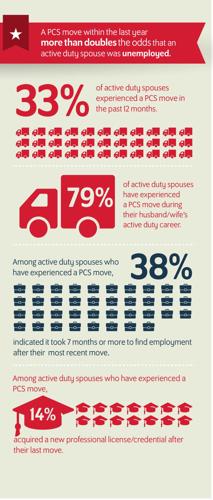
The cycle is never-ending. Even when spouses find work, when they get orders to relocate, they have to quit their job and only have a short period to find another job. The U.S. Chamber of Commerce Foundation stated that 65 percent of the survey respondents who had to quit their job to relocate needed four or more months to find a new employer. Twenty-nine percent took four to six months, 12 percent took seven to twelve months. It took 25 percent over a year.
Many military bases can be located more than 50 miles away from an urban location limiting the number of high-quality jobs for spouses. They can still apply for federal positions through the Spouse Priority Placement Program; however 79 percent of spouse applicants are not hired.
Vassell believes there are even more barriers that military spouses are facing, things that cannot be fixed or controlled. She thinks that companies do not see the benefits of hiring military spouses, just downsides.
“For some companies, if they are looking for longevity and they know that this person is a military spouse,” she said, “they immediately think OK I am going to have to rehire in the next few years or the next year. So I rather go the safe route and choose somebody who I think will be here for a long time. And they won’t say that, but it happens.”
In the Hiring our Heroes survey, 41 percent of spouses believe that companies don’t want to hire a military spouse because they might move, leading to struggles in finding suitable employment opportunities.
Forty-Seven percent of respondents to the survey also said finding work and managing a career is the third highest cause of stress for their Family – falling behind deployment and leaving behind friends and family. Eighty percent of military spouses also reported that their employment search created stress between them and their active duty spouse.
Vassell has witnessed spouses in times of despair in their search for employment. She believes this moment of weakness, the moment of giving up is an additional significant factor in why spouse unemployment is an urgent issue. The term she uses is “limiting beliefs.”
“They have been out of the workforce, the brevity in employment and (permanently changing stations) so often they kind of lose hope,” she said. “Hope that some organization or company will still find them as assets to their team because they do not know how to communicate well because of the brevity in employment. And because they get so frustrated with always having to job search, over time they form these limiting beliefs.”
Here to Help
Once in a relatable position with her husband, Vassell has created a class for FMEAP about breaking down barriers to employment.
The time it takes a spouse to find a job at a new duty station varies. It depends on the person, their career choice, and their role at home. Vassell and Joyner ask the spouses they meet with what they are looking for and what education or experience they have and help them find options from there.
Some of the spouses Vassell and Joyner work with are of senior leaders, who are at the end of their careers, and want to go back into the workforce.
“The spouses will join (their service member) at the senior leadership retirement seminar, and that’s when they really get an opportunity to understand what FMEAP is all about,” Vassell said. “At that point, they feel a little bit more comfortable job seeking because they finally get an opportunity to settle down in one area for a long period of time, and they can establish a career. So at that point, they are ready to come and start working on their resume and get more serious about job seeking.”
For younger spouses married to current service members, one option that Vassell and Joyner give their spouses is the option of portable careers. The Department of Defense has partnered with many Fortune 500 companies to give spouses a list of companies that support military spouses for employment. Not only will these be careers that spouses can take them from duty station to duty station, but some companies also allow them to telecommute – allowing them to work from home, eliminating costs of traveling, and sometimes child care.
Joyner and Vassell also help spouses in their job search with whatever they need from beginning to end. They offer multiple classes and one-on-one assistance. They make them aware of other places to look for job opportunities such as federal jobs through the Priority Placement Program for military spouses, how they can start their own business, and resources such as Hiring Our Heroes – who recently launched a campaign with 15 companies and organizations nationwide to hire 100,000 military spouses in the next three years.
In one-on-one assistance they assist clients in writing resumes, which according to Vassell is one of the most daunting tasks she sees as a part of spouses seeking employment, and it usually is the root of some of the problems spouses have while seeking for work as she recently saw with a spouse who stumbled across her office one day.
“She was so excited to find out I was here,” she said. “She had applied to I think 10 or 15 positions she said, and she hasn’t heard anything back. I sat with her and for two sessions, and I think she applied to three positions and got hired for one. Once we work on the resume, they have better results.”
“It is getting that employer to see that (military spouses are great employees) sometimes as an issue because when you look at their resume, it doesn’t tell them what skills they have and what abilities they have,” Joyner said.
Joyner also said that she helps her clients create private company and federal resumes, which follow their own set of rules.
Vassell feels like she has a hard time reaching spouses because the population is scattered throughout the D.C. Metro area and not living in base housing. Still, she wants spouses to know that they do not have to go about their job search alone.
“The most frustrating part of my job is not being able to easily access my client population, and letting them know that I am available and always willing to help,” she said. “I know there are several spouses, younger spouses, in this area who would love to get some assistance, but I don’t think that they are aware that we are here, and the services that we provide.”
Vassell is going to continue to strive to give the best advice she can to the spouses who come into her office, as well as reach the ones who don’t know she is there for them to guide them.
“For that commitment and that flexibility (of military spouses) being able to serve their service members, they should have people that are committed to serving them,” Vassell said.
On the Fort Myer side, Judy Joyner can be reached at judy.joyner2.civ@mail.mil or 703-696-3047. Dionne Vassell, on Henderson Hall, can be reached at 703-693-8841 or dionne.vassell@usmc.mil.
Pentagram Staff Writer Abigail Kelly can be reached at akelly@dcmilitary.com.