


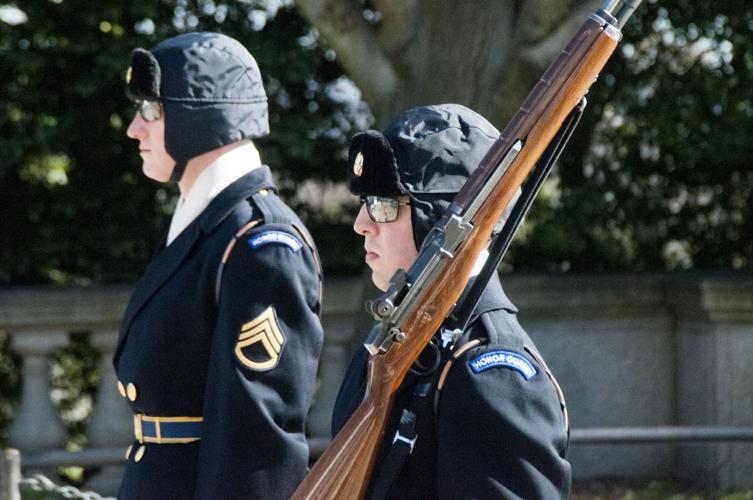
The human body functions differently in wintry conditions when temperatures and wind chills fall far below the freezing mark. Brave souls stepping outside on a subfreezing day know the feeling – or the lack of feeling – of how winter weather conditions can hamper one’s well-being. An inhaled breath feels like a frosty punch to the lungs. Eyes tear, ear tips tingle and inactive feet reach the point of numbness.
Yet inside the walls and gates of Arlington National Cemetery, factions of 3d U.S. Infantry Regiment (The Old Guard) will work through shivers and frozen hallowed ground to make sure ceremonial missions are accomplished.
Members of The U.S. Army Band, “Pershing’s Own,” The Caisson Platoon and the Tomb Guard Platoon pay extra-close attention to weather forecasts. When a snow band or a northwest wind approaches the Military District of Washington, Old Guard Soldiers prepare for outdoor duty differently than an October or April day.
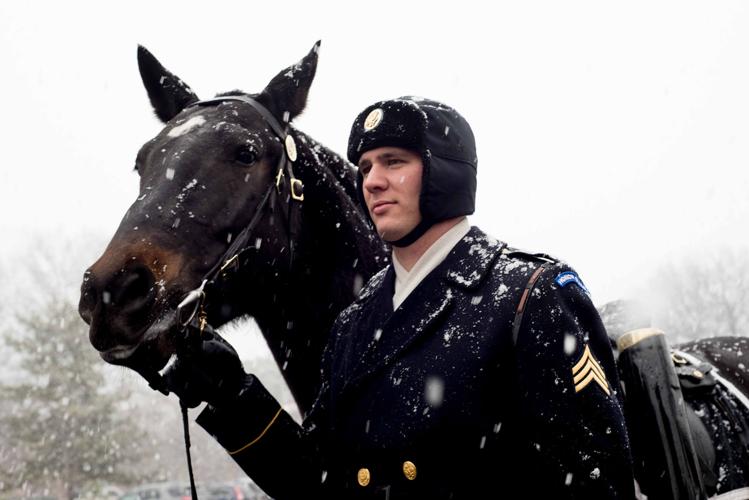
Army outerwear must remain uniform, but depending on the thermometer reading, an Old Guard Soldier could be in an insulated trooper cap/overcoat combination one day or a rain/snow protection-wardrobe during the next day of missions. Temperatures dictate how Soldiers prepare wardrobes for a winter day of walking the Tomb of the Unknown Soldier mat or Arlington burial services.
For a frigid day, the essential pieces of uniform become the overcoat, the trooper cap and warm gloves.
“When the temperature is below 32 degrees, we will be in what we call trooper cap and black gloves with overcoat,” explained Tomb Guard Platoon Assistant Sergeant of the Guard Sgt. Patrick Leamy. “The trooper cap basically covers the ears and the back of the head. It is insulated and the black gloves, of course, protect the hands. Once it gets above 32 degrees, we go under the discretion of how the individual on the mat feels. If they feel they can still operate outside at a comfortable level, they can switch to the ceremonial cap [C cap] with black gloves. The first thing [in regard to the cold] we worry about are the Soldier’s hands. That is the first part of the body to lose feeling. We keep them in black gloves.”
Leamy added that when the temperature rises above 35 degrees, white ceremonial gloves replace the black gloves, but the overcoat and C Caps remain.
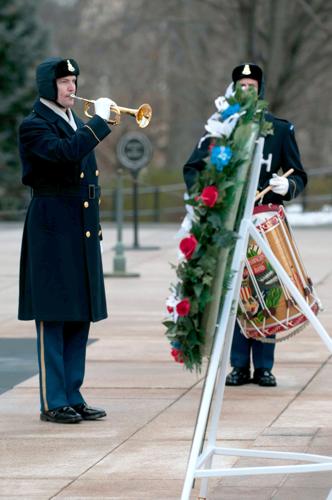
TUSAB bugler Sgt. 1st Class Todd Taylor has sounded Taps at Arlington National Cemetery funerals for 20 years. Taylor is from Louisville, Ky., where weather conditions can be similar to the National Capital Region’s temperatures. Still, participating in a funeral when wind chills plummet to near zero takes an extra measure of focus.
“The challenge is that playing the bugle is a physical instrument,” Taylor said. “When your face and lips are frozen and you put your wet lips on a cold piece of metal… muscle memory takes over.”
Taylor has assembled and uses a number of tricks to get through the bone-chilling days. He keeps his mouthpiece in his hand or gloves just before he plays Taps. He takes caution from using hand warmers to warm his mouthpiece since a fellow bugler once burned his mouth from the overheated metal. He refrains from using a non-sticking, synthetic mouthpiece made of plastic. That is just his preference.
“I’ve put the mouthpiece [to my mouth], and it has been so cold, I cannot feel my mouth,” the TUSAB bugler said. “When you do this, it is all about feel and breath and controlling nerves and controlling air. At that point, you tell yourself: ‘I’ve done this; I can do this.’”
No matter what the temperature and the type of precipitation falling from the Virginia sky, Taylor understands that his mission is to honor fallen service members.
“The reason we are successful [during Arlington National Cemetery ceremonies and funerals] is because we’ve done it so many times,” he said. “Sure, we could sit in a car [or bus], come out at the last moment and play, but we don’t want to draw attention away [from the funeral]. We want to get the mission done and pay honors.”
At The Old Guard Caisson stables, preparing for the day begins at 4:30 a.m. When cold mornings occur, Caisson Platoon Soldiers prepare two and sometimes three half dozen-horse and three-Soldier teams for a battle against the cold.
“About 6 o’clock, we get a uniform call telling us what we should be wearing out in the cemetery,” said Caisson Platoon’s Sgt. David Smith. “A lot of guys wear snivel gear underneath. Snivel gear is cold-weather gear – long sleeved shirts that are not seen. That way, it keeps us warm, while we’re on the horses. We add a couple more layers underneath to what we’re supposed to wear.”
Horse teams are consistently covered with blankets to minimize the cold, but one winter weather condition will put a stop light on a caisson detail.
“If there is a lot of ice on the roads, the horses won’t go out, but the funerals go on,” Smith said. “Funerals don’t get cancelled- it’s rare if they do.”
Below the Arlington Memorial Amphitheatre, Tomb sentinels prepare for an hour’s winter walk on the mat. Seventeen Soldiers currently hold sentinel badges, while 12 are sentinels in training, but the cold is the same for all who make the solemn 21-step walk in front of the Tomb of the Unknown Soldier.
“During the winter, when relief takes over at zero six in the morning, we’re checking the temperature and constantly checking the weather,” Leamy said. “We’re checking to see if there is going to be any precipitation and when it is going to get here. Now being in the middle of the bad part of winter, we’re checking the wind chill, as well.”
When the cemetery closes, sentinels switch to additional clothing layers and ACUs (Army Combat Uniforms), and the mission changes to a roaming guard type of patrol. Leamy, a native of the southwest side of Chicago, thought this winter – his fourth at the tomb – was not as severe as last year’s punishing cold months.
“Compared to last winter, it really hasn’t been too bad. I’d say it has been a pretty moderate winter,” he said. “The wind has been a big factor a couple of days. The snow and the wind are our biggest concerns.”
But the paramount concern of the sentinels does not include personal comfort.
“We do it [in the cold] for the unknowns,” said sentinel platoon staff member Sgt. 1st Class John Wirth.