






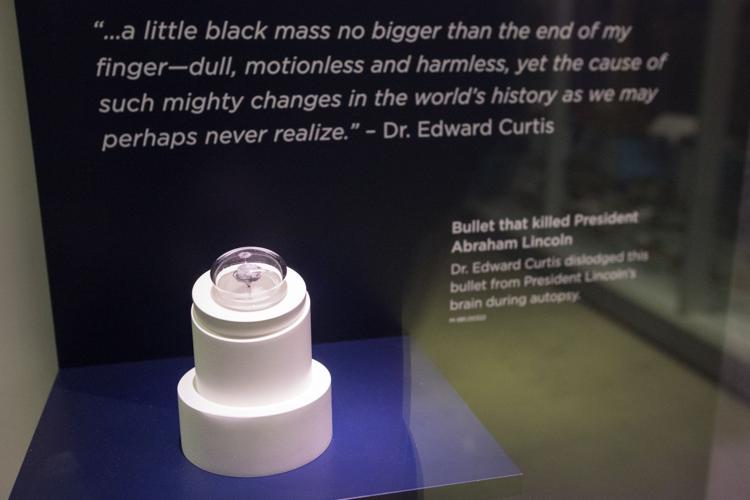


The bullet that killed President Abraham Lincoln, historic artifacts spanning centuries of military medicine and anatomical specimens ranging from the beautiful to the macabre are just some of the many wonders and curiosities on view at the National Museum of Health and Medicine (NMHM).
Located in the U.S. Army’s Forest Glen Annex in Silver Spring, Md., the institution houses a unique and fascinating collection that stands out even amidst the National Capital Region’s wealth of museums.
Founded as the Army Medical Museum in 1862, the NMHM was originally tasked by Surgeon General William Hammond to gather and study artifacts from the Civil War, including “specimens of morbid anatomy, projectiles and foreign bodies removed.”
The museum has remained a hub of medical research throughout its history. As curator from 1893 to 1902, Army Maj. Walter Reed completed pioneering work on infectious diseases such as typhoid fever and yellow fever. In 1946, the museum became a branch of the Army Institute of Pathology, before being renamed the Armed Forces Medical Museum in 1974, and becoming the NMHM in 1989.
It now occupies a sleek, modernist building that opened in 2011 near the Walter Reed Army Institute of Research.
“Our mission today is to inspire an interest in the past, present and future of American military medicine and military medical research,” said Tim Clarke, NMHM’s deputy director of communications. “We aim to share the value of military medicine to our visitors, the value both to the military and also what the value of military medicine is to the general public.”
Upon entry into the museum lobby, visitors immediately encounter forensics trays featuring plastinated human organs and human skeletal casts that they can touch and examine up close. Museum staffers are stationed by the trays, sharing information and fielding questions.
Selections from the museum’s vast and eclectic collections are displayed in a series of rooms divided into three overarching themes.
The centerpiece of the wing devoted to “Advances in Military Medicine” is a seven-foot-wide, 3000-pound slab that once served as the floor of Trauma Bay II at the U.S. Air Force Theater Hospital in Balad, Iraq. The scarred and stained concrete bears testament to the life-and-death dramas that played out in the Trauma Bay when it served as one of the military’s main emergency-medicine facilities during Operation Iraqi Freedom from 2003-07.
“The floor helps us remember all those lives that were lost, but also to remark upon how many lives were saved under fairly extreme and intense wartime conditions,” Clarke said.
Clarke noted that the Trauma Bay exhibit has held special meaning for many who have visited the museum.
“Some of the very first visitors to see the floor on display were young men and women who were still recovering from their injuries in Iraq, and who had passed through that hospital and very likely passed over that exact piece of floor,” he said. “They were able to see the place where they had been treated all those many miles away, and often were able to bring their loved ones to see where they had once been, and reflect on the fact that they were recovering from those injuries.”
Clarke also recalled a comment from a visiting parent of a service member who said that seeing the Trauma Bay display renewed his confidence in the quality of medical care his child would receive if injured on a deployment.
“That’s part of our mission is to make sure that persons who visit the museum are able to understand the mission of military medicine in those types of environments,” he said.
Along with the Trauma Bay floor, the NMHM’s other premier attraction is an exhibit of artifacts related to Lincoln’s assassination on April 14, 1865.
Within the galleries housing “The Collection That Teaches,” the fateful bullet fired by John Wilkes Booth rests in a small glass case, alongside other relics such as fragments of Lincoln’s skull, a lock of his hair and a medical probe used by Army Surgeon Joseph K. Barnes during his ultimately unsuccessful treatment.
“We are trying to share not only a reflection on the assassination of the president, but also the care of the president, and who helped provide that care, and the meticulous nature of the autopsy of the president which resulted in the recovery of the bullet,” Clarke said.
He added that Lincoln’s care was provided in part by members of the staff of the Army Medical Museum.
“We are sharing our own history and the role that military medical surgeons played in caring for the president in the hours before he died and then performing his autopsy that same day,” he said.
The Lincoln exhibit sits amongst a host of other artifacts from the Civil War, including human remains bearing disease or wounds, projectiles, and crude surgical kits from a bygone era of medicine.
The gallery also showcases centuries of advancements in medical technology, with devices on display ranging from 17th century microscopes to contemporary DNA kits used to identify the remains of fallen service members.
A morbid fascination is evoked by anatomical specimens such as a series of fetuses and twins displaying congenital abnormalities, and the skeleton of Army veteran Peter Cluckey, every joint in whose body was fused due to severe rheumatoid arthritis.
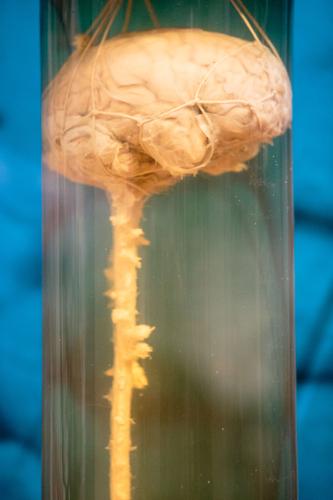
An adjacent room is dedicated to “The Human Body: Anatomy and Pathology.” Here, a normal human brain and spinal column is preserved alongside a display of specimens of traumatic brain injury, a condition battled by many service members and veterans.
Virtual exhibits on the NMHM website showcase aspects of the collection not on permanent view, and the museum hosts a robust calendar of educational programs to further its mission.
The National Museum of Health and Medicine is located at 2500 Linden Lane, Silver Spring, Md. Hours are 10 a.m. to 5:30 p.m. daily. The museum is closed on Dec. 25. Admission is free. For more information, visit www.medicalmuseum.mil.
Pentagram staff photojournalist Francis Chung can be reached at fchung@dcmilitary.com.