
101 Critical Days of Summer Safety Tips: Beware of the Heat
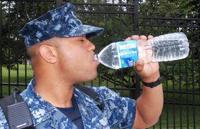
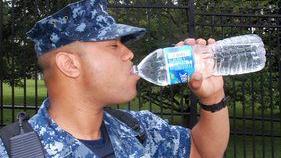
Master-at-Arms 1st Class Troy Felton, of Naval Support Activity Bethesda Security, takes a drink from a water bottle during a break. Health care providers recommend staying hydrated by drinking water, approximately 12 quarts per day, especially during hot and humid weather. - Credit: Photo by Mass Communication Specialist 2nd Class Chris Krucke
Summer is officially here, and with it comes the heat and humidity. Unfortunately, in the United States, heat is one of the leading causes of weather-related deaths, according to the National Weather Service (NWS).
The NWS, part of the National Oceanic and Atmospheric Administration (NOAA), reports in August 2003 a record heat wave in Europe claimed an estimated 50,000 lives. In 1995, more than 700 deaths in the Chicago area were attributed to the heat. During a heat wave in the United States in 1980, an estimated 1,250 people died from heat-related injury.
According to NOAA, summers in the Washington, D.C. area are hot and humid with a July daily average of 79.8 degrees and average daily relative humidity around 66 percent, which can cause moderate personal discomfort. July and August are on average the hottest months with the highest humidity here in the Washington D.C. area. Temperatures average nearly 90 degrees, but can often reach more than 100 degrees. NOAA officials add North American summers are hot, with most summers experiencing heat waves in one or more parts of the United States, and the Washington, D.C. area is no exception.
The NWS forecast office issues heat-related products as conditions warrant:
• Excessive Heat Outlooks are issued when the potential exists for an excessive heat event in the next three to seven days.
• Excessive Heat Watches are issued when conditions are favorable for an excessive heat event in the next 24 to 72 hours.
• Excessive Heat Warning/Advisories are issued when an excessive heat event is expected in the next 36 hours.
The homepage for Walter Reed National Military Medical Center’s (WRNMMC) intranet includes the Wet Bulb Globe Temperature, a composite temperature used to estimate the effect of temperature, humidity, wind speed (wind chill) and visible and infrared radiation (usually sunlight) on humans. It is used by industrial hygienists, athletes, and the military to determine appropriate exposure levels to high temperatures.
In addition, WRNMMC Trauma and Emergency Management officials offer measures that may help you recognize and respond to the warning signs of heat-related trouble. They explain your best defense against heat-related illness is prevention. Staying cool and making smart decisions concerning your fluid intake, activities and clothing during hot weather can help you remain safe and healthy.
There are three main conditions physicians at WRNMMC recommend to watch out for during the hot summer days: heat exhaustion and heat stroke. The following scenarios may assist you in knowing and preventing the signs of heat illness to have a safe summer.
You and your work-out partner go for an afternoon jog. About a mile into your run, your partner complains his leg is tightening up and is pulsating.
What your partner is experiencing a heat cramp, which is best treated by applying firm pressure on the cramping muscles or a gentle message to relieve the spasm. Also, give sips of water to replace fluid loss.
Scenario II — you and a friend decide to take a long bike ride on a nice summer day. A few miles into the ride, you notice your friend isn’t looking well. He complains of a headache, feeling a little nauseated and dizzy. His legs become weak and his skin feels cool and clammy.
Watch out! Your friend might be experiencing heat exhaustion, which is due to loss of water and salt through sweat.
The Centers for Disease Control and Prevention (CDC) recommends if someone experiences heat exhaustion, first, find some shade (under a tree or next to a building), next have the person hydrate, with either water or a sports drink, but not with an alcoholic or caffeinated beverage. Lastly, cool the body by placing a damp cloth or towel over the head and loosening the clothing.
Scenario III — you decide to play flag football and during the course of the game, you notice an opposing player staggering and looking a little confused. He bends to his knees and starts to breathe rapid, shallow breaths. You ask him if he’s okay. He just looks up and you notice his skin is red, he’s not sweating and his pupils are dilated. It also appears he’s about to pass out.
He is experiencing a heat stroke, a serious condition experienced when the body’s cooling system stops working and core temperature rises to dangerous levels. If ignored, heat stroke can lead to death. Time is now critical. The CDC recommends calling 911 immediately, then placing the victim in the shade. If there isn’t shade, use your body to block the sun and pour cool water in a towel or on his shirt and place it on his head. If you can get ice from a cooler or even a cold soda from a vending machine, put it in a sock and place it on his neck to accelerate cooling. While waiting for medical help to arrive spray or pour cool water on him and fan his body. Do not give victims of heat stroke fluids.
“We have seen all types of cases from heat exhaustion to heat stroke,” said Lt. Col. B. Kent Weathers, director of Trauma and Emergency Management at WRNMMC.
“In the summer months when the heat starts to increase, we do tend to see an increase of patients with heat injuries,” Weathers said. “It’s hard to tell who is going to come in. We can have the young healthy well-conditioned active duty [service member], or we can have the elderly 65-year-old person who was just out shopping.”
Emily Martin, safety specialist at WRNMMC, provided a few precautions before you head out in the heat.
“It is important to limit exposure,” Martin said. “If you are out in the sun for long periods of time, it’s recommended you wear a hat that can cover your ears and neck, and UV sunglasses to protect your eyes from the sun’s rays.
“The main thing that people don’t realize is they should eat small light meals, not heavy meals, and take lots of water breaks,” Martin suggested. She added water breaks should occur at least every 15 minutes.
Officials from the NWS also recommend avoiding foods high in protein because they increase metabolic heat, and avoid using salt tablets, unless directed to do so by a physician.
For a more information concerning heat exhaustion or heat stroke, visit http://www.cdc.gov/niosh/topics/heatstress/.