



The sailors on 18th-century ships navigated with sextants, compasses and the stars overhead. Their power came from the wind in their sails, when they had wind. Many seamen turned their vessels with a wooden tiller connected to a rudder.
They slept on hammocks inches apart in the perpetually dark hold down below, amid rats and rotting wastes from the animals they slaughtered for meals. Dried fish was a mealtime staple.
While in today's dizzying digital world of the Global Positioning System (GPS) and computerized navigation systems, instant worldwide communication, refrigeration and readily available food, these ships may seem to be bare bones, but they were magnificent vessels, to the mariners who sailed them and to the people who watched them from ashore.
People around the Chesapeake Bay and up the East Coast to Boston, Massachusetts, can experience the thrill of several stunning naval gatherings in June and July with Sail250, America's 250th anniversary maritime celebration, a gathering of tall ships and military ships from 20 countries.
More than 60 ships with 10,000 sailors will participate in this anniversary of the United States' founding, sailing from New Orleans, Louisiana, to Boston, Massachusetts, with stops in between, including Norfolk, Virginia; Baltimore, Maryland; and New Jersey. The ships will be in the Chesapeake Bay region in June and on to New York Harbor for a celebration, July 4-8, and then Boston, July 11-16. At many sites, visitors can climb aboard, and landlubbers can enjoy festivals and other events.
Calling the ships "ambassadors of friendship," Chris O'Brien, president of Sail4th 250, wrote in the March 31 Washington Post, "The founding principle of America wasn't perfection – it was the perpetual effort to form 'a more perfect union.' That requires both honest reckoning with our failures and joyful recognition of our aspirations. This July 4, when those tall ships sail past Lady Liberty, they'll remind us that other nations still believe in the American experiment enough to send their finest vessels and sailors to honor it."
The ships
Visitors will see two types of tall ships: large, government tall ships that sail with midshipmen from their country's naval academy and serve as floating ambassadors for their countries and U.S. and international privately owned tall ships that offer educational programs.
The government ships' midshipmen are typically on training voyages, learning to work together to sail a ship.
The private vessels are generally from their home operating area. The crews' sizes range from nine to more than 200.
The sailing techniques are a mix of traditional and modern.
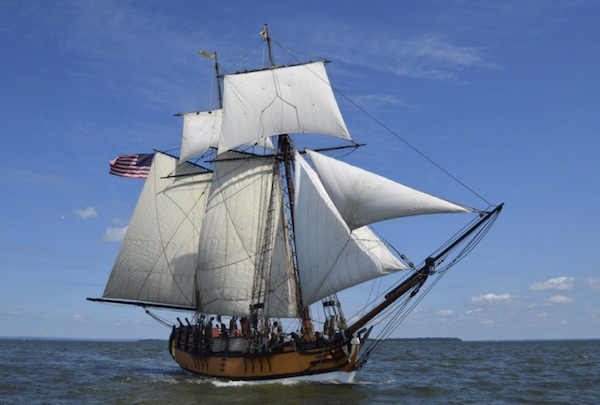
"The physics and principles of how a sail works are the same throughout history, cultures and the materials used to construct those vessels," said Hank Moseley, director of maritime operations, Sail250 Virginia. "While some of the ships participating in Sail250 Virginia are re-creations of historic sailing vessels from the 17th or 18th century, the vast majority of them were built since the early 20th century and are designed from keel up as modern ships, albeit with historic sailing rigs. Those rigs require more crew to work the sails and rigging than modern vessels and have limits on how they sail compared to a modern yacht or America's Cup boat."
The ships are all equipped with 21st-century equipment – life rafts, GPS, radar, chart plotters, depth sounders and a shipboard broadcast system, an automatic identification system (AIS), that provides position, speed, heading, and other information within radio range. Crew members may also learn traditional navigation techniques like dead reckoning, visual bearing fixes and celestial navigation.
"These methods have been in use for centuries and are still relevant today," Moseley said.
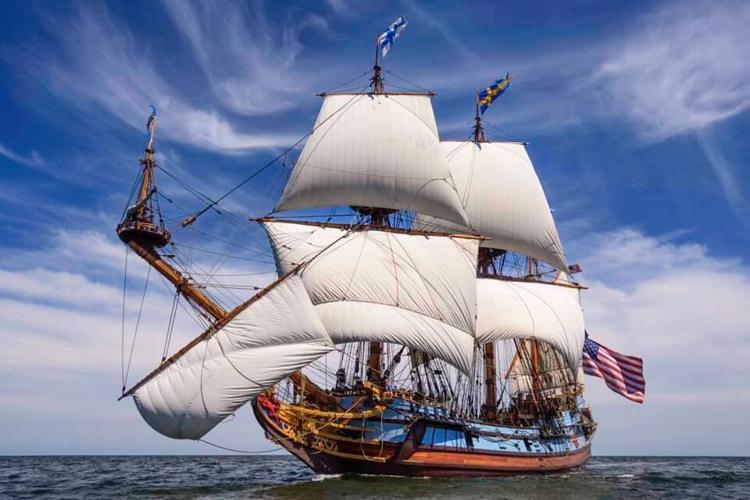
Capt. Sharon Dounce oversees the Kalmar Nyckel, a 140-foot, square-rigged ship from Wilmington, Delaware, with eight sails.
"We use our eight sails as often as possible," she said. "If a sailor from the 1600s came on board, he would know what to do, like how to use mechanical advantage to move a 3,200-pound wooden rudder."
Destinations
Ships will dock at nine harbors in the Chesapeake Bay region. For example, June 12-14, Richmond SailFest will feature three tall ships, historical re-enactors, ship tours and live performances. June 19-24, more than 60 vessels will be in Norfolk's harbor, including tall ships, military vessels, traditional Chesapeake Bay watercraft and character vessels. Festivities include a 50th annual Harborfest Celebration, ship tours and fireworks over the Elizabeth River.
In Baltimore, June 24-30, in addition to ships, the U.S. Navy Blue Angels Flight Demonstration Squadron and other aviators will perform in an air show.
On July 4, the port of New York and New Jersey will host a flotilla of tall ships from many countries. Some will sail down the East River, some will dock along the Hudson River, and some will sail up the Hudson from the Verrazzano-Narrows Bridge to the George Washington Bridge.
Tall ships in Sail250
The United States Coast Guard Cutter Eagle from Hamburg, Germany, was originally named Horst Wessel. Built and commissioned as Horst Wessel in 1936, it was taken by U.S. forces as a war reparation after World War II, then renamed and recommissioned as the U.S. Coast Guard Cutter Eagle in 1946, serving as the training vessel of the U.S. Coast Guard Academy. Today, U.S. Coast Guard Academy cadets and candidates from the U.S. Coast Guard Officer Candidate School train on Eagle. It also represents the United States on worldwide goodwill voyages.
ARA Libertad (Q-2) is an Argentine Navy, steel-hulled, full-rigged, Class A sailing ship that serves as a school and goodwill ambassador in and out of about 500 ports in more than 60 countries. One of the largest and fastest tall ships in the world, holder of several speed records, it made its first training voyage in 1963 and has annual instruction trips for graduating naval cadets.
The French Navy schooner Belle Poule, built in 1932 as a replica of a cod fishing vessel used off Iceland, was a training ship for the students of the École Navale. During World War II, Belle Poule sailed to the United Kingdom after France fell and was used by the Free French Naval Forces, returning to Brest in 1945.
Many ships will offer public tours. The harbors will also host festivals and other events.
Information, ports and schedule: www.sail250.org.