
#FlashbackFriday :Berlin Blockade Ends
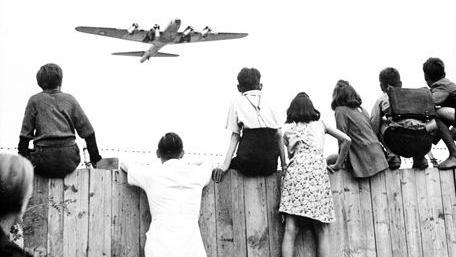
Children in West Berlin watch U.S. airplanes bring in supplies during the Berlin Airlift.
Following the Allied defeat of the Axis in World War II, Germany was a nation divided into four sectors administered by the four major Allied powers: the USSR, the United States, Great Britain and France. The capital of Germany, Berlin, although located deep in the Soviet sector, was also divided among the four powers. While the western democracies were open, the USSR was a police state, making Berlin an island in the middle of the Soviet sector. Germany, and Berlin’s, future was a major point of agenda in postwar treaty talks, especially after the United States, Britain, and France sought to unite their occupation zones into a single economic zone, and in 1948 the USSR withdrew from the Allied Control Council governing occupied Germany over this issue.
In May 1948 the U.S., UK and France agreed to form West Germany, a nation that would exist entirely free of Soviet-occupied eastern Germany, and the three western sectors of Berlin were to be united as West Berlin, which was to be under West German administration. On June 20, 1948 a new Deutche mark was introduced in West Germany and West Berlin, angering the USSR who claimed it was an attack on East Germany currency, and with four-power administration of Berlin ceased when West Berlin was unified, the Western powers no longer had a right to be there. On June 24 began a blockade of all rail, road, and water communications between Berlin and the West, intending to force the West to cede West Berlin to Soviet control.
Great Britain and the United States responded to the blockade by commencing the largest airlift in history, flying 278,288 relief missions to the city during the next 14 months, resulting in the delivery of 2,326,406 tons of supplies, and at the height of the Berlin Airlift, in April 1949, planes were landing in the city every 60 seconds.
Though tensions between the West and the USSR were high, the Soviets did not attempt to disrupt the airlift, and finally, after 14 months, on May 12, 1949, the Soviets abandoned the blockade. The first British and American convoys traversed through 110 miles of Soviet-occupied East Germany to reach West Berlin. On May 23, the Federal Republic of Germany, more commonly called West Germany, was formally established. The airlift continued until September 30, to build a year’s supply of essential goods for West Berlin in the event of another Soviet blockade, which never materialized. Tensions over Berlin remained high however, climaxing in the construction of the Berlin Wall in 1961.