




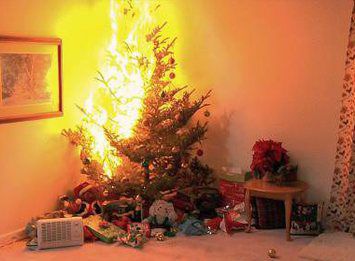
It’s that time when many families deck the halls in preparation for the holidays, but did you know that each year, more than 200 fires are attributed to this festive tradition?
Christmas trees account for 240 fires annually, resulting in 13 deaths and more than $16.7 million in property damage, according to the National Fire Protection Association (NFPA). Tree fires are typically ignited by shorts in electrical lights or open flames from candles, lighters or matches.
Well-watered trees are not a problem. Dry and neglected trees can be.
On average, one of every nine Christmas tree fires resulted in a fatality compared to an average of one death per 75 non-confined home structure fires overall. Further, 49 percent of Christmas tree fires spread beyond the room of origin. The fires that spread beyond the room of origin caused 94 percent of the associated fatalities.
Don’t be one of these statistics and keep the following safety tips in mind when decorating for the holidays.
Live Tree Safety:
Pick a tree that is fresh. A fresh tree is green and its needles are hard to pull from branches. When bent between your fingers, fresh needles do not break.
Keep the tree away from heat sources like fireplaces, radiators, candles.
Keep the tree watered. The trunk of a fresh tree is sticky with resin.
A shower of falling needles shows that the tree is too dry.
Remember, Lincoln Military Housing allows the use of cut Christmas trees in individual family housing units only; cut Christmas trees are not allowed in the townhome units.
Decorative Lights:
Only use lights that have been tested for safety; this applies to both indoor and outdoor lighting. Check the light’s label to identify those that have been tested.
Check each set of lights, new and old, for broken or cracked sockets, frayed or bare wire, or loose connections. Discard damaged sets.
Candles:
More than half of home candle fires are cause by some form of combustible material coming too close to the candle. NFPA found that residential fires sparked by candles are twice as likely to occur in December as any other month in the year.