


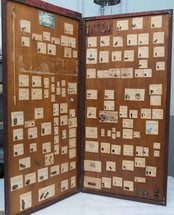
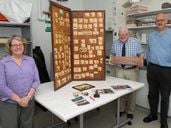
Ranging from a display board featuring bullets and fragments from explosive devices once embedded in the limbs of service members, to a Vietnamese pharmaceutical kit, Dr. Norman M. Rich, a retired Army colonel and renowned vascular surgeon, is in the process of donating the last of his impressive collection of Vietnam War-era medical items to the National Museum of Health and Medicine in Silver Spring, Md.
Rich, the recipient of many awards and the namesake of a surgical department at the Uniformed Services University of the Health Sciences, set up a small medical museum within the 2nd Surgical Hospital (Mobile Army) in An Khe, Vietnam, while serving as chief of its department of surgery during the Vietnam War. The idea to create the museum occurred to Rich while reading “Wound Ballistics,” a World War II and Korean War review of ballistics and wounding power, on a ship heading for Vietnam in the fall of 1965. After he finished reading the book, Rich decided he would collect similar information for surgeons treating wounded service members in Vietnam.
Upon arriving at the hospital in Vietnam, Rich began asking for donations of bullets and other objects retrieved during surgery. When word spread of the project, Rich soon had enough items to begin compiling his medical museum. All branches of the American military services contributed, he said, and each item was saved, identified and catalogued. Reports were also made with a detailed description of the wound and the origin of the wounding object.
“As my college professors at Stanford University said, you should collect everything you can, and analyze and document it, and then see what you can do with that information to treat patients in a better way,” said Rich, a graduate of Stanford University.
Rich’s collection also includes several punji sticks- a type of wooden stake made of sharpened bamboo and primarily used in booby traps. He noted that he saw more than 200 punji stick wounds while serving at the 2nd Surgical Hospital.
After completing his tour of duty, Rich arranged for many of the items he collected in Vietnam to be shipped to the National Museum of Health and Medicine, which at that time was called the Armed Forces Medical Museum and was an element of the Armed Forces Institute of Pathology in Washington, D.C., so that the objects could be viewed by the public. A soldier’s boot that was punctured by a punji stick is on display today in an exhibit commemorating the 150th anniversary of the founding of the Army Medical Museum (today’s NMHM).
Rich went on to become the first fellow in vascular surgery at Walter Reed Army Medical Center (now Walter Reed National Military Medical Center), and shortly after assumed the position as chief of vascular surgery and director of the fellowship from 1967 to 1978. He also created the vascular surgery registry, an outcome study of vascular surgery performed in theater during the Vietnam War. Upon retirement from the Army, Rich became a professor of surgery at USUHS and later was awarded the Leonard Heaton and David Packard Professorship, which is named for two USUHS founders. In 2002, the USUHS department of surgery was named in his honor; Rich served as that department’s chairman from 1977 to 2002.
Recently, Rich, who continues to teach at USUHS, visited NMHM to donate more artifacts, such as a mortar base, two flechettes, an M-79 grenade and a thermometer bearing the words “Made in USSR.” He said he chose to give his items to NMHM because he believed they would find a good home at the Museum.
“Since my service in the Republic of South Vietnam (1965-1966), I have been dedicated to putting all of our items from the 2nd Surgical Hospital (MA) Museum into the National Museum of Health and Medicine as originally communicated to and with then Brig. Gen. Joel Blumberg as Director of the AFIP,” Rich said.
Alan Hawk, collections manager for NMHM’s Historical Collections, said Rich’s collection and his establishment of a medical museum in Vietnam is similar to the Army Medical Museum’s own founding.
“Dr. Rich’s collection is in the tradition of the Army Medical Museum during the Civil War, preserving the wounding agents of war to inform contemporary and future military surgeons,” Hawk said. “It is a very important collection, and we are glad to have it and be able to preserve it.”
NMHM is located at 2500 Linden Lane, Silver Spring, Md. For more information, call 301-319-3303. Information about NMHM, including directions and parking, can be found at http://www.medicalmuseum.mil.