

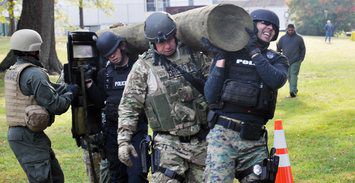
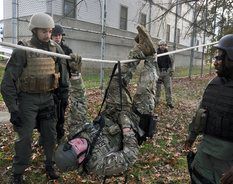
Local, state, federal and military police officers trained at Naval Support Activity South Potomac’s Police Training Facility at Dahlgren as part of a two-week course designed to teach the art and science of tactical operations. Training also took place at the Rappahannock Regional Criminal Justice Academy, Fredericksburg Police Department, a range in Stafford and the O’Gara Training Facility in Montross.
Robert Brooks, chief of police for Naval Support Activity South Potomac, instructed the annual class with the help of fellow local, senior law enforcement leaders Bill Hallam and Scott Simon, as well as about 30 assistant adjunct instructors over the two weeks, according to Brooks.
“The purpose of the course is to establish a baseline training for new operators who are going into a special weapons and tactics team whether you call it a SWAT, ERT or SRF, it doesn’t matter; it’s a tactical team,” Brooks said. The two weeks are predicated on basic skills, knowledge, build up - everything from fire arms to tactical movement to weapons handling to a myriad of other types of subjects as far as negotiators and sniper operations among others, according to Brooks.
“You give the student kind of an overview of what the SWAT community is responsible for and give that operator those individual skill sets where he can go back into his team and have a start point where he can continue on as an operator and train with that team and become an effective member of that tactical organization.”
Master at Arms Chief Samuel Ortiz was the only representative of the NSASP Police Department in Class 10-14, and flourished, according to Brooks.
“He did an outstanding job,” Brooks said of Ortiz. “He was selected as one of the team leaders on the final exercise.” Brooks said normally the instructors pick the team leaders, but on the final exercise the students were given the option to select team leaders based on past experience and performance and Ortiz was consequently selected.
“Chief Ortiz was picked by his own people. That was quite telling of his abilities and leadership,” Brooks said. Ortiz said his team came out in first place in all the events, except the last two.
“We immediately gelled,” Ortiz said. “We played on each other’s strengths and weaknesses.” He added that it couldn’t have happened without team work. “As a team we were able to come together and succeed.”
Ortiz said he had been through several law-enforcement courses and that the SWAT Basic Class was highly challenging.
“I recommend to anyone who has the opportunity to go to do so. It was definitely a great experience. This was some of the higher-paced, dynamic training I’d ever been though,” Ortiz said.
There were also a few surprises.
“We had a scenario that included the introduction of CS gas... that was fun,” Ortiz said, describing a drill at the Rappahannock Regional Criminal Justice Academy . “When they popped that CS gas and asked us to walk through it, I was not mentally or physically prepared for that. They just scratched the surface on what a tactical team would entail and gave us the basics we would need to function in that type of environment.”
Ortiz emphasized the importance of teamwork throughout all the missions involved in the course.
“It’s an everyday thing. You’re always going to need a leader,” he said. “You either need to be a good leader or a good follower. They go hand-in-hand. You can’t do everything by yourself. It’s a team.”
SWAT Basic Class 10-14 came together the same way all SWAT classes do - on their own volition. “Once they volunteer, they are given an internal assessment by their organization,” Brooks said. “Once they’ve gone through that initial screening process, they put in for the school which also has a selection process. You have to be a volunteer, you have to be motivated and there is a PT (physical training) test which is the final bar they have to cross. Once they successfully complete that PT test, they are accepted into the training.” That doesn’t guarantee someone to make it through the course, he added.
If they didn’t already know it going in, Class 10-14 found out quickly how serious their training was going to be.
“This is a life or death business,” said Hallam, senior instructor from the Fredericksburg team. “That’s all SWAT is. We nail you with scenarios to lay the foundation down with your team now.”
The course included, but was not limited to cross-fit training, an active shooter drill, obstacle course, rappelling, clearing buildings, vehicle assaults, raid tactics, a class about improvised explosive devices and SWAT Olympics. The events, preceded daily by PT, took its toll physically and mentally.
In addition to everything else, cross-fit training was implemented into the course about three years ago with instructor Lisa Quinn.
“It was so successful we invited her back every year,” Brooks said. “It’s probably the hardest thing they do physically. She also talks nutrition and lifestyle. It’s a very valuable class for them.”
Ortiz said it took a great deal of physical fortitude to get through the course. “You had to be in great shape,” he said.
Brooks, who has instructed the course for 14 years, said Class 10-14 was a smaller class, yet mature, team-oriented and ultimately successful - graduating everyone despite a historical attrition rate of about 15 to 20 percent.
“It was only 20 students as opposed to what we had last year, which was 34 students,” Brooks said. “They were particularly motivated. We had a very good mixture of prior service and senior police officers so the learning curve was a little better with these guys. They picked up on a lot of the stuff that we normally have to spend a couple of more days on to get everyone on the same sheet of music. This class was a little bit ahead of the game.”
Officers in the course showed up with varying amounts of experience and are divided into three team where their ability to lead and follow is tested.
“We broke everyone up and that helps with the team-building concept,” Brooks said. “A lot of what we teach is predicated on leadership. On a daily basis, leadership may change and that’s done for a reason - to give guys an opportunity to lead peers and plan operations. It puts a little more pressure on them. It wears on them. By the end of the two weeks, they’re pretty much whipped puppies.”
Brooks frequently used phrases such as “the only easy day was yesterday,” and “it pays to be a winner” as motivation for the officers to dig deeper to get through the physically and mentally draining course.
“It all boils down to heart,” Brooks said. “The essence of the course is the combat mind set - the mental ability to maintain that situational awareness and do the things that most people are unwilling, unable, or afraid to do. If they can embrace that and wrap their head around that, they will be fine.”