
Report examines economic impact of NSFs Dahlgren, Indian Head
Despite ongoing fiscal uncertainty in the Department of Defense (DoD), Naval Support Facilities (NSFs) Dahlgren and Indian Head remained major economic contributors to the communities surrounding the installations during fiscal year 2014 (FY14), according to a report by Naval Support Activity South Potomac (NSASP). The purpose of the study was to measure the economic impact both bases have on the community around them at minimum; the actual economic contribution of the bases, a complex calculation beyond the scope of the report, is undoubtedly higher.
The report examined several aspects of commands at Dahlgren and Indian Head, including the number of employees, contractors and service members, their geographic distribution, military and civilian payroll, budget authorizations, total contracts and local contracts. The latter data point calculated contract dollars from NSASP-based commands and activities spent in the localities in the immediate vicinity of NSFs Dahlgren and Indian Head. Though the study sought to incorporate the most current data available, in some cases numbers from fiscal years 2013, 2012 and 2011 were included to provide a more comprehensive summary.
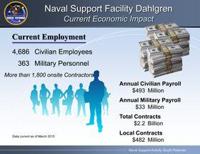
At NSF Dahlgren, employment numbers remained steady in comparison to the FY13 report, with a few measurable but minor decreases related to attrition. A total of 6,895 federal employees, service members and contractors work onboard the installation. Unlike last year’s report, the figures did not include Dahlgren- or Indian Head-affiliated contractors working off site. More than 34 percent of personnel assigned to Dahlgren live in King George County, with Spotsylvania County hosting the second most Dahlgren personnel at more than 14 percent.
Total civilian and military payroll at Dahlgren during FY14 was $493.21 million and $32.79 million, respectively. Total budget authorizations for the commands and activities at NSF Dahlgren totaled more than $3.5 billion, with total contract expenditures of $2.2 billion. More than $482 million of those contract dollars were spent locally. The study defined local contract dollars as those spent in the Virginia counties of King George, Spotsylvania, Stafford, Caroline and Westmoreland, and the city of Fredericksburg, and the Maryland counties of Charles, St Mary’s and Prince Georges.
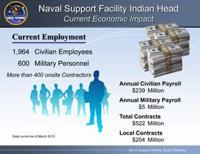
At NSF Indian Head, the study found there were 2,976 federal employees, service members and contractors working onboard the installation. More than 63 percent of NSF Indian Head personnel resided in Charles County during FY14. St Mary’s County came in second, hosting more than 6 percent of the installation’s workforce and military personnel.
Civilian payroll and military payroll at Indian Head totaled $239.7 million and $5.15 million, respectively. The commands and activities at NSF Indian Head received a total of $312.69 million in budget authorizations and spent $522 million on contracts, of which $204.26 million was spent locally.
Taken together, the numbers show both installations holding steady in their economic impact on surrounding communities despite the implications of the Budget Control Act of 2011, more commonly known as the sequester. However, it must be noted that the effects of the sequester were partially mitigated by the Bipartisan Budget Act of 2013, which raised the spending limits imposed by the sequester during FY14 and FY15. The sequester cuts to the DoD will go back into effect at the end of FY15, though Congress may yet reach a new budget resolution.