
NSF Indian Head recognized by Maryland Historical Trust
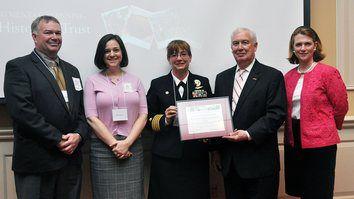
From left to right, Tommy Wright, cultural resources manager at Naval Support Facility Indian Head, Julie Darsie, cultural resources program manager for Naval Facilities and Engineering Command Washington, Capt. Mary Feinberg, commanding officer of Naval Support Facility South Potomac, Maryland Secretary of Planning David Craig, and Elizabeth Hughes, acting director of the Maryland Historical Trust, during a March 27 ceremony at the Maryland State House that recognized people and organizations for their contributions to historic preservation. NSF Indian Head was awarded in the Outstanding Stewardship by a Government Agency category. - Credit: U.S. Navy photo by Andrew Revelos
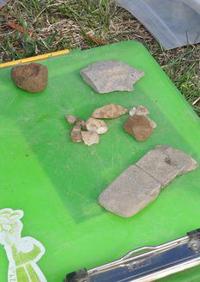
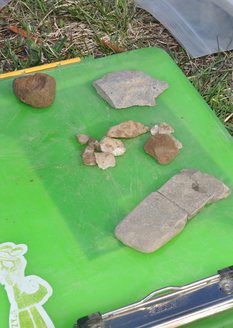
A sample of some of the artifacts found at Naval Support Facility Indian Head’s Stump Neck Annex during an archeology dig in 2013. The item at the bottom of the photo is a stone hatchet head. - Credit: U.S. Navy photo by Andrew Revelos
Naval Support Facility (NSF) Indian Head was recognized March 27 by the Maryland Historical Trust for its superb management of historic land and cultural resources on the installation at a ceremony at the Maryland State House in Annapolis. The base shared the prestigious award-Outstanding Stewardship by a Government Agency-with the National Institutes of Health Historical Preservation Program.
“I want to congratulate all the people honored today,” said Maryland Secretary of Planning David Craig in opening remarks. “We all agree on historic preservation-on how important it is to preserve the historic issues. Not just physical issues, but also the social and cultural issues and not just for the next generation, but for all the next generations.”
Several Maryland state delegates and senators took time out of a busy voting day to add their congratulations to the award recipients, which included a total of 13 authors, programs, schools, owners of historic properties and organizations.
The historic significance of NSF Indian Head, one of the oldest installations in the Navy, predates the establishment of the base in 1890. “There are more than 126 archaeological resources in the existing inventory, most of which have been identified as a result of large-scale surveys during the 1980’s and 1990’s,” said Tommy Wright, cultural resources manager at NSF Indian Head. “Among the known resources, six archaeological sites have been determined eligible for the National Register of Historic Places (NRHP). These NRHP eligible sites are predominantly representative of Native American occupation of the installation during prehistory.”
Wright and Capt. Mary Feinberg, commanding officer of Naval Support Activity South Potomac (NSASP), recently took members of the Piscataway Indian Nation to one of the most important sites. “The most significant archaeological site on NSF Indian Head is the Posey Site, a Native American village with occupation during the late prehistoric period through the sixteenth and seventeenth centuries,” said Wright. “Its documented features include house patterns and storage pits. NSF Indian Head has conducted 28 archeological surveys since 1977.”
The Navy’s considerable achievements at Indian Head also factor into the base’s rich history. “NSF Indian Head supports four historic districts, two newly proposed districts and three complexes,” said Wright. “There are 270 buildings that comprise these districts and complexes. As energetic technology evolved, the Navy built new facilities to address the research and development, testing, and production of products such as smokeless powder, rockets, Polaris missiles, multiple surface to air and air to air missiles, bazooka, and advanced energetics, as well as research into foreign nations weaponry.”
Despite the challenges related to preserving history on a base that is still very much focused on supporting the national defense, the award recognized the Navy’s work to protect NSF Indian Head’s heritage. Preservation laws require state and federal agencies to analyze how projects might impact historic resources, a process that is especially complex on an active military installation. Feinberg, Wright and the Navy, however, are not alone in the belief that the difficult work is entirely worthwhile.
“Preserving our historic resources strengthens the state and enriches and fulfills our personal lives as well,” Elizabeth Hughes, acting director of the Maryland Historical Trust, told award recipients.
Feinberg and Wright, along with Julie Darsie, cultural resources program manager for Naval Facilities and Engineering Command Washington, accepted the award on behalf of the base.
“We’d like to thank the Maryland Historical Trust Board of Trustees for honoring Naval Support Facility Indian Head with this award, which recognizes our past and current cultural resource management at Indian Head,” said Feinberg. “For the past 125 years, NSF Indian Head has supported the Navy’s mission through significant research, development and production of energetic materials.”
The Navy worked with Maryland Historical Trust and St. Mary’s College to conduct an extensive excavation of the Posey Site beginning in 1996. “It is a rare look into the lives of Native Americans and colonists, who traded goods, materials and experiences. “More than 10,000 individual artifacts have been collected and catalogued from the site and are currently curated at the Maryland Archeological Conservation Laboratory.
“This award is the culmination of more than 30 years of effort by individuals who have dedicated their time and efforts to identify and document the rich history of Indian Head,” Feinberg continued. “We truly appreciate the Maryland Historical Trust’s recognition of these past and current efforts and look forward to enriching our current relationship.”
Wright, who regularly works with the Maryland Historical Trust in his duties managing the cultural resources of NSF Indian Head, added specific thanks to an administrator and preservation officer at the trust for their assistance. “I want to thank Beth Cole and Amanda Apple for all the help they’ve given me over the years,” said Wright. “Without them, our program would not have been successful.”