
NSASP Recycling Program tracking, but problems persist
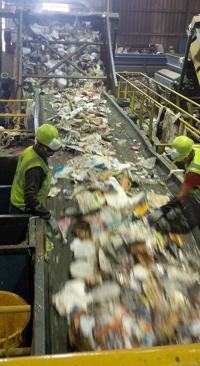
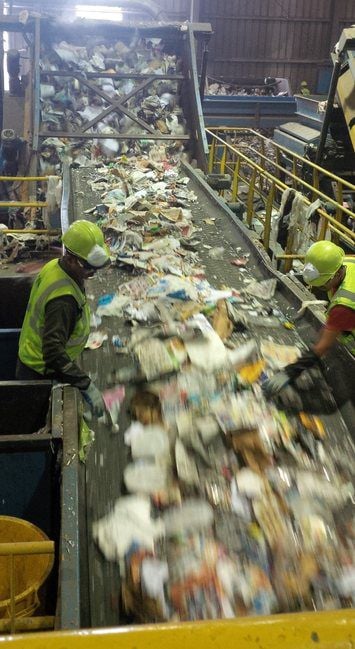
Workers at Waste Management Recycle America’s Material Recovery Facility in Elkridge, Md., sort recyclable material. The state-of-the-art facility processes more than 24,000 tons material per month, including recyclables from Naval Support Activity South Potomac. - Credit: Photo courtesy of Waste Management Recycle America
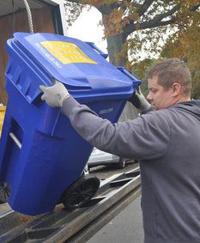
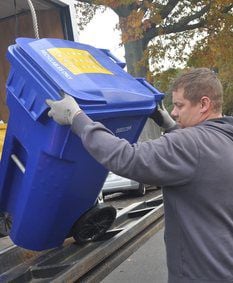
Will Solt, recycling technician for Melwood, ?collects recyclables at Naval Support Facility Dahlgren on Nov. 7.
Naval Support Activity South Potomac and the tenant commands that call Naval Support Facilities Dahlgren and Indian Head home have a problem: The installations’ recycling programs are plagued by individuals who carelessly toss their trash in the wrong place.
“We have a huge problem with people putting non-recyclable items in the bins,” said Heidi Morgan, Naval Facilities Engineering Command Washington pollution prevention manager for Dahlgren.
Plastic bags, un-rinsed food containers and bottles filled with tobacco spit are a few of the problem items encountered by refuse collectors in the blue bins. Packing peanuts and plastic packing material also pose problems. Otherwise appropriate items like cardboard are also an issue if the pieces are so large they clog up the bin. Greasy pizza boxes, however, are not recyclable and should be thrown into the trash.
Desk recycling bins are to be used for recycling only and not as trash cans. Due to funding issues the janitorial service contract does not pick up trash collected in desk areas or empty recycling bins. It is up to the desk occupant to put their recyclables in the large blue bin located in their office area. Desk trash is to be taken to trash receptacles in kitchen areas.
Morgan advised all personnel at Dahlgren and Indian Head to fold cardboard and place it behind the blue bins. Spent printer cartridges should be placed on the floor beside the bins. “We all need to be part of the solution,” said Morgan.
Scrap metal and materials such as office furniture should be turned in to the old seaplane hangar at Dahlgren (Building 120B). At Indian Head, persons with this kind of waste should call 301-744-1654.
Employees from the Melwood non-profit organization collect recyclable material on base. Joe Hickman, senior truck driver for Melwood at Dahlgren, discussed some of the things he encounters on the job. “You name it, we find it,” he said. “We have some people on the base who don’t care. I don’t think it’s right.”
Sometimes, said Hickman, people throw entire bags of office trash into recycling bins. When Melwood employees collect recyclables, the weeks-old trash often spills. “It gets all over your clothes,” he said.
“It’s become an every week thing,” added Will Solt, recycling technician for Melwood. “It’s unsanitary.”
Solt has pulled everything from cigarette butts to old kitchen trash from recycling bins. The latter often attracts swarms of bees in the summer heat. “[Recycling] is supposed to be clean,” he said.
Problem items in the bins have marred an otherwise successful recycling program at NSASP. In 2008, NSASP installations were chosen for a pilot study that brought single stream recycling to the Navy. Single stream recycling means that most common recyclable office items-paper, plastic and glass bottles, aluminum and steel cans, and paperboard-do not need to be sorted into separate recycling bins for each material.
The amount of single stream material recycled in fiscal year 2013 was 227 tons for Dahlgren and 75.5 tons for Indian Head.
Recycled material from NSASP goes to three waste processing facilities, the largest of which is Waste Management Recycle America’s Material Recovery Facility in Elkridge, Md. Opened in 2006, the facility processes more than 24,000 tons of recyclable material each month. The single stream recycling effort at NSASP installations is complimented by a shredding program for unclassified papers at Naval Surface Warfare Center Dahlgren Division facilities.
“Shredding all [unclassified] paper serves a three-fold purpose,” said Alex Malaguti, information security and privacy act coordinator for NSWCDD. “First, it enhances the [operational security] program by making it virtually impossible for our adversaries to glean usable information from our trash. Second, it makes it extremely difficult for criminals to steal identities of people associated with the base. Third, it is great for the environment: Every piece of paper placed in a gray NSWCDD shred bin is 100-percent recycled after being securely shredded onsite.”
For additional information on the NSWCDD Shred Program, contact Malaguti at 540-653-3682.
A similar program is in place at the Naval Surface Warfare Center Indian Head Explosive Ordnance Technology Division. Employees must shred their own unclassified papers; from there, the shredded paper is bagged and placed into recycling bins.
In all cases, material placed in recycling bins, trash cans or dumpsters must be work-related; disposing of personal trash or recyclable materials brought to NSFs Dahlgren or Indian Head from employees’ homes is prohibited.
Acceptable items in and around the blue bins include:
• Flattened cardboard, placed behind the bin
• Ink and toner cartridges, placed beside the bin
• Magazines, newspapers, paperboard and phonebooks
• Office paper, junk mail and brown paper bags (NSWCDD employees should place all unclassified papers in gray shredding bins)
• Plastic bottles, glass bottles and jars
• Aluminum cans, foil and pie tins
• Steel cans and empty aerosol containers
*Any recyclable food container must be rinsed before being placed into the blue bins Items that are not to be placed in recycling bins include:
• Plastic bags
• Plastic tubs
• Garbage
• Un-rinsed containers
• Any containers with food residue
• Styrofoam containers, plates and cups
• Pizza boxes soiled with grease
Readers with questions or concerns about single stream recycling at Dahlgren should contact Mike Mcatee at 540-653-7508; for Indian Head, contact Jamie Hare at 301-744-4269.
(Editor’s note: Heidi Morgan contributed to this article)