
From Naval Guns to the Electromagnetic Railgun Test & Evaluation is a Big Team Effort
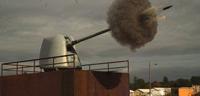
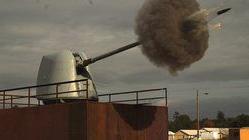
The 5-inch MK 45 MOD 2 gun fires a BL&P (Blind, Loaded and Plugged) projectile during a checkout test of the MK 45 MOD 2 and gun stand interface. The test was conducted from Main Range at the Potomac River Test Range. - Credit: U.S. Navy photo by NSWCDD
“Ready, aim, fire!” It’s not that simple say Navy engineers firing test rounds on the Potomac River Test Range.
It’s a complex process that involves extensive technical collaboration.
Patrick Freemyers, test manager in the Test and Evaluation (T&E) Division at the Naval Surface Warfare Center Dahlgren Division (NSWCDD), said performing a test involves a large team of engineers who go through long processes, develop documentation and engage in rigorous study in order to develop capability to mitigate hazards. There are many aspects involved in successfully planning and executing a test.
“It’s takes a lot of coordination and it’s a big team effort,” said Chele Kelly, test manager in the T&E Division at NSWCDD. “It begins when we’re notified by a customer who wants to conduct a test. Once that happens, we meet with the customer to try to work through the test requirements.”
The notification and meeting marks the beginning of the process. Based on the requirements, a test approach is determined and a cost estimate is generated. The cost estimate and test plan are sent to the customer for approval.
The safety approach and test planning - including coordination for range use and personnel - are considered. Depending on the test, there may be other considerations related to explosive ordnance, field, or flight readiness.
If everything checks out, a weapon is fired and a boom explodes through the air. After the test, there is analysis about what it all means.
That’s the skeleton of things. Behind the scenes, scores of employees are planning, writing, analyzing, budgeting, and risk assessing to making a test happen.
“We have processes in place to fire five-inch projectiles we’ve been producing since the 1970’s all the way up to the projectiles that are going to be shot out of the railgun which has just been developed in the last couple of years,” Freemyers said. “Our process has to encompass all of that.”
Freemyers said that there are some steps that apply to the test and evaluation process every time and others that don’t.
“The bottom line is that we have to approach every test from the safety aspect first and make sure everyone is on board with what we’re doing,” he said. “We have to account for every aspect that we think can possibly go wrong and try to protect ourselves and our people from that.”
Freemyers and Kelly deal with guns and ammunition, overseeing tests that are coordinated with a customer base, which includes various program offices within the Naval Sea Systems Command (NAVSEA), the Marine Corps as well as the Army and Air Force.
“A lot of these tests are a one-shot deal,” Freemyers said. “You either get it or you don’t. You don’t have a second chance. We do all the preparation coming from the aspect of safety, obviously, but engineering rigor is also associated with a test because many times, you can’t repeat it. Once you’ve tested it, the opportunity to collect that data is gone. If we don’t get data, then we’ve failed.”
It is critical that testers get a lot of bang for their buck and produce an optimal amount of data.
“Pretty much anything that our Sailors and Marines need to shoot, we’ve shot here,” Freemyers said. “Everything from field artillery pieces and mortars that the Marines use to guns that are on a Navy ship - we’ve shot them.”
Kelly added that sometimes the testing isn’t just about the ammunition, but also the weapons system.
“We have to fire the ammunition to determine if a weapons system is functioning,” Kelly said. “Maybe it’s a new gun. We’ll put it through a qualification process. In that case, we have to fire rounds and determine reliability and look at safety requirements.”
Kelly said some of the standard items tested are the five-inch gun, five-inch ammunition, fire control connected to a gun, Mark 38 Mod 2 gun, and the Advanced Gun System (AGS) 155, 57 and 30 millimeter guns.
“If it needs to be tested, specifically near water, this is the best place in the country to do that because we can shoot over water,” Freemyers said. “Down this range, we can observe everything that’s going on with respect to a particular system and ammunition in a controlled environment. We can mount sensors and have direct real-time digital communication to those sensors to 21,000 yards down range. That is one of the reasons we exist and why we do it here and not out in the desert somewhere.”
In order to conduct testing on the Potomac River Test Range, the Test and Evaluation Division uses range boats and lookouts to scour the surrounding area, ensuring the space required for testing is clear.
“If we see someone, whether it’s on a plane, boat or car getting into our space, the mitigation is to stop,” Freemyers said.
Sometimes they have to kindly ask people to get out of the way for their own safety. Traffic increases as the weather gets warmer and more people are out and about on the water.
“The frequency of the river issues goes up, obviously, when the weather is nice in the summer time,” Freemyers said. “More people are on pleasure crafts, fishing, and jet skiing in and out from Colonial Beach, so it becomes harder for us from that aspect.”
Then there is the visibility issue.
“You have to be able to see,” Freemyers said. “A cloudy day like today (March 20) is obviously a challenge. In the summer, the casual observer might not notice, but for us - if it’s a super humid day, you can’t see down the river. It’s hazy.”
However, many safety measures have been put in place to combat such challenges.
“There are multiple layers of safety,” Kelly said. “The range boats can see if there’s a problem. If they don’t see something, the radar can see it. If the radar doesn’t see it, we have the lookouts- not just on the water, but also on the land.”
Freemyers noted that while there are designated safety personnel, everyone in the area is responsible for safety.
“Everybody always has their eyes and ears open,” Freemyers said. “The whole workforce is responsible and everybody participates.”