
Capt. Feinberg visits Charles Composite Squadron CAP
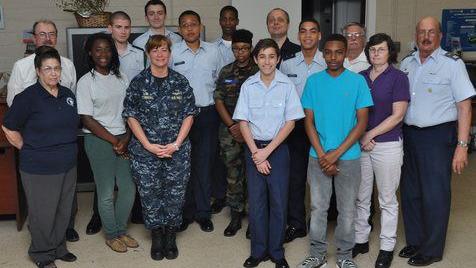
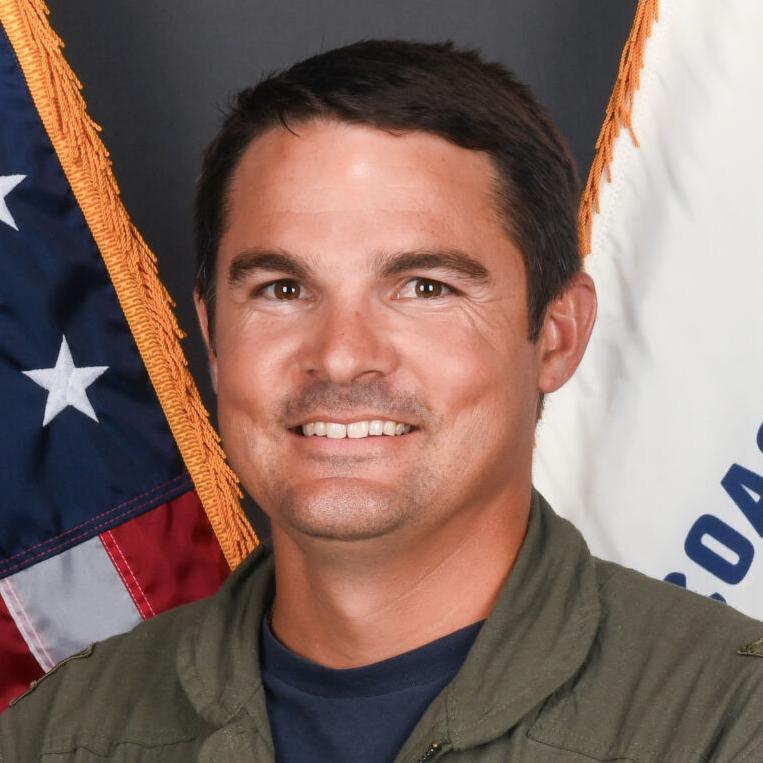
Members of the Civil Air Patrol Charles Composite Squadron with Capt. Mary Feinberg, commanding officer of Naval Support Activity South Potomac (NSASP) and a naval aviator, during her visit May 4.
Naval Support Activity South Potomac’s commanding officer talked aviation, education and service to group of likeminded young people and adults during her visit to the Civil Air Patrol’s (CAP’s) Charles County Composite Squadron at the Maryland Airport on May 4. Capt. Mary Feinberg doesn’t often get a chance discuss flying now that she commands two Navy installations, but her career as an aviator, and in particular her tour with Antarctica Development Squadron Six (VXE-6), kept the group leaning in and asking questions.
Established in 1941, the CAP is the U.S. Air Force Auxiliary and supports emergency services, cadet programs and aerospace education. The Charles Composite Squadron is one of 27 CAP squadrons and flights in the state of Maryland.
Feinberg began by discussing her career and how it has changed over the years. “Before I was flying desks-and that isn’t going away anytime soon-I was navigating aircraft,” she said. As an aviator, Feinberg traveled the world and shared photos of her experiences with the cadets.
In reality, she explained, her Navy career began long before she put on a uniform. “My father drove ships for the Navy and my mother was actually in the Navy when she met my father. As I was growing up, my father used to tell me that I should go into the military. I told him I never wanted to be in the military; I never wanted to wear a uniform or a hat on my head.”
After completing high school and college, Feinberg reconsidered that position. “Well, parents typically know what’s best for you,” she said. “Even if you’re not really listening to them, you’ll probably end up where they thought you’d be a good fit.”
Feinberg’s Navy journey began when she enlisted and served as an air traffic controller at a flight training facility. The more she helped train aviators, however, the more she wanted to be an aviator. She applied to become an aviation officer and learned that she had been accepted when her base commanding officer offered to take her flying. “I was thrilled,” she said.
Going through aviation officer candidates school, Feinberg learned the importance of attention to detail and encouraged the cadets to practice it. “Why do you guys think attention to detail is so important?” she asked.
“One small mistake could mess up the whole aircraft,” quickly answered one cadet.
“Absolutely,” Feinberg replied. “You don’t deviate from the checklist. Attention to detail is absolutely critical, even to you your everyday life.”
Attention to detail was especially critical for Feinberg in Antarctica, where she navigated LC-130 aircraft around the continent in support of the National Science Foundation. Beside the interesting photos of orcas surfacing in a hole in the ice and a very large, very friendly emperor penguin, Feinberg spoke about the specific aviation challenges. “We would haul scientists and their equipment around to test the environment, the atmosphere, the rocks, the snow and the ice,” she said. “[The scientists] would tell us where they wanted to go; we’d pick a spot [to land] and fly around to make sure it was safe.”
The pilots had to make two perpendicular passes on the landing area with the rear wheels down before they could be sure the site was safe. “There are a lot of crevasses, a lot of valleys that could potentially open up and swallow people,” she said. “Then we would land the aircraft. We would never shut down the engines because it was so cold down there, they would not restart.”
Feinberg spent the remainder of the visit taking questions from the cadets and their adult leadership, whose curiosity was obvious. What is life like on a ship? How does a military career affect family life? What is it like to be a woman in the military? What college did you go to? What made you want to become an officer? Do you recommend that young people join the Navy?
Feinberg answered each question and on the latter, encouraged the cadets to keep their options open by applying themselves at school. Of course, she also admitted that she was a little biased on the matter. “I’m partial to the Navy and it is my favorite service, but you know, we are all one team,” she said. “We all contribute to the safety of this country.”
After Charles Composite Squadron thanked Feinberg and presented her with a cake, the curiosity and conversations continued into the evening.