
Recycling: A commitment to preserve
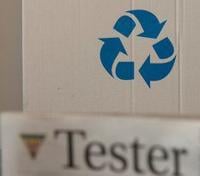

Roughly 3 percent of Tester newspapers are recycled each week; 24,500 copies annually. - Credit: Courtesy photo by Christopher Grensted
One sure method of preserving Mother Earth is to be an active user of the recycling options offered by many organizations. In some neighborhoods you’ll find conspicuous colored bins for recycling collection to include paper, plastics and more, while Naval Air Station Patuxent River offers indoor and outdoor storage bins and receptacles for reusable’s.
At the Tester, we take recycling seriously.
There are approximately 15,000 new issues of the Tester delivered to the base each week to more than 100 locations. So, what happens to the old Testers once they’re replaced every Thursday with its new edition?
John Rives, publisher for Comprint Military Publications, is in charge of printing the Tester newspapers, and he has embraced a recycling program for the Tester that he says “spans more than 10 years.”
Once all outdated newspapers are collected, roughly 500 each week, they are brought back to Comprint’s Laural, Md., facility for recycling, Rives said. This amounts to approximately 24,500 copies recycled annually.
Although this might seem miniscule, Rives said it saves Comprint $100 per year on the Tester newspaper alone; Comprint is the publisher for all military newspapers within the region.
Rives said he also appreciates the additional benefits recycling the newspapers brings, such as helping with “environmental concerns.”
As a publisher, multiplying the number of newspapers that Comprint prints could amount to substantial savings, not including the space saved from dumping at landfills, he said.
Rives said Comprint also meets the Maryland Department of Environment’s mandate of printing on 40 percent content paper use; the Tester is printed on 40 percent recycled stock.
“We are working smart to improve the environment while ensuring good business practices,” he said.
At Pax, customers can join in the recycling efforts with paper, plastic and more by utilizing any of the four sites available for recyclables: across from the Navy Exchange on Cuddihy Road, parking lot of building 407, Shaw Road just south of the circle, and adjacent to the recycling center off of Tate Road.
Each site has a trailer with sections for paper, aluminum and steel cans, glass and plastic bottles; a cardboard dumpster and a newspaper dumpster.
All satellite sites are available 24/7. The Base Recycling Center off of Whalen Road in building 604 is open from 7 a.m. to 3:30 p.m. weekdays.
Bulk metal items are only accepted after the customer has certified that it is scrap and can be turned in for recycling.
All items that contain oils, coolants or gases must have documentation showing they have been properly drained/purged before they can be turned in as scrap. No bulk items are permitted at the sites nor should any material be left on the ground.
So far this year, the Base Recycling Center has averaged 71.2 tons of recyclables per month. These items have included office paper, cardboard, newspaper, plastic bottles, aluminum cans, glass bottles, steel cans, toner cartridges and scrap metals.
The center provides weekly recycling services for 195 buildings located through the installation, Webster Outlying Field and Navy Recreation Center Solomons.
New military employees assigned to Pax are briefed during their in-processing by representatives of the Recycling Center on a monthly basis on the recycling options on base.
So, the question at the Tester is: “To recycle or not?” Well, the answer is an emphatic — yes!