
Pax River teams improving flight deck clothing
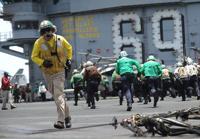
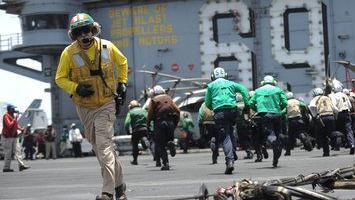
A Sailor (yellow jersey) aboard aircraft carrier USS Dwight D. Eisenhower (CVN 69) wears a prototype of the improved flight deck ensemble currently being tested and evaluated by members of the fleet. The new flame resistant jerseys and trousers, made of high-tech moisture wicking and quick-drying fabric, could be worn by flight deck crews Navywide as early as 2014. - Credit: U.S. Navy photo by Mass Communication Specialist Seaman Lauren Booher
In partnership with the Office of Naval Research (ONR) and Navy Clothing and Textile Research Facility (NCTRF), two NAVAIR teams at Naval Air Station Patuxent River have developed improved versions of the flight deck gear worn by Sailors aboard aircraft carriers, with prototypes currently being evaluated and tested by the fleet.
ONR, which promotes the science and technology programs of the Department of the Navy, used advice from senior Navy enlisted personnel on the Flight Deck Clothing Aviation Working Group of the Navy Uniform Board to redesign the flight deck ensemble (FDE), explained Dan Ratcliff, level 1 integrated program team lead for Personnel Protective Equipment in the Naval Aircrew Systems Program Office (PMA-202).
“The No. 1 concern was flame resistance,” Ratcliff said. “You’re not fighting a fire in this clothing, but if one occurred, it buys you the few extra seconds you need to get to safety.
“ONR requested assistance from our clothing team because we have a great deal of experience working with fire-retardant clothing for aviators,” he continued. “We have textile engineers working in [the Human Systems Department] AIR-4.6 who are very specialized in this type of clothing.”
About 11,000 jerseys and 8,000 trousers were sent out to be tested by fleet personnel.
Flight deck crews provide the critical support necessary for pilots and aircraft to carry out their mission, said NAS Patuxent River Command Master Chief William Lloyd-Owen, who previously worked the flight decks of USS Theodore Roosevelt (CVN 71) and USS America (CV 66).
“With aircraft being launched and recovered at the same time various crew members are repositioning aircraft, loading bombs and missiles, refueling planes, conducting maintenance and handling liquid nitrogen, an aircraft carrier’s ‘roof’ is a hectic, dangerous place to work,” Lloyd-Owen said.
The varied duties of the flight deck crew and the dangers associated with them were contributing factors in the redesign of the FDE, NAVAIR officials said. Beyond the obvious dangers, flight decks can also be hot and dirty.
“Temperatures can easily reach 125 degrees,” said Lloyd-Owen, who shared some of what might end up on a Sailor’s clothing by the end of the day: jet fuel, hydraulic fluid, grease from aircraft tie-down chains, rubber from tires and even carbon buildup from engine exhaust.
Dressed in trousers, boots, float coat, headgear, gloves and the colored mock-turtleneck jerseys that visually identify their roles, working the sweltering flight deck can make for some very uncomfortable Sailors.
So, in addition to flame-resistant qualities, the working group suggested the new FDE be durable; comfortable; wick moisture away from the body; dry quickly; stand up to exposure from sun, sweat and salt air; resist staining; and keep its shape and color — no stretching, shrinking or fading.
With requirements provided by the fleet, based on the recommendations of the working group, the textile engineers at PMA-202 and AIR-4.6 wrote the engineering specifications to achieve the desired results and put out a request to the industry to provide material samples.
“Manufacturers tested their materials based on the criteria provided in the request,” Ratcliff said, “and then AIR-4.6 engineers contracted with the Navy Clothing and Textile Research Facility in Natick, Mass., to conduct additional testing to determine which materials met the desired specifications.”
The testing narrowed the manufacturers’ submissions to five materials that best met the requirements, and prototypes were manufactured from those materials for selected members of the fleet to wear and evaluate.
The entire process involves many people working together from different areas.
“We had NAVAIR military personnel fly out and go aboard the ships to do training, distribute the clothing and provide guidance on monitoring the clothing assessment,” said Sheila Milburn, PMA-202’s level 2 integrated product team lead for Aviation Clothing and Survival Items. “There was Navywide involvement, including Pentagon personnel. Once the fleet assessment is complete, random prototype samples will be returned to PMA-202 for further testing to see if they are still fire resistant and if they’re doing what they’re designed to do.
Aviation Electrician’s Mate 3rd Class Devin Walters, serving aboard carrier USS John C. Stennis (CVN 74), is participating in the evaluation.
“The breathability is outstanding on these jerseys,” he said in an article published March 25 in Navy Times. “It’s pretty great for working up on the flight deck [when] you’re sweating a little, or [when] you’re doing a wash job on an aircraft. They dry much quicker and it’s just more comfortable.”
When final results are in, PMA-202 will provide recommendations on the qualified materials to the Defense Logistics Agency, the organization responsible for obtaining vendor bids and placing the order for the new FDE.