
Inaugural F-35B Ski Jump Launch Makes History
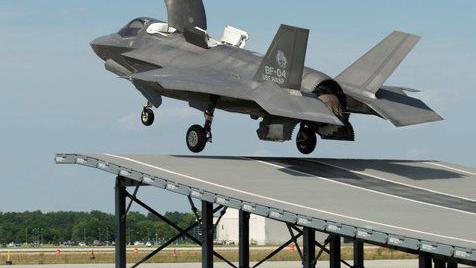
Lockheed Martin photo by Andy Wolfe
The F-35 Lightning II Pax River Integrated Test Force from Air Test and Evaluation Squadron (VX) 23 conducted the first-ever ski jump of an F-35B Lightning II short take-off/vertical-landing (STOVL) variant June 19. During flight 298, BAE test pilot Peter Wilson launched aircraft BF-04 from a land-based ski jump located aboard NAS Patuxent River. This test is the first of a series of U.K. ski jump events scheduled for 2015.
By Sylvia Pierson
F-35 Lightning II Naval Variants Public Affairs Officer
The inaugural ski jump of the F-35B Lightning II multi-role Short Takeoff and Vertical Landing (STOVL) variant made aviation history June 19 as BAE Systems test pilot Peter Wilson launched the fifth generation stealth fighter into the skies above NAS Patuxent River.
The land-based test — conducted by the F-35 Lightning II Pax River Integrated Test Force (ITF) assigned to Air Test and Evaluation Squadron (VX) 23 — marks the first time that an F-35B has taken off of a ski jump and will determine the aircraft’s compatibility with British and Italian aircraft carriers. The joint U.S.-U.K. test team will continue phase I of ski jump testing this summer in anticipation of eventual U.K. and Italian aircraft carrier operations.
“Friday’s F-35B ski jump was a great success for the joint ski jump team,” said Wilson, U.K. citizen and ski jump project lead for a highly diverse cadre of technicians, engineers, administrative support staff and test pilots based at the Pax River ITF and in the U.K. “I’m exceptionally proud of this team. Their years of planning, collaboration and training have culminated in a fantastic achievement that advances the future capabilities of the aircraft and its integration into U.K. operations.”
The U.K. and Italy use the ski jump approach to carrier operations as an alternative to the catapults and arresting gear used aboard U.S. aircraft carriers. The shorter U.K. and Italian carriers feature an upward-sloped ramp at the bow of the ship. Curved at its leading edge, a ski jump ramp simultaneously launches aircraft upward and forward, allowing aircraft to take off with more weight and less end-speed than required for an unassisted horizontal launch aboard U.S. aircraft carriers.
The first-ever ski jump was conducted off of a land-based ski jump that was jointly developed between the U.K. and the U.S. Before the test, the Pax River ITF team partnered with the NAVAIR Atlantic Test Ranges (ATR) Geomatics and Metrology team to perform a high fidelity survey of the shore-based ski jump that was designed and built in the U.K. by WFEL, Ltd., divided into sections, then transported and reassembled aboard NAS Patuxent River.
“As expected, aircraft BF-04 performed well and I can’t wait until we’re conducting F-35 ski jumps from the deck of the Queen Elizabeth carrier,” Wilson added. “Until then, the de-risking that we’re able to achieve now during phase I of our ski jump testing will equip us with valuable data we’ll use to fuel our phase II efforts.”
The F-35B’s design allows it to automatically position the control surfaces and nozzles for takeoff; a unique capability compared with previous STOVL aircraft. Such automation frees up pilot capacity and provides an added safety enhancement.
“We designed the control laws on the F-35B to make the task of taking off and landing at the ship much easier than for previous STOVL aircraft,” said Gordon Stewart, flying qualities engineer representing the U.K. Ministry of Defence. “For ski jump launches, the aircraft recognizes when it is on the ramp and responds by positioning the control surfaces and nozzles automatically for takeoff and climb. Friday’s testing was our first chance to demonstrate these new control laws using a land-based ski jump. We’ll be using today’s results — along with those from future testing — to help us prepare for the first shipboard ski jump launch from HMS Queen Elizabeth.”
The ski jump was a major milestone for the F-35 program. The U.K. is the only Level 1 partner with the U.S. on the joint, multinational acquisition to develop and field an affordable, highly common family of next generation strike fighter aircraft for the U.S. Air Force, Navy, Marine Corps, and eight international partners. Its major role in the F-35’s System Design and Demonstration phase is enabling the regeneration of the U.K. carrier strike capability, which will result in significant contracts and jobs for U.K. industry as the F-35B Lightning II and Typhoon become the U.K.’s fast jet combat air elements of the future. The primary role of the F-35B STOVL aircraft is ground attack, with a secondary air-to-air role. The aircraft is powered by a single main engine with a vertically-mounted, shaft-driven lift fan propulsion system.
This test marks the second time in one week that the F-35 Lightning II program made aviation history. Royal Air Force Test Pilot Squadron Leader Andy Edgell released two inert 500-pound dual mode Paveway IV precision-guided bombs from aircraft BF-03 over the Atlantic Test Ranges June 12. Working on the multi-phase testing of the F-35 Block 3F, U.K.-unique Paveway IV are U.S. government, military and contractor personnel, U.K. Ministry of Defence representatives, and U.K. industry partners from BAE Systems, QinetiQ and Raytheon Systems Ltd.
The F-35 Lightning II is a single-seat, single-engine, stealthy strike fighter that incorporates low-observable (stealth) technologies, defensive avionics, advanced sensor fusion, internal and external weapons, and an advanced prognostic maintenance capability to deliver optimum international security via integrated coalition operations. Partner nations include the U.K., Italy, the Netherlands, Turkey, Canada, Australia, Denmark and Norway — as well as three Foreign Military Sales (FMS) countries — Japan, Israel and South Korea. The F-35A conventional takeoff and landing (CTOL) variant will be a multi-role, stealthy strike aircraft replacement for the Air Force’s F-16 Falcon and the A-10 Thunderbolt II aircraft, complementing the F-22A Raptor. The F-35B STOVL variant will be a multi-role stealthy strike aircraft to replace the Marine Corps’ F/A-18C/D Hornet and AV-8B Harrier aircraft. The carrier-suitable variant (CV), the F-35C, will provide the Department of Navy a multi-role, stealthy strike aircraft to complement the F/A-18 E/F Super Hornet. Lockheed Martin is the aircraft contractor and Pratt & Whitney is the engine contractor.