

History and Heritage note
In the Navy, possibly one of the easiest and yet one of the most important medals to earn is the Good Conduct Medal.
The Navy Awards Manual advises that all Sailors need to do is “have a clear record (no convictions by court-martial, no non-judicial punishment, no lost time by reason of sickness-misconduct, no civil convictions for offenses involving moral turpitude)” within the “required period of active service.”
In other words, stay out of trouble and you should be able to earn a Good Conduct Medal. Most everyone in the Navy knows this, but how many know the history of the Navy’s second oldest continuously awarded medal after the Navy Medal of Honor?
The Good Conduct Medal's history began well before the Civil War, as a simple discharge form signed by a Sailor's commanding officer certifying the man's service. This form had to be presented at a recruiting station as proof of seagoing experience.
The actual awarding of the Navy Good Conduct Medal technically began in 1865, when all enlisted men receiving honorable discharges were authorized to wear a fouled anchor on the left sleeve to be called "the honorable discharge badge." A star was to be added for each additional honorable discharge.
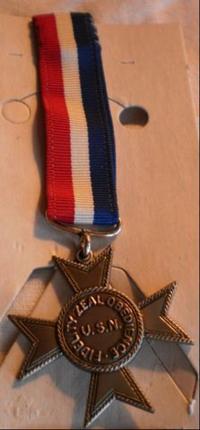
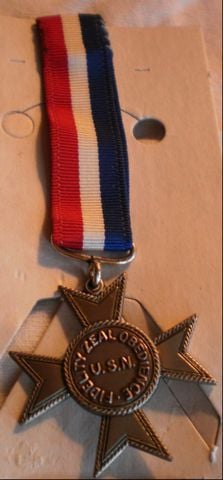
A post-Civil War push for re-enlistments prompted Secretary of the Navy A.E. Borie to announce on April 26, 1869, the authorization of the Good Conduct Badge. The following January, the Navy Department awarded a contract to produce 500 badges provided with ribbons, engraved with the name of the recipient on the reverse, at 35 cents apiece. The badge was a Maltese cross of nickel metal with the front having the words "FIDELITY - ZEAL - OBEDIENCE" in a circle, with "U.S.N." in the center of the disc. The reverse side was blank except for the script-engraved name of the recipient. A one-half inch wide red, white, and blue ribbon was supplied without a suspension pin. Over the years, this particular badge has picked up the nickname "Nickel Cross" among collectors and researchers.
The first requisition for medals was placed on April 19, 1870. The 102 badges were to be issued to Sailors on board the USS Iroquois, which was returning from a European cruise. Initially, the badge was awarded to "... any man holding a Continuous Service Certificate who is distinguished for obedience, sobriety, and cleanliness, and is proficient in seamanship and gunnery..." Sailors were issued a separate badge for each discharge with good conduct. The badge, and related discharge papers, had to be shown to the recruiting officer at the time of re-enlistment to prove the quality of previous service as well as to obtain any re-enlistment bonus and receive credit for continuous service. A sailor with 20 years of good conduct was eligible for a pension or admission to a naval home or hospital. Re-enlistment with three badges allowed rating as a petty officer.
The medal went through several more changes before taking its present form, with stamping of the service member’s name on the medal halting, in 1954. The bottom suspension bar on the ribbon was also replaced with a ring which gave the medal and ribbon the familiar appearance common to most other United States awards. The use of award bars to mark repeat awards also was discontinued in favor of the 3/16" bronze and silver stars still in use today. Each bronze star represents one additional good conduct enlistment. A silver star is worn in lieu of five bronze stars.
And so there you have it: a rich history in an award nearly all of us have. Next time you see a Good Conduct Medal, don’t only think about the honorable service that allowed the wearer to earn it but also think about your Shipmates from the late 1800s, when it all got started.