
GEM, Airfield Services play behind-the-scenes roles at Air Expo
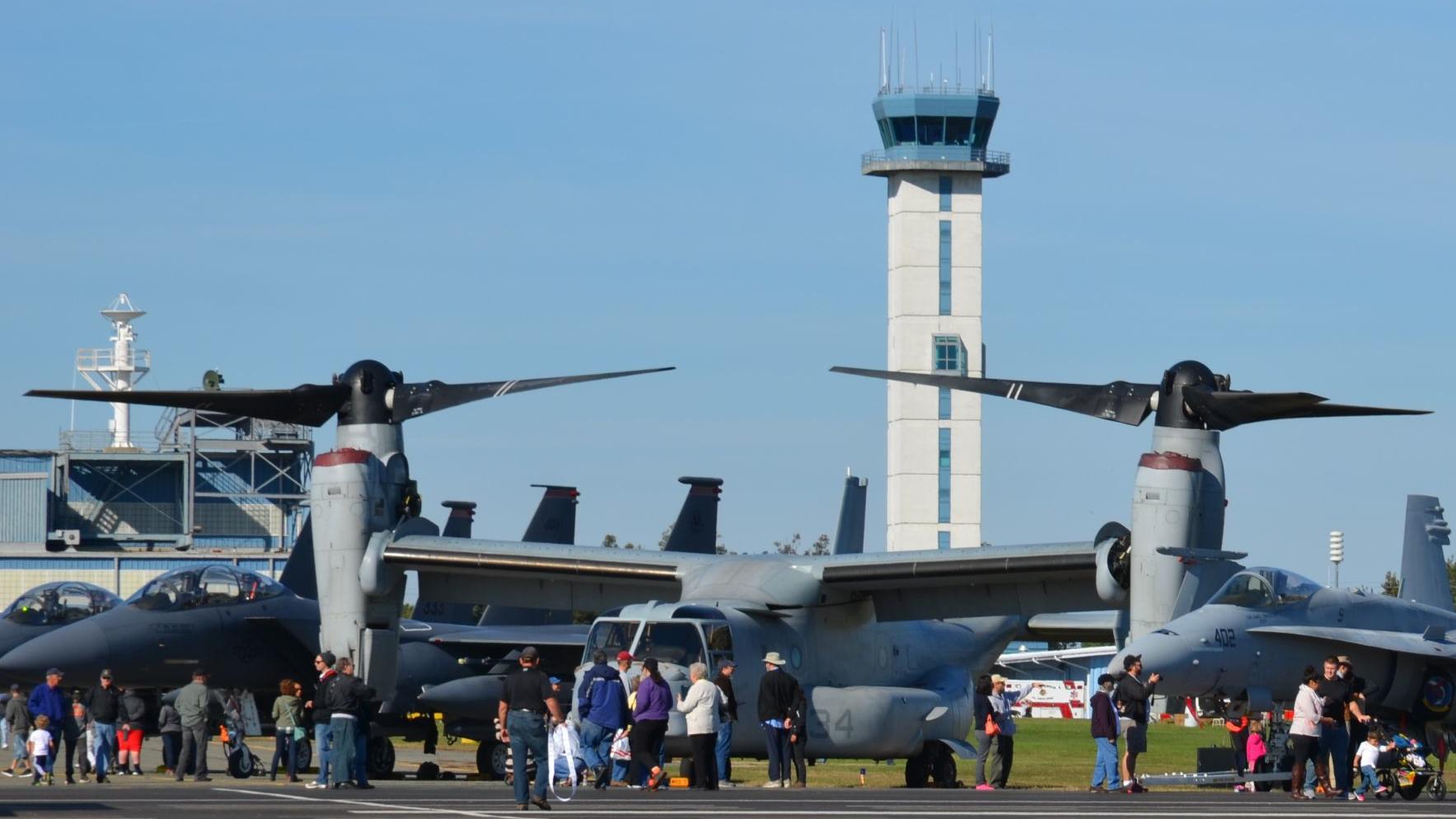
Visitors gather around static aircraft on display at the NAS Patuxent River 2016 Air Expo. This year, Airfield Services personnel will position more than 30 military and civilian aircraft to be showcased during the air expo weekend, June 2 and 3.
Ground Electronics Maintenance (GEM) is responsible for maintaining airfield navigational aids, communications, Land Mobile Radio, and other ancillary electronic equipment such as the public address system. In short, the NAS Patuxent River 2018 Air Expo couldn’t get off the ground without GEM personnel to support it.
“The way I explain it to people is that the performers and controllers are the rock stars, and [GEM personnel] are the roadies,” said Mike Agamaite, Ground Electronics Maintenance officer. “Nobody knows anything about us, but we’re behind the scenes making it happen.”
Communications — including land mobile radio communications, ground-to-ground (VHF), marine radios, and ground-to-air (UHF) — is a vital element in coordinating the multiple moving parts of an air show and GEM technicians are ready and waiting to jump in on a moment’s notice if there’s a break in the link.
“We provide a one-stop shop for electronics support,” Agamaite explained. “If anyone has radio issues, we’re customer service. If you can’t talk on your radio, our techs are standing by to either fix it, walk you through the problem, or replace it for you. We’ve also got another group of techs dedicated to supporting air traffic control if problems should arise with air surveillance radar systems. They’re a rapid response team and they’ll be right there; we’re required to respond within 10 minutes.”
GEM will also support the Local Dispatch Center, a central communications command hub that will be controlling network connection and monitoring everyone’s chatter and movements.
“There will be radios in there, IT power lines, emergency generators, security personnel, an assistant air show director — it’s the brain center,” Agamaite noted. “If they lose power, there’ll be a tech sitting in there to get things up and going again.”
The GEM team has run a few communications drills, emergency scenarios and ‘what if’ situations so that everyone is prepared.
“You try to think of every contingency so you can plug the holes in the dike; that’s what we do,” Agamaite said. “I’ve been doing air shows since the early 90s and nothing’s happened yet; we don’t anticipate issues, but we have to be prepared.”
Airfield Services Division
While many of the planes at Air Expo will be in the skies above Pax River, there will be about 30 aircraft on display on the ground for visitors to check out up close and personal, and it is Airfield Services (AFS) personnel who are responsible for getting them there.
“We’re getting all of the static displays together, coordinating with different squadrons as to what statics they’re providing and where we’ll set them up,” explained Lt. Stephen Yaccarino, AFS division officer. “We’re also working with civilian pilots who are bringing in aircraft. They’ll start flying them in Thursday [prior to the expo weekend] and we’ll meet them to begin towing them and setting them in place within the Static Display Area.”
In addition to a number of helicopters on display, there will be an F-35C, FA-18E Super Hornet, Legacy Hornet, E-2C Hawkeye, MV-22B Osprey, P-8 Poseidon and more, representing military aircraft. Civilian-owned aircraft will include a Beech Bonanza, Baker Super Cat, Citabria, PA28-160 and an RV-8, among others.
“Right now, we have six squadrons participating by providing aircraft; some are providing multiple aircraft,” Yaccarino added. “During the show, pilots and squadron representatives will be on hand to talk about their aircraft and answer questions.”
The 25 AFS Sailors working the show will be split between the airfield area and a second staging location at Test Pilot School.
“We’ll be calling for fuel if they need it and telling the fuel guys where to go,” Yaccarino said. “As [the planes] are getting ready to perform and after they’ve finished their performance, we’ll be directing them in and out. We’ll have radios to communicate.”
AFS will also conduct FOD walk downs to remove debris from areas where aircraft operate.
“[FOD walk downs] usually take about 30 minutes, and for the expo, we’ll probably be looking at 50-plus people stretched across; it’ll be us plus a squadron effort,” Yaccarino said. “Will do one prior to the start of the air show, another one at the end, and will likely do another one Monday morning prior to the airfield opening back up for normal operations at 0800.”
Collateral duties
In addition to their specialties, GEM and AFS have additional duties to carry out during the air expo with GEM members designated to chauffer some of the acts and escort them on tours of the air traffic control tower, and AFS assisting with trash pickup and possibly crowd control.
“We’re considered the ‘do it all’ people,” Yaccarino said. “We’ll be here for the entire show, so wherever they may need help and whatever they need done, we’ll be there.”