
FRCSW returns first E-2D Hawkeye to complete PMI-2
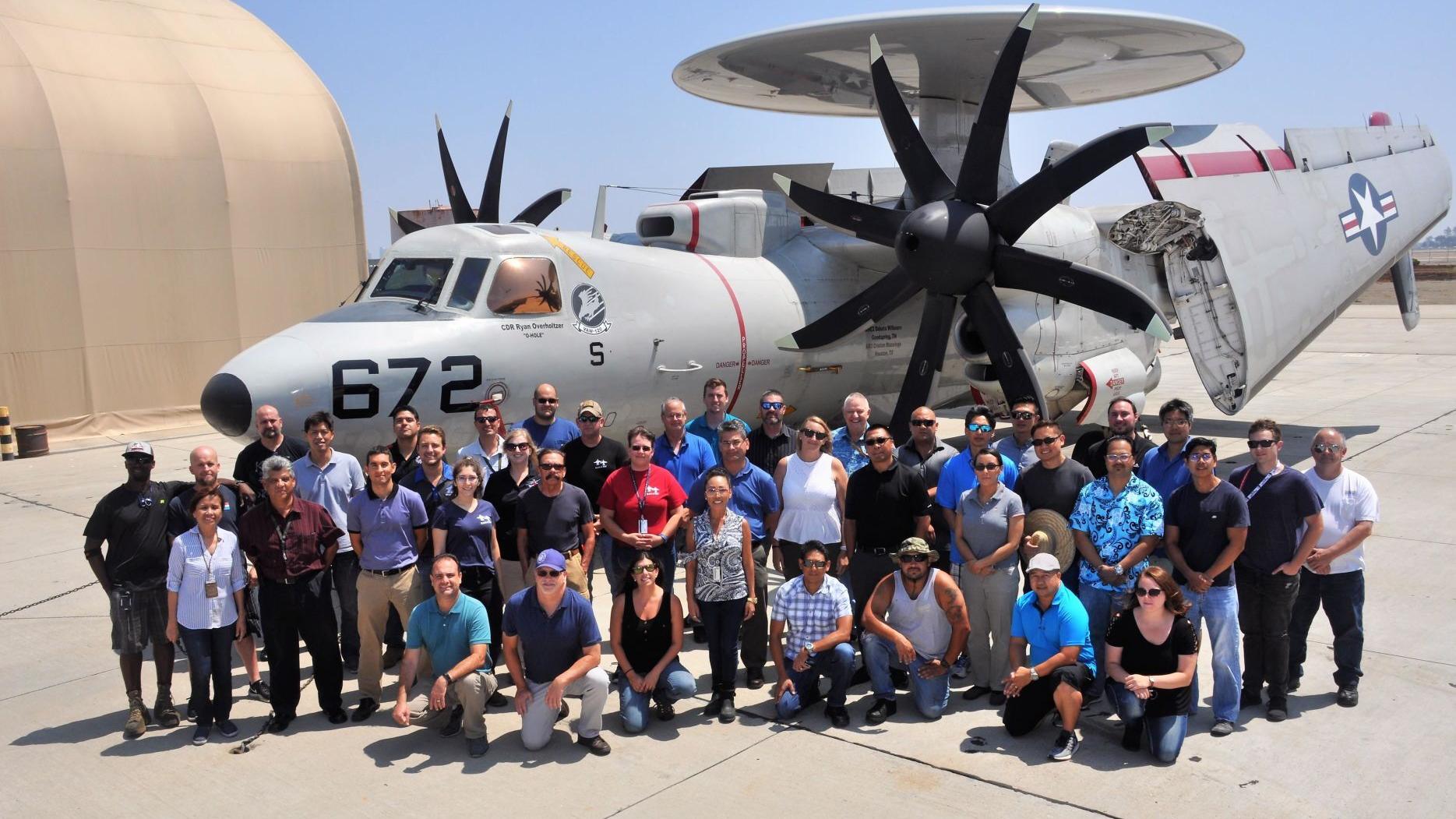
In this photo taken prior to COVID-19, artisans and support staff of the FRCSW E-2 program are pictured at the testline Aug. 21, 2018, as they welcome the command’s first E-2D inducted for PMI-2. The aircraft is one of two E-2Ds assigned to VAW-120 currently undergoing the 220-day PMI-2 maintenance cycle.
Fleet Readiness Center Southwest (FRCSW) set yet another milestone Jan. 23, 2020 with the delivery of its first E-2D Hawkeye to complete periodic maintenance interval two (PMI-2).
FRCSW returned the aircraft to Carrier Airborne Early Warning Squadron 120 (VAW-120), headquartered at Naval Station Norfolk. The Hawkeye was inducted in August 2018.
Developed to replace the Navy’s existing E-2C airborne early warning system aircraft, the E-2D is the fourth variant and manufactured by Northrop Grumman. The aircraft completed its maiden flight in 2007, and three years later, the first E-2D was delivered to the Navy.
“Compared to the E-2C, the E-2D is a completely different animal,” said E-2 deputy program manager Chris Crawford. “Everything is newer: Newer technologies, avionics, newer test equipment and procedures.”
Technologically superior to its predecessors, the E-2D is equipped with a radar featuring electronic and mechanical scanning capability, an integrated glass tactical cockpit, and advanced tactical workstations and mission computer.
FRCSW performs two levels of scheduled maintenance on the airframe: a light periodic maintenance interval one (PMI-1) which is done at FRCSW Site Pt. Mugu and FRC Mid-Atlantic, and PMI-2, or a heavy maintenance, at Naval Air Station North Island.
FRCSW is the Navy’s sole provider of PMI-2 events on the E-2 airframe, and the 135-member staff assigned to the program will add the maintenance of the E-2D to the existing E-2C workload in Building 460.
PMI is based upon a 96-month cycle: PMI-1 completed every 48 months, followed by PMI-2 48 months later.
PMI-1 targets specific areas of the airframe (primarily the tail) where artisans inspect for corrosion, cracks, mechanical and electrical issues. The procedure requires about a 45-day turn-around time (TAT).
Though not a complete overhaul, PMI-2 is a major disassembly of the aircraft to the fuselage. Artisans remove the aircraft’s wings, engines, landing gear and tail. The aircraft’s corrosion preventive paint is removed and an in-depth metal assessment is performed targeting cracks, corrosion, exfoliation and other surface anomalies.
Guidance for PMI servicing of the E-2D is found in the airframes Interactive Electronic Technical Manuals (IETMS), or computerized maintenance manuals.
“All of the procedures aren’t covered in the IETMS, so we worked a lot of hand-in-hand with engineering getting some things done,” Crawford noted. “This was a prototype aircraft, the first we’ve done, so we’re working toward the 220-day (PMI-2) TAT.”
If customers authorize repairs that are outside of the scope of specification, the work is classified as an in-service repair (ISR). ISRs are funded separately and normally completed during the PMI event.
ISR work involving the replacement of some fiber optic lines in the VAW-120 aircraft was completed, while artisans also performed an age exploration analysis to the landing gear and rotodome.
FRCSW is currently performing PMI-2 on a second VAW-120 aircraft and recently inducted another E-2D from Air Test and Evaluation Squadron Twenty (VX-20) based at Naval Air Station Patuxent River, Maryland.