


More injuries are occurring each year nationally as people look down at their smartphones while walking – and while there have been no incidents reported onboard Naval Support Activity Bethesda (NSAB), the base’s safety manager said he’s heard of some close calls.
“They have their faces down and eyes focused on their smart phones while walking around the installation, including while crossing the street,” NSAB Safety Manager Jim Ganz said. “I have actually seen occasions where someone stops in the middle of the roadway to tend to something on his/her phone.”
The National Safety Council reported in June that distracted walking injuries have increased parallel to the increase in cell phone usage since 2000, and Ganz said he has noticed distracted walking increasing in the past couple years on the installation. While he said he hasn’t seen any formal accident or injury reports, Ganz said he’s heard plenty of anecdotal evidence of pedestrian/vehicle incidents.
“However, when discussing safety risk, ‘near-miss’ incidents can be just as important as actual accidents,” he said. “I have seen several near miss incidents (about a couple each month) when I’m out and about that fortunately have not been accidents … the driver was able to stop in time to avoid colliding with the pedestrian.”
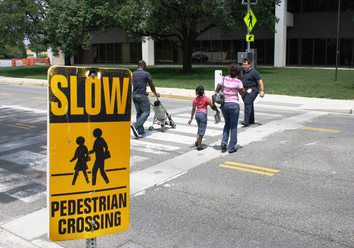
That’s why Ganz wants to reiterate crosswalk safety with the most important safety tip to only cross the street after looking up and down the road for oncoming traffic and only crossing when it’s clear to do so. Other tips he shared were to only cross the street at a crosswalk, obey all pedestrian crosswalk signals and to not cross the street between two parked vehicles.
He also advised people to avoid distractions by not looking at their phone while crossing the street and if using headphones to keep one ear clear.
Drivers, he said, should always yield to pedestrians in crosswalks – reduce speed when approaching a crosswalk and prepare to stop, and to not pass vehicles already stopped at a crosswalk.
There are a few road crossings on the installation that Ganz said warrant extra caution. Those include:
• North Palmer Road/Brown Drive – it’s a busy crossing generally and both pedestrians and drivers can behave unpredictably.
• North Palmer Road – just west of Roosevelt Circle – people exit from the side doors of the building and cross the street as a shortcut to the G-Lot between the crosswalks. He advised people to take more time and use the crosswalks on the east and west sides of the parking lot.
• South Palmer Road just south of Building 10 – the traffic direction in the center lane flip-flops depending on the time of day but while there are several crosswalks here, sometimes pedestrians cross wherever they want.
• South Palmer Road/South Wood Road – Vehicles turning from South Wood Road to South Palmer Road do not have a stop sign and pedestrians here tend to spread out beyond the actual crosswalk.
Off the installation, he said pedestrians shouldn’t cross Wisconsin Avenue at the North Gate (Gate 1) because there is no crosswalk there – instead pedestrians should use the crosswalk at the South Gate (Gate 2). But, even at the South Gate crosswalk, pedestrians exhibit risky behavior by not waiting for the signal to cross or crossing the road well outside of the crosswalk, he said.
“This is a busy intersection with all sorts of vehicular activities going on; it is usually well clogged during the afternoon rush hours,” he said. “Pedestrians should wait at the corner and cross when the signal allows them to do so.”
Crosswalks on base are evaluated regularly and repainted when they fade too much to be easily recognized, said Ganz, who also evaluates traffic and pedestrian patterns to advocate for additional safe crossing areas when needed.