


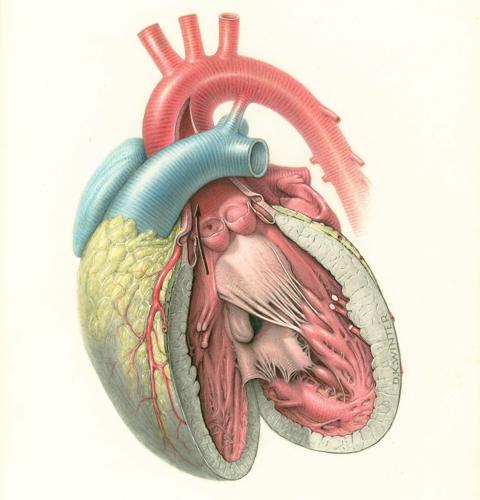
In recognition of American Heart Month and Valentine’s Day, the National Museum of Health and Medicine (NMHM) is featuring a series of heart-related medical illustrations in a new temporary exhibit, “The Army’s Artist: Medical Illustrations of D.K. Winter.”
NMHM’s Otis Historical Archives maintains a collection of approximately 150 original artworks, a monograph and an unpublished manual on medical illustration by Duncan K. Winter, a gifted illustrator who worked for the Armed Forces of Institute of Pathology’s (AFIP) Medical Illustration Service between 1952 and 1968. He was trained at Johns Hopkins University’s School of Art as Applied to Medicine under pioneering medical illustrator Max Brödel. Very little is known about Winter, but his talent is evident in the medical illustrations he created for the organization.
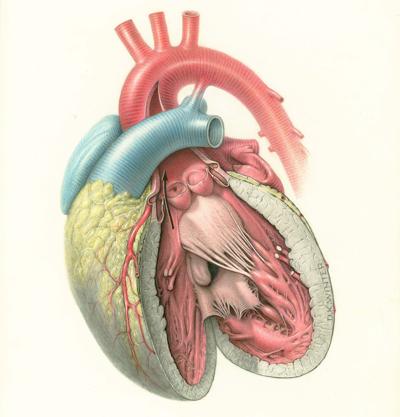
Featured prominently in the exhibit are seven illustrations of the human heart showing heart defects from different angles. These illustrations are part of a collection of 100 anomalous hearts completed by Winter between 1958 and 1968. William C. Manion, M.D., a pathologist at AFIP, requested the work to illustrate an “Atlas of Anomalous Hearts.” However, Manion died unexpectedly in 1970, and his atlas was never completed. Winter’s artwork was never published and the collection was returned to the NMHM in 2011.
The exhibit includes drawings of a human skull, a placenta from a quintuplet birth, a muscle incision and more. One case features Winter’s unpublished manual on medical illustration. In a letter to the AFIP Librarian, Winter wrote, “…some years ago I promised I would write down for [the AFIP librarian] the principal drawing techniques and procedures which I had learned from Max Brödel and others.” Winter was disappointed that the book was not published for a general public, but felt that it was important to document “this badly needed information” for medical illustrators, and hoped to get a pamphlet made by the Government Printing Office.
Laura Cutter, assistant archivist at NMHM, said she is glad that Winter’s work is being shared with the public, but wishes more was known about the illustrator.
“What fascinates me about Winter is that we know so little about him,” she said. “His work is so compelling, and exquisite. Yet there is no indication that he was an artist in his private life. As a historian, I find myself wondering why that is— was the work lost, or did it never exist? What else was he doing?”
Elizabeth Lockett, collection manager of NMHM’s Human Developmental Anatomy Center and a trained medical illustrator, said she appreciates the amount of thought and detail Winter put into his work.
“Aside from the beauty of the drawings, Winter considered every aspect of the illustration process — from selecting the appropriate technique to its final reproduction methods,” she said. “When he did that, he ensured the message that his client was trying to convey was always clearly presented.”
“The Army’s Artist: Medical Illustrations of D.K. Winter” is on exhibit through the end of February, and can be found in the “Anatomy and Pathology” gallery.
The Museum is open to the public every day (except December 25) from 10:00 a.m. to 5:30 p.m. and admission is free. For more information about the Museum, visit http://www.medicalmuseum.mil or call 301-319-3300.