
New Students Welcomed to USU School of Medicine
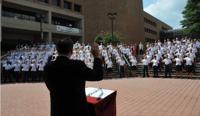
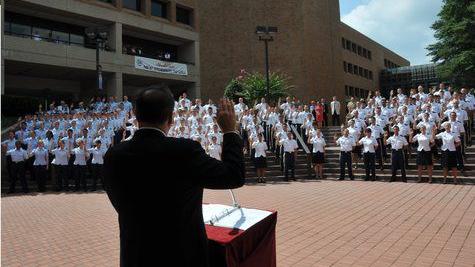
Acting Dean of the School of Medicine, Col. (Dr.) John E. McManigle leads the class of 2017 in the Hippocratic Oath in the Uniformed Services University courtyard. - Credit: Photo by Ryan Hunter
With their right hands raised high, student service members took their first Hippocratic Oath, marking their induction into the F. Edward Hèbert School of Medicine Friday, August 30.
These students will spend the next four years studying medicine at the Uniformed Services University of Health Sciences (USU) tuition free. Not having to worry about student loan debt allows students to “focus on studying, learning and caring for patients,” said Deputy Vice President for External Affairs and Alumni Affairs Director, Sharon Willis. This opportunity “relieves a huge burden on students,” especially considering the average private medical school education cost is more than $300,000 per year according to the American Medical Student Association.
In exchange for a tuition free education, students are required to join a branch of either military or public health service. Roughly 50 percent of enrolled students are in the Army, about 45 percent are comprised of members from both the Air Force and Navy and 5 percent are members of the Public Health Services. Upon graduating from USU, alumni are required to commit to practicing medicine in their selected service.
“[Students spend] seven years practicing medicine in a federal health system, where every patient is guaranteed access to care and their medication, labs, radiology and consultations are paid for. When a patient is hospitalized it doesn’t bankrupt them. The government provides for doctors malpractice fees, and overhead costs. Their job is to practice medicine, not learn the business of medicine or spend four hours at night trying to get reimbursement from 15 different insurance companies. There’s a tradeoff for coming to a tuition free medical school but that can be an advantage,” said Lt. Col. Aaron Saguil, the asst. dean of recruitment and admissions.
After their seven year obligation, alumni are allowed to leave the service. However, according to Willis, “70 to 75 percent of school graduates continue as active duty after their obligation has ended.”
The 107 new students will become a part of a skilled, diverse cadre based in no small part to the USU open enrollment policy. “About 68 percent of this year’s class has no prior service history,” said Willis. “Our students are a mix of folks directly from universities without any prior experience in the military at all, as well as prior service enlisted and prior service officers [who don’t necessarily] come from the medical field.”
“We’re looking to make sure that our student body is representative of our force from the standpoint of geographic diversity as well,” said Saguil. In addition to varied economical, racial, and geographical backgrounds, “we try to look at their attributes, like service orientation and experience.” However, USU is under no obligations to achieve quotas for specialty demographics. “Anybody that comes to this school came here on their merit,” stresses Saguil.
The cadre size also affects student’s studies, leading to a more intimate and cooperative learning environment. “Most [of the practicing military physicians] know each other, work with each other or took care of a family member. Since we all form part of that very small cadre, we know that we have to help each other to be the best physicians we can possibly be, and that works its way down to the students,” said Saguil, who cited the alumni cadre as only having about 10,000 practicing doctors.
William Gilliland, associate dean for medical education, continued to describe the school as one where students “cooperate and graduate.”
New students in attendance for the ceremony were eager to begin their studies. “We have a hospital literally five minutes away walking distance [and that affords us a] lot of patient interaction. I love that aspect of this school,” said Air Force 2nd Lt. Khang Lu.
Navy Ensign Abigail Axel hopes the school will help her achieve her dream of serving aboard the USS Mercy or the USS Comfort, the Navy’s two largest hospital ships. Army 2nd Lt. Thomas Guilder wants to use his experience at USU to aid wounded warriors through academic research medicine, with a focus in prosthetics and Traumatic Brain Injury.
In 2017 the incoming class will graduate, benefitting from the schools 98.4 percent graduation rate, and take their place among a distinguished body of alumni, including physicians to the president, surgeon generals and astronauts. “There is no end to the types of assignments that our graduates have. It’s amazing,” said Willis.