




A Purple Heart sits on Navy Capt. (Dr.) Mark A. Kobelja’s desk, earned by his maternal grandfather during World War II.
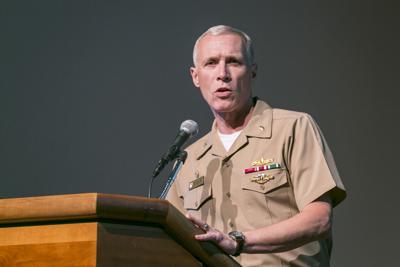
“I’m not the first military physician in my family,” explained Kobelja during his first town hall as director of Walter Reed National Military Medical Center (WRNMMC) held on July 11.
“My grandfather did a fellowship at Walter Reed in 1942. [He] perished at the Battle of the Bulge while serving as an Army physician. I keep his Purple Heart on my desk as a reminder that we are not just clinicians. We don’t just take care of the warriors…we are the warriors.”
As warrior clinicians, Kobelja explained it’s important for service members assigned to WRNMMC to maintain their competencies and readiness for deployment.
“We have to get at the complexities of health care, and we have to innovate so we can take new techniques and concepts to the battlefield to save lives and bring our sons and daughters home, rehabilitate them and return them to society [as productive individuals],” he continued.
In addition to fielding the nation’s expeditionary medical force and providing “high-quality, good outcome health care,” WRNMMC educates most of the Department of Defense health-care providers, as well as conducts or sponsors the majority of DOD’s clinical research, Kobelja stated. He added all of this makes Walter Reed “more than a historical reference to a brilliant Army physician,” but a brand in the making for more than 100 years. That brand connotes “compassion, caring, solace, comfort, help and excellence.”
Kobelja said beneficiaries choose to come to WRNMMC not necessarily because they have evaluated the quality of care provided here. “The fact is they assume it. They hear the name and [know] they are going to get high-quality health care,” he continued.
But while beneficiaries can assume and expect that high-quality health care at WRNMMC, the staff should remain ever vigilant that “the difference between a successful outcome and injury is very narrow” in the practice of medicine today, Kobelja said. “[Success] requires a professional focus, which is a specialty. If we’re going to assert our claim of excellence in health care, we need to [have this focus],” he said.
“Quality requires our attention,” Kobelja continued. “We have to get at quality by working very hard at it.”
Kobelja said patients measure the quality of their care at WRNMMC by their experiences with its staff, as well as what they see and hear when they arrive. These “surrogates”, including parking, front-desk experiences, timeliness, and staff demeanor, as Kobelja referred to them, will shape the opinions beneficiaries and their families have of WRNMMC, and determine if they make the choice to have WRNMMC as the place where they receive their health care.
“Our patients are going to exercise their choice based on their perceptions on those surrogates and the quality of care [they receive here],” he said.
“Congress, on behalf of the American people, sponsors this expensive endeavor [WRNMMC] because they think it’s worth it to have expert expeditionary medical capability ready when the nation calls. It is complex, it’s expensive, it’s hard to do, but they’re convinced this is the best way to do that.
“The Walter Reed brand was built by the tens of thousands of people who came before us, but now we’ve got the watch. It’s our turn, [and] it’s truly my privilege to be back working with you,” Kobelja added.
He also discussed WRNMMC’s upcoming triennial Joint Commission (JC) survey, explaining that while the medical center prepares and participates in the JC process approximately every three years, “staying focused on the difficult work of high-quality health care in an era of high risk,” is an everyday practice at WRNMMC.
Gene Monroe, chief of Joint Commission Readiness at WRNMMC, agreed. He explained that the WRNMMC staff should always be ready to provide safe and high-quality care to patients and their families, and the Joint Commission standards help in accomplishing that. WRNMMC received full JC accreditation in 2012 and 2015.
Also during the town hall, Navy Cmdr. (Dr.) Jason Schroeder, director of clinical services at WRNMMC, discussed ongoing construction projects underway at WRNMMC. He explained that utility upgrade work to enhance information technology and communications distribution, which has resulted in much of the construction along Brown Drive for the past year, is on track to be completed by the end of this calendar year. He added a pedestrian tunnel is scheduled to be built to connect Buildings 9 and 19 during the Medical Center Additions and Alteration (MCAA) construction project.
The MCAA project involves new construction of approximately 540,000 square feet of medical center space within the existing locations of Buildings 2, 4, 6, 7 and 8 resulting in work on base for the next several years. To accommodate those departments affected by the project, a two-story modular facility providing 100,000 square feet of temporary medical and clinical space will be constructed in the G lot. The facility will include 124 large modules, which Schroeder explained will be brought to WRNMMC individually and parked along Perimeter Road until they are needed, and then transported to G Lot along Taylor Road.
The modules are scheduled to begin arriving at WRNMMC this summer and fall. “If everything goes as planned as far as construction, this building will be complete by the end of the calendar year,” Schroeder said of the temporary medical facility.
In addition, the H garage, near the bowling alley and Child Development Center, is nearly complete and could be in use within the next couple months, he added.
For more information about construction at WRNMMC, people can visit the website https://go.usa.gov/xNv4p, or call 301-400-1934 (24-hour construction hotline).
WRNMMC’s town halls are held on the second Tuesday of each month at 7:30 a.m. in Building 10’s Clark Auditorium and noon in the Memorial Auditorium.