


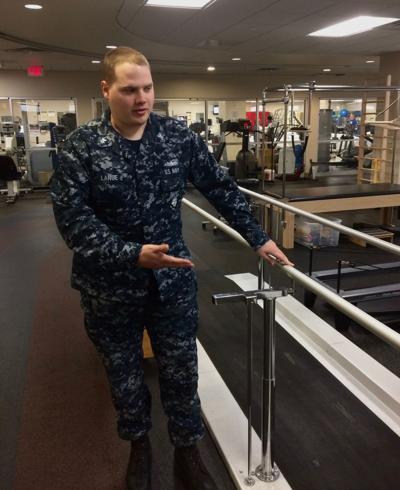
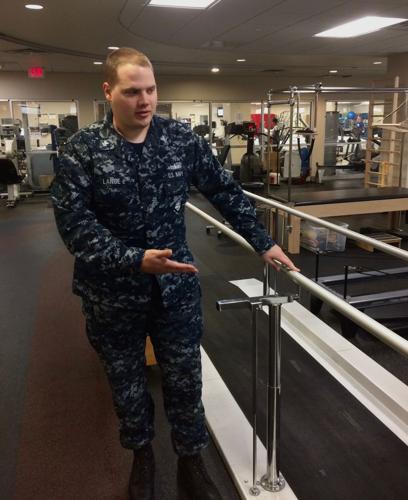
Machinist’s Mate 2nd Class Jake Lange never thought about physical therapy as a career when he was aboard the USS Kearsarge working with the ship’s engines, but that’s what fills his days now after he was hit by a drunk driver in 2014.
The 23-year-old from Connecticut was looking forward to a career in the U.S. Navy, but plans changed after his accident on Dec. 27, 2014. Now, four days a week, Lange finds himself in the Walter Reed Bethesda (WRB) physical therapy department working with the same people who helped him during his recovery.
“I guarantee there are other people in my position that are dealing with the same issues of what to do, so maybe I could use my recovery story to help them through theirs,” Lange said.
Lange was walking to get his Jeep so he could help get his buddy’s truck unstuck from the mud when he stopped to talk to two guys asking if they could help. “Then, next thing,” he said, there was a drunk driver who came down the road, “hit me and [the impact] threw me up and over the car and in the road and then another car ran me over.”
His injuries included damage to his vertebrae, a shattered elbow, a dislocated left shoulder, a broken shoulder blade, torn ligaments in his left knee, and a traumatic brain injury.
For a long time after his accident, Lange believed he was going to get better and he would return to active duty.
“The first year I was here I was like ‘I am gonna get better and I’m gonna go back,’” he said. “But after I had my shoulder surgery and it was an 11-hour operation and I still didn’t go back to a normal arm, I was like, this is probably not in the running. I went back to my ship when they [returned] from deployment and I went into the engine room and up the stairs and my knee was killing me. I was like, ‘Yeah, I don’t think I’ll be able to do this.’”
So, with assistance from Navy Wounded Warrior Safe Harbor, Lange secured an internship with the physical therapy department. He’s been working with physical therapists and physical therapists assistants in the Traumatic Brain Injury unit.
“He has the insight of how hard it is to go through the pain, to go through the frustration, to go through the disappointment, to go through the uncertainty,” said Carla Alexis, WRB physical therapist, who helped Lange when he first came to physical therapy. “So his having been in their shoes and having been on the receiving end of therapies and getting pushed and being supported to move forward, he’s able to do the same thing for others now.”
When he first arrived, Alexis said, Lange didn’t want to open up to anybody and wasn’t interested in others around him.
“Before it was ‘I’m going to go back to my engines, I don’t like people,’” she said.
But over time, “he started to develop that empathy, but could also see himself going to school … it was getting to see him really develop into this young man who was open to new things and new experiences.”
Lange has mainly worked with stroke patients and he said he likes to see them improve in their abilities, recounting how one patient was able to progress toward normal walking again.
“They’re happy about it, so you get happy about it,” he said.
Lange said being a part of someone’s recovery is a big part of why he wants to pursue physical therapy as a career.
“To be able to turn something so bad in my life – because at one point they were all saying I was going to die,” he said candidly. “To transform it into something positive and have patients [ask], ‘You were a patient over here?’ … and I tell them my story and they look at me and say ‘Wow, I thought I was bad. It’s kind of like if you can do it, I should be fine.”
Lange is awaiting medical retirement from the service. Once he leaves the Navy, he plans on enrolling in a physical therapist assistant program at the New England Institute of Technology.
Chris Brown and David Martin, physical therapist assistants, give Lange homework to review on his days off.
“He’s definitely going to have a head start when he starts school,” Martin said. “Just being around here, and knowing the terminology and what he’s going to be learning.”
Brown adds that Lange has a notebook full of notes of topics they’ve assigned him to research, such as the muscle groups and exercises associated for those groups. They both say they’re amazed at how far Lange has improved since he was first brought to the medical center following his accident.
“He could’ve died,” Brown said. “He had that halo [neck brace] on because he fractured his neck.”
Martin said Lange is close to where he was before his accident, with no speech deficits, and has a good memory.
“The fact that he’s able to learn something new is pretty big for a brain injury,” Brown said. “A lot of times that’s the hardest thing. They remember what they used to do, but teaching them a new task is pretty hard.”
Lange said he’s learned a lot from his internship and he likes helping people in their recovery.
“It’s going to sound corny, but the happiness of being able to see someone who’s hurt do something they weren’t able to do and see how happy it makes them, I’m just like ‘Yeah, I had a part of that,’” Lange said.