
August Medic Alert Awareness Month
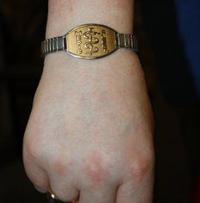
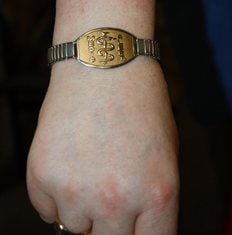
The metal medical alert bracelet worn by Greta Patten, a Red Cross volunteer at Walter Reed Bethesda, appears unassuming, more like a watch at first, but she explained it contains vital information for emergency medical personnel.
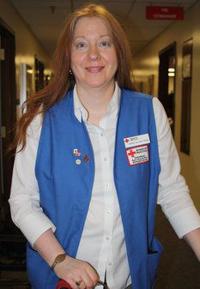
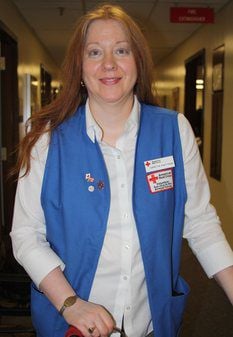
Greta Patten has worn her medical alert bracelet for nearly 23 years. - Credit: Photos by Sharon Renee Taylor
Emergency first responders and medics at Walter Reed Bethesda encourage patients with allergies, special needs, internal medical devices or certain medications to wear a medical identification tag. The month of August is designated Medic Alert Awareness Month to educate and bring attention to these life-saving tools.
“The medical ID [alert] speaks for you when you cannot speak for yourself,” explained District Fire Chief John Gray of Naval Support Activity Bethesda Fire and Emergency Service. “They are your voice.”
Worn as a bracelet, necklace or on clothing, a medical identification tag will tell first responders that the individual wearing the tag has a medical condition that may need immediate attention. Unconsciousness, shock, delirium, hysteria, and loss of speech may prevent a person from communicating vital information in medical emergencies.
“It’s less of a guessing game when you’re dealing with medical ID bracelets because it can point to the problem immediately,” said Gray.
Available for purchase at drug stores, pharmacies, and other retail outlets, medical identification alerts can be found as a charm on a bracelet, necklace pendant, or a simple silver band with a red emblem that draws the attention of paramedics, physician, or emergency department personnel of a medical condition, allergies or certain drugs to help a person get the medical attention and aid that they need. Within the military community, the issuance of a red dog tag, or identification tag, indicates an allergy to penicillin or a similar medication, according to Gray.
The latest forms of medical information alerts are digital. Some contain a USB port that responders can plug into a laptop for instant information. Gray said emergency medical technicians and first responders are taught very early in their training to look for and identify medical identification alerts.
According to the fire chief, individuals with diabetes, known drug or food allergies, seizure disorders, as well as pacemakers or other medical devices, should wear medical identification tags. A medic alert emblem also helps to identify people who take blood thinners, insulin or other medications, that may interact with the procedures or treatments used in emergency situations.
Greta Patten, 47, a Red Cross volunteer with her dog Schroeder at Walter Reed National Military Medical Center, has worn her medical alert bracelet for nearly 23 years. The metal bracelet appears unassuming, more like a watch at first, but she explained it contains vital information for emergency medical personnel.
“Mine has my blood type, a toll-free number where they can get [my] paper record, my emergency contact person, which is my sister… [and] the fact that I’m allergic to tetanus. I also have obstructive sleep apnea, so if I can’t speak for myself, the anesthesiologist needs to know…this says no opiods, so they won’t put me too far under where I won’t come back.”
Has she ever had a situation where her bracelet has spoken for her? “So far not,” Patten said. “I’m a kind of preventative person. This is the kind of thing you wish you had [in an emergency situation]. I recommend them highly to everybody.”
Gray said it’s important for children and older adults who have been diagnosed with medical conditions to wear medical identification tags. Food allergies are common with smaller children, especially those allergic to peanuts.
“Autism now is a big one that they’re putting on bracelets because sometimes that will indicate that you may have a communication barrier — trying to communicate with someone that may not be able to necessarily express what’s going on with them,” explained Gray.
He spoke of the “golden hour” with trauma patients, the critical period of time that may change the outcome of an emergency medical situation. The same for stroke patients, Gray said. “There’s a big push right now for people who have suffered previous strokes to have that listed on a medical ID bracelet because the faster we can get them to a stroke center, the less damage is done to the brain and to the body,” he said. “Definitive care within a certain amount of time saves lives.”
Medical alert identification can mean life or death for a cardiac patient according to the fire chief, especially if a person has a pacemaker or internal defibrillator. “Critical information for us to have when responding to people with chest pains or cardiac arrest and they are not able to verbally convey to us that they have that equipment on board — it changes our treatment options,” he said.
Individuals seeking more information about medical identification alerts should contact their primary care provider, according to Gray.