


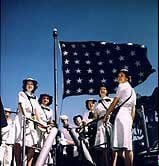
WASHINGTON (NNS) -- It was July 30, 1942 - 70 years ago - that the U.S. government realized the need for women to take their place beside their male counterparts in the Navy.
It is difficult to imagine what life was like in America in 1942: Walking was still the primary means of transportation, only a little more than half of residences had any indoor plumbing, male life expectancy was 6o years old and females 68 years old, and the rationing of every resource, including food, metal and energy sources, was the norm.
President Franklin Roosevelt signed Public Law 689, July 30, 1942, creating the Women's Naval Reserve commonly known as Women Accepted for Volunteer Emergency Service (WAVES).
"With the war imminent, members of Congress and the services started to prepare for what was likely to happen," said Regina T. Akers (PhD), a historian for Naval History and Heritage Command (NHHC) whose doctoral thesis was on the impact of the WAVES. "It had become evident to the War Department (which preceded the Department of Defense) that they would not have enough people to do all the jobs that might be required."
Though the Army was the first to accept women into their ranks, Akers saw this as an advantage. The Navy was able to learn from the Army's experiences..
"The secretary of the Navy put his foot down and said, 'Look, we are not going to do what the Army did. We are not going to have these women as an auxiliary. They are going to have access to information and we want to be able to use them in any way we can," explained Akers.
Mildred McAfee, resident of Wellesley College, was sworn in as a Naval Reserve lieutenant commander - becoming the first female officer and was selected to become assistant chief of naval personnel for women. McAfee was given the charge of the female Sailors and unlike World War I where they were relegated to nurses or yeomen (a clerical job), the women could now choose a wider variety of jobs.
"There wasn't a piece of mail processed that wasn't touched by WAVES, few pilots were trained without interacting with WAVES. About one third of the women served in the aviation community and had integrated training, which was unheard of before then," Akers said.
She explained that the changes were due to Joy Bright Hancock, a former WWI yeoman F (female yeoman) who worked in the Bureau of Aeronautics after WWI.. Hancock was commissioned during World War II by McAfee and worked her way up to becoming the WAVES director in 1946 and a captain.
According to Akers, the WAVES had other gender non-traditional Navy jobs such as pilots, dentists, intelligence and lawyers. Male Sailors started to resent the impact the females hard work had on their jobs. Though, despite the misgivings of male Sailors and that of Congress, the WAVES impressed many.
"WAVES did so well in certain ratings they could come and do the job of two or three males. One of the best compliments, McAfee often remarked, was the repeated demand for the WAVES," Akers said. "In some ratings they couldn't keep enough of them. They volunteered to serve knowing they would be in service for the duration of the war and six months after. They didn't know what the war's duration was going to be. But they took the oath and they served with great distinction."
And that distinction won over many of their former detractors.
"Even before the war was over, some of those congressmen that were so against having women in the military and opponents in the War Department and the Navy Department were considering having a permanent place for these women. Why? Because of the incredible contributions these women made," Akers said..
By the end of World War II, the WAVES had become a large part of the Navy, numbering more than 8,000 officers and 80,000 enlisted Sailors and leaving an indelible mark on the history of the U.S. Navy. Currently, the Navy employs more than 52,000 active duty women in a total force of 321,000.
The courage and sacrifices of the WAVES contributed to the U.S. victory in 1945.
"I have the greatest admiration and respect for these first-ever pioneers. I have met some of these remarkable women, most recently at our March 2012 Sea Service Leadership Association, Joint Women's Leadership Symposium. They are still going strong and setting the example," Vice Adm. Carol Pottenger, the Navy's senior-most female Sailor, said. "Our Navy today would not be the same without their sacrifices and commitment to service. They make me proud to put on my uniform every day."
Pottenger, a commissioned naval officer since 1977, is currently the deputy chief of staff for Capability and Development, at North American Treaty Organization (NATO) Supreme Allied Commander Transformation. From the days of having only one captain in the Navy to now having 35 female active duty and reserve admirals and 143 master chiefs across the diverse communities, Akers believes the WAVES would be impressed with the progress of today's female Sailors.
"This is an unprecedented era," Akers said. "I don't think the WAVES could imagine what the women in the Navy are doing today - the wide variety of duties and the types of positions that they are in. I think if those women that served during WWII could see and fully understand the female Sailors of today, they would be proud and amazed."
For more Information on the WAVES visit http://www.history.navy.mil