
The Raid from Shangri-La
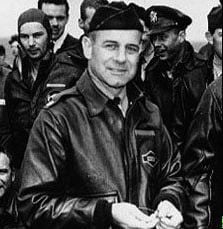
Courtesy Photo
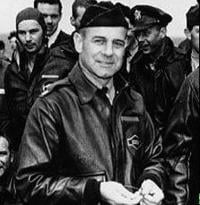
Lt. Col. James Doolittle in April 1942.
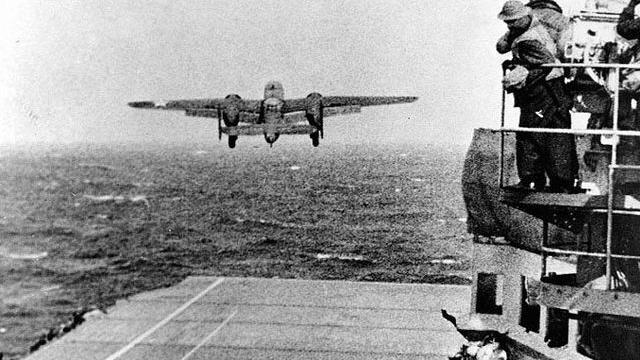
Courtesy photo
A B-25 Bomber aircraft lifts off from the USS Hornet during the Doolittle Raid in April 1942.
JOINT BASE ANACOSTIA-BOLLING, D.C. -- The air raid of Tokyo, Japan-one of the most innovative joint employments of military forces in World War II- took place on April 18, 1942. It would go down in history as the Doolittle Raid.
After the attack on Pearl Harbor, on Dec. 7, 1941, President Franklin Roosevelt asked the military to find a way to retaliate against the Japanese home islands. America sorely needed a morale boost; and striking Japan directly would cause the Japanese to reevaluate their strategy in the Pacific. But, the U.S. military had a problem: no land-based aircraft could be stationed close enough to attack Japan; and no ship-based aircraft could strike from far enough away to keep an air craft carrier out of reach of the Japanese.
As a result of some creative thinking by naval officers on Chief of Naval Operations Fleet Admiral Ernest Joseph King's staff, it was determined that U.S. Army Air Forces (USAAF) bombers might be able to take off from an aircraft carrier. King had the naval officers brief General "Hap" Arnold, chief of the USAAF, to see if he was interested in pursuing the idea. He was very interested; as a result, the First Special Aviation Project was established.
Shrouded in secrecy, Lt. Col. James Doolittle, USAAF, and U.S Navy Capt. Donald Duncan headed up the project. Both men concluded that the B-25 bomber was the right, and only aircraft for the job. It was the only aircraft capable of taking off in fewer than 300 feet, with a potential range of 2000 miles. Doolittle focused on modifying the B-25 to meet the unique mission requirements. The B-25's selected for the mission were stripped down; defensive guns were removed and additional fuel tanks were added. The Norden bombsights in the nose of the aircraft were also removed, because they were considered a technologically critical wartime instrument.
Duncan, on the other hand, spent time coordinating the naval aspects of the raid. The pilots needed training on aircraft carrier takeoffs; and the Navy had to get the USS Hornet into the Pacific. On March 20, the USS Hornet arrived at San Francisco. On March 31, the planes were craned onto the flight deck in the order they would take off. There was no room to rearrange them, and it was impossible to send them below to the hangar deck. The joint mission departed California at the beginning of April, and on April 12, the carrier joined the USS Enterprise Task Force several hundred miles north of the island of Midway.
On April 18, Japanese picket ships spotted the task force 400 miles before the intended launch location. The Japanese ships were quickly destroyed by the Enterprise Task Force; but the Hornet was afraid that its position may have been compromised. As a result, the 16 B-25�s decided to take off, even though the added distance would leave them dangerously low on fuel for the second leg of their one-way mission. All planes safely launched within one hour, and flew at low-level by dead reckoning toward their assigned targets to avoid detection by Japanese radar. By midday, the B-25s arrived above their intended military and industrial targets in the cities of Tokyo, Yokohama, Kobe, Nagoya, and Osaka.
The B-25s encountered enemy antiaircraft fire, and some Japanese fighter aircraft, but none were seriously damaged. Dangerously low on fuel, 15 bombers proceeded towards China, their intended landing point; one proceeded to Vladivostok, Russia. The China-bound bombers all crash-landed either along the Chinese coastline, or in eastern China. The 16th landed safely in Vladivostok; the plane was confiscated, and the crew interned.
Of the 80 crewmembers taking part in the Doolittle Raid, 64 returned to fly again. Lt. Col. Doolittle was awarded the Congressional Medal of Honor and promoted to Brigadier General for his efforts. On June 28, 1942, the rest of the crewmembers were awarded the Distinguished Flying Cross at a ceremony at Bolling Field, which is now part of Joint Base Anacostia-Bolling.
The use of land-based bombers confused the Japanese. Directly after the attack, when President Franklin Roosevelt was asked from where it originated, he replied, "They came from our secret base in Shangri-La." Although the raid inflicted minimal damage to its Japanese targets, it boosted American morale tremendously. The Japanese recalled many units in order to protect the home islands. The larger strategic impact to the war in the Pacific was significant. It infuriated Japanese Emperor Hirohito, who then tasked Admiral Yamamoto to hastily plan an attack on Midway.