

Air Force veteran Valerie Stemac has been putting pen to pad since she was 12 years old. She used this art form, as most do, as a way to express herself.
“It was just the thing I did, never for public consumption,” Stemac told me while sitting at a Starbucks near the Capitol Hill neighborhood on a Sunny day. “I wasn’t writing it for anyone to read it. I was writing it because I was an ‘antsy’ 12-year-old. You know.”
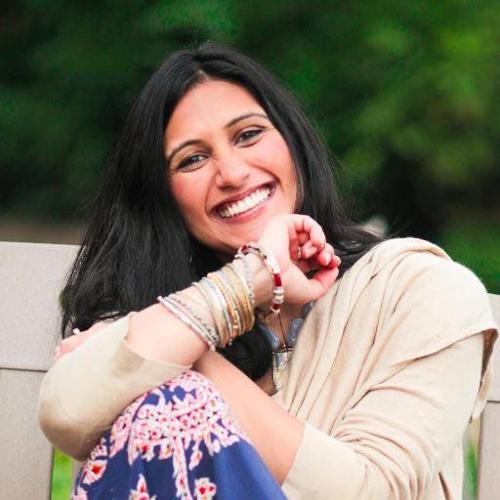
Stemac, a little taller than 5 foot 3 inches with blond hair, has a colored tattoo of a sunflower on her forearm — a sign of hope and endurance, she said.
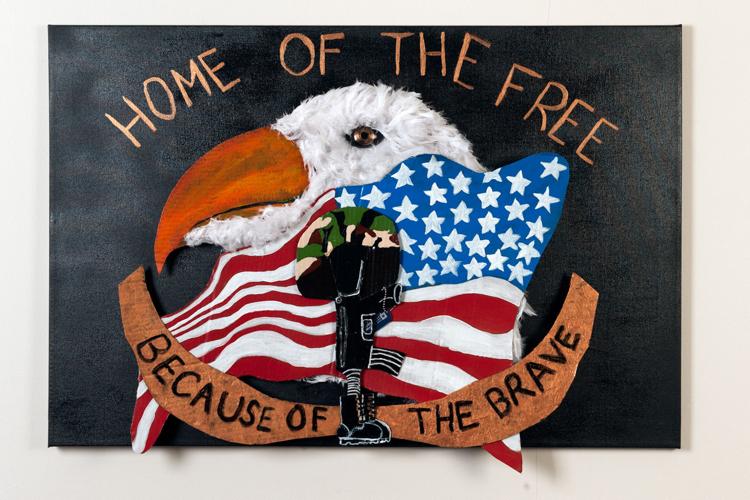
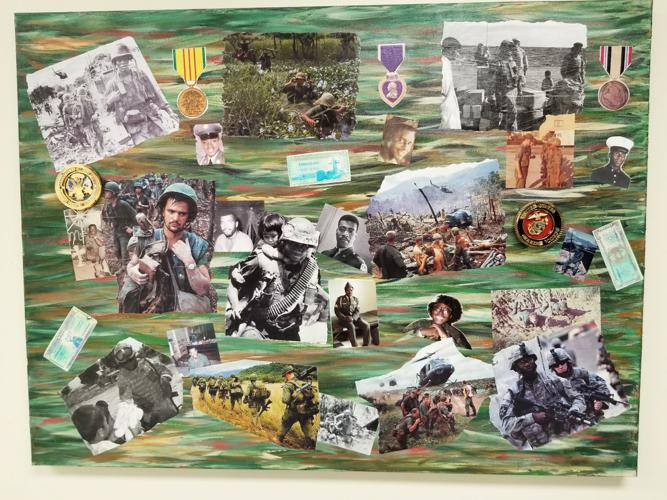
Stemac isn’t an antsy 12-year-old child writing for herself anymore, but rather a mature woman who now travels throughout the D.C., Maryland, Virginia area sharing her story through poetry and visual art.
In a poem called “Untitled,” she writes:
“When I say that I am okay
I’m not saying that I am okay
I’m saying that it is all still
Too messy and complicated to put into words”
Stemac is a fellow at Warrior Writers, a nonprofit organization that helps veterans to express themselves through art, where she leads a writing workshop in Lorton, VA. Lovella Calica, founder and director, started the nonprofit in 2007 in Philadelphia. The organization exists to create “ a safe space for veterans to come together to write, using writing and art to process, reflect, heal and to build a community,” explained Calica in a YouTube video posted on the organization’s website.
During our conversation, as her skin turned patches of red, Stemac nervously told me that she was diagnosed with PTSD and that she had experienced sexual trauma — an experience that’s ravaged her body, her soul, and mind.
“I was diagnosed with PTSD from non-military and military sexual trauma,” said the former Airman 1st Class, 779th medical group mental health technician. “It brought me to this intensive-outpatient program where it was an alternate duty location, where I went to groups six hours a day, five days a week.”
Not revealing too much, electing to allow the past to stay where it lie, she elaborated on the journey that led to an outpatient program where she is now. While at that program, Stemac crossed paths with Seema Reza. For Stemac, Reza is the bridge that connected her with Warrior Writers and another organization called Combat Paper, a non-profit that helps people to transform military uniforms into handmade paper.
“I got hooked in with her and everything she was doing with the treatment facilities and then she said, ‘Hey, there is this group that’s coming into the USO you can come and hang out with us for a week. We are going to be cutting up military uniforms and turning them into paper,’ ” Stemac shared.
Reza is a poet, entrepreneur, speaker and author. For nearly a decade, she’s used poetry as a way to help civilians and veterans struggle through their problems and perhaps to become better human beings. Reza shies away from saying that she’s responsible for people taking ownership of how they experience the community she helps to form through art. Instead, she understands herself to be a guide, one who walks along the community helping them see their beautiful struggle, helping them to put words to pain, loss, and redemption.
Reza, like the people she disciples, found solace and transformation through writing poetry at a difficult time in her life. “There was this one difficult year where my destructive, sort of dysfunctional abusive marriage was falling apart and my father died suddenly and all the ways that I’ve been pretending to be something I was not fell apart,” she explained.
It was during that time she realized she needed to be in community. Reza was already working at the old Walter Reed Army Medical Center, once located on Georgia Ave. in NW Washington, D.C., and the Mologne House Hotel teaching arts and crafts.
“I realized that people were coming to our sessions not just for learning the craft and learning how to write poems or how to make art, but to connect with other people, which was something they were missing a lot through the experience of mental illness, mental or physical [abuse],” she said.
Though she uses art as a way to help those who are marginalized to form communities and find a voice, Reza is adamant that what she does isn’t art therapy. Art Therapy, especially in military clinical settings, is usually taught by someone who is a trained therapist. Reza isn’t a therapist. She’s an artist and her writing sessions are ritualistic and restorative. At the beginning of each class, according to Reza, the class in concert, recites words that affirm the purpose of the meeting, what they can expect and how art and healing go hand-and-hand.
“The whole room comes together and does it,” she said. “We are warming the room and then it’s like, OK,we are going in.”
Writing poetry is a rigorous process. It is through this process of finding the right words, Reza contends, helps the person realize something about themselves — that they have a voice. However, Reza said she’s not responsible for giving people a voice, but, through the process of learning to express themselves through poetry, helps them to “amplify their voices.” Working with and continuing to educate herself about traumatized people, Reza has learned that they respond to it in four basic ways: anger, grief, fear, and shame. She said the first three are “usually addressed in a traditional therapeutic setting.”
“But shame is a little bit trickier,” she explained. “Shame requires a community of people, of peers, who hear you saying your truth and [choose] to accept you anyway. That is only to overcome that and for that, we have to move outside of the clinic setting.”
Art in this context is used to transport the students outside the clinical setting, Reza said. “The piece of art; the piece of writing becomes this sort of vehicle through which you show yourself. It’s a little easier to enter into your truth or to share your truth when you’re like, ‘hey, here’s this beautiful thing I made and this is what it is saying.’”
Reza’s understanding of how art helps to amplify a person’s voice, which helps them to navigate painful realities, are concepts that Beryl Brenner, recreation therapist and art therapist at the Brooklyn, NY, VA Harbor Healthcare Systems, agrees with and more.
Brenner, who teaches veterans to do all kinds of art, has been working in the VA system for more than two decades. She’s worked with African-American, Vietnam, transgendered, young and old, men and female with PTSD and military sexual trauma, homeless and healthy veterans, she said.
Brenner said she uses it to teach veterans “creative self-expression, self-insight, for helping them to reduce anxiety, depression, to reduce isolation, to increase cultural and intellectual stimulation and I try to give them a voice.”
The VA uses what is called alternative healing practices in a majority, if not all, of its medical centers around the United States. Some of those practices are Native American Healing practices, acupuncture, Tai Chi, and Qigong. The Brooklyn VA Medical Center is one of the few VA’s in the country that has Art Therapy as one of those practices.
There are times when humans experience difficult moments in their lives, and the arts, Brenner said not only provides the avenue for those who participate to have voice — or amplify it, as Reza said — but to form “a new voice,” one that is self-aware and able to articulate their realities and to celebrate triumph over trauma.
“Whatever is going on within you the art therapy process help you to bring it out,” said Brenner. “Even I, after all these years, am astonished by how it helps a person to open up and gain self-understanding. It is a very helpful process.”
John Palks, the supervisory recreation therapist at D.C. VA Medical Center, has worked with Veterans with mild to severe forms of PTSD, said he uses the arts because they’re non-threatening. He said the arts (Palks helps them to learn painting) is a mechanism that keeps their PTSD from escalating. Veterans come early and stay late, he said.
“They love the camaraderie,” Palk said. “They support each other not only in their artwork but in each other’s lives.”
Recounting an encounter he had with one of the veterans who attended the class, whose artwork was featured in the VA veteran art show, he said the person told him that the art class and the work that he has done has changed his life.
“He told me the art had turned his light on,” said Palk.
I asked Palk what he thought he meant by such a statement. He said veterans with PTSD symptoms struggle with isolation and are “guarded” and the fact that his art is on display for all to see made him into a public person.
Valerie is now a public person. Like that man, she finds joy in sharing her story. Stemac shatters shame with her new, amplified voice.
Stemac remembers the first time she stepped on stage to perform what she had written in private. She said it felt like she had taken the audience on her journey. It felt like home, she said. In that moment, she had created her safe space, she remembers.
“Sometimes it’s just saying words,” she said. “Sometimes it is that feeling of community and of communion. It is always terrifying, every single time.”
However, for Stemac there is a reason to fight the fear to share: “If you’re telling your story with fearless honesty then you may make someone else feel less alone. They might hear themselves in what you’re saying.
The work, as Reza calls it, has changed Stemac. It didn’t take away her PTSD or the pain of her past experiences, but it, “the work,” did provide her with a community of artists who don’t feel ashamed anymore, ones who are fiercely honest.