
Strategy
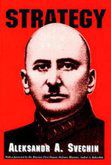
Strategy by Aleksandr A. Svechin. First published in the Soviet Union in 1927, and available in English first in 1992 with a reprinted version in 1999. Published in the west by East View Publications, Minneapolis, Minnesota. 367 pages.
The Soviet Union under the heinous regime of Joseph Stalin had within it a cadre of officers considered to be important thinkers in military tactics and strategy. Many would be liquidated by Stalin in a purge of military officers he considered a threat to his regime on the eve of World War II. They include the subject of this book, General Aleksandr Svechin, a prolific writer on military strategy whose masterwork is “Strategiia” was so influential it was kept secret in Soviet military archives and was not translated into English until 1991.
What makes Svechin’s book, “Strategy,” important is the combination of political, social and economic factors in warfare, combined with a careful analysis of western military classics from a communist perspective. It discusses the means by which a nation must economically be prepared to sustain long-term warfare. This sustainability is what we call the military-industrial complex today, yet he wrote this in 1927. Readers will be treated to a critique of American Civil War leaders with President Lincoln respected for his flexibility in changing strategy but referred to as a petit-bourgeois, a derisive term to refer to middle-class obsession with consumption and materialism. Svechin understands the indivisibility of politics and military strategy, and has written copious commentaries on Prussian theorist Carl von Clausewitz (1780-1831), his classic text “On War,” and Clausewitz’s dictum that “war is politics continued with other means.”
Other ideas are the geographic dispersion of military industries, and the argument that the Soviets should not invest highly in a navy, with Russia being a landmass with little access to ports. He also has a healthy respect for Russia’s adversaries such as Napoleon, the Japanese, and many more. Studying Svechin is not easy and requires re-reading the text more than once, but for those with an absolute passion for alternative military thinking, strategic thought, and tying together many strands of western into Soviet strategic thought, it is a great read.
Editor’s Note: Cmdr. Aboul-Enein writes a regular book column for Military District Washington newspapers. He wishes to thank Dr. Paul Severance for introducing him to Svechin’s work and providing him the guidance needed to study this complex work of Soviet strategy.