
Patton, Montgomery, Rommel: Masters of Battle
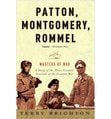
Patton, Montgomery, Rommel: Masters of Battle by Terry Brighton. Published by Random House, New York. 2008, 406 pages.
British historian Terry Brighton is curator of the Queen’s Royal Lancers Regimental Museum. His latest book is unique in that it ties the biographies of three World War II field commanders in one volume, U.S. Army Gen. George Patton, British Army Gen. Bernard Montgomery and German Field Marshal Erwin Rommel. Most historians would argue that the biography of one cannot be written without mentioning the other two. This volume not only combines the three, but is weaved in a delightful fashion that reveals their military tactical interaction.
Readers will learn that all three were students of war, reading the works of Carl von Clausewitz at their respective military academies. Each took from Clausewitz what best suited their styles of command. For Rommel it was “Fingersptizenguhl,” an instinctive sense of the battle situation; for Patton it was the choice between audaciousness and being careful; and for Montgomery it was his genius for what Clausewitz calls “Materialschlact,” the slow buildup of material resources and manpower.
The book opens with a biography of the three starting with Rommel who was born in 1891, and who hated school but loved airplanes and airships. If the infantry had not accepted Rommel into the 124th Wurtemburg Regiment as a cadet, he may have become a Zeppelin engineer. Though Rommel was undistinguished in the Kriegschule military academy, he earned high marks in leadership. In 1914, the young lieutenant saw World War I as a defensive act against the hostile alliance of Britain, France and Russia.
Montgomery was born in 1887, in London, the fourth child of a member of the clergy who would become a consecrated bishop in Tasmania, off the Australian coast. Like Rommel, Montgomery had difficulties in school and entered the Royal Military Academy at Sandhurst, gaining an assignment to the Royal Warwickshire Regiment, seeing service in Peshawar in what is today the Northwestern Frontier of Pakistan. He would remain in British India until the outbreak of World War I.
Patton was born in 1885 to a military family and was proud of his grandfather, a Confederate colonel, and his grand-uncle who was killed at Gettysburg. Patton also saw many academic challenges, we know today he suffered from dyslexia, and used his appointment to the Virginia Military Institute as a stepping stone to enter West Point.
The book continues to discuss the intellectual influences of each military leader. World War I would shape each towards an advocacy for future warfare based on the tank, the aircraft, and the development of new tactics. Rommel would see action in the mountains of Italy in World War I, receiving Germany’s highest decoration. Montgomery would be injured and serve the rest of the war as a staff officer seeing the senseless slaughter of whole units without any military planning. Patton although late in the war would witness American unpreparedness, and would attempt to improve on fighting the technology he saw in Europe, chiefly the tank. All three would ponder, read, reflect and even write about future warfare. Rommel would be among those disgruntled military officers who felt Germany was stabbed in the back and would succumb to the rise of Adolf Hitler, who was attracted to Rommel for not being among the Prussian military aristocracy. Rommel was also praised for his famous book “Infantrie Grieft An,” a narrative of the tactics of his World War I experiences. While Germans were reading his book, Rommel was reading a little known book by Heinz Guderian, “Achtung! Panzer!” In it Guderian advocates transferring infantry tactics to armor. Patton also used the interwar years to think, and wrote for the “Cavalry Journal,” getting in trouble for pressing the case for the tank.
The first encounter among the three was between Rommel and Montgomery. It was in 1940, and Rommel was utilizing blitzkrieg tactics during the German occupation of France, leading Montgomery to plan for the evacuation of British forces there. These were heady days for Rommel and Hitler, but some of Hitler’s henchman like Martin Bormann despised Rommel.
A chapter covers the Rommel’s Africa campaigns, and the conquests of the Deutsches Afrika Korps (DAK). He would reverse the losses incurred by Italian units, and advance into Egypt, causing panic among the allies. Rommel used leadership, reconnaissance, deception, and tactics to outmaneuver British generals in Cairo. This worked until the arrival of Montgomery who reinstalled morale, used his charisma, and developed a cult following among his troops so they would focus less on the phantom called Rommel. Germans used Rommel’s successes as propaganda and to distract the German population from the disasters in Russia. Montgomery, known affectionately as Monty, also understood that a desert war would be one of attrition, preparation, and supply. A personal insight, Montgomery kept a poster of Rommel hanging in his command post and took with him throughout the North African campaign, wanting to study the face of his adversary. Readers will follow how the Afrika Korps, which despite winning battles could ill-afford losses, and the entry of Patton in Operation Torch, which would tip the scale in the allies favor. Late 1942 proved to be a turning point for the Allies, as American forces were learning from German defeats in Tunisia, and Monty defeated the Afrika Korps in the Battle of El-Alamein, keeping Egypt safe from an Axis thrust.
Patton and Montgomery would fight Rommel through Italy, and would then re-engage him after the invasion of Normandy in 1944. By this time, Rommel would grow distant from Hitler, and would be implicated in a plot to assassinate the Fuhrer. Hitler would give the Field Marshal a choice between suicide and an honorable burial, or a trial. Rommel understood he would likely be killed before any trial took place took a vial of poison in an SS car. His funeral was a charade for his wife and son Manfred, and was done to bolster the regime, and morale of the German people. One of the interesting aspects of the book is the relationship between Rommel and Hitler; how Rommel saw that Hitler was delusional towards the end and cared nothing for the preservation of what remained of Germany.
The book also covers how Patton and Montgomery fought each other bureaucratically and competed for commands. Patton’s numerous missteps are also discussed, from his slapping of a solider suffering from post-traumatic stress to his remarks against the Soviet allies. His punishment was viewed by the Germans as a ruse, as they could not believe the Americans would hold back their best field commander and focused intensely on a fictional army created around Patton, and distracting the Germans from actual preparations for D-Day.
This is an excellent book that reads well, it is highly recommended for those interested in World War II, military leadership, and armor tactics.
Editor’s Note: Cmdr. Aboul-Enein has taken hundreds of Marines of the 24th Marine Expeditionary Unit on Professional Military Education tours of the Battle of El Alamein in Egypt while a Lieutenant in 1998. He is a frequent contributor to ARMOR, and is working with the magazine on an eleven part series on the writings of the father of Iraqi sociology.