
Operation Typhoon: Hitler’s March on Moscow, October 1941
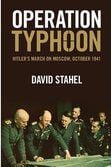
Operation Typhoon: Hitler’s March on Moscow, October 1941 by David Stahel. Published by Cambridge University Press, 2013.
The Eastern Front of World War II was where Hitler’s armies met its demise and the numbers are staggering. Numerous battles, field commanders, and armed formations can take years to grasp, however no study of warfare is complete without an immersion in World War II battles generally and Russia’s Eastern Front specifically. To give you an idea, the June 1941 German invasion of the Soviet Union, known as Operation Barbarossa, would involve three army groups and 3 million men. This book is about the reinforcement of Army Group Center, which formed the blitzkrieg fist and was supposed to take Moscow.
This reinforcement by Hitler in October 1941 would be code-named Operation Typhoon and would see 1.9 million men under the command of Field Marshal Feodor von Bock, making him commander of one of the largest German tactical formations of the war. The author, David Stahel, is well versed on the book’s subject and has authored three previous books on various aspects of the eastern campaigns of World War II. “Operation Typhoon” is supposed to be part of a multi-volume collection he has published and plans to continue publishing. What makes his particular account interesting is the multi-disciplinary way he analyzes the operation, from intelligence and logistic to military, technology, and medical. You will appreciate how the Germans blinded themselves by believing their own propaganda, and what is incredible is how the Wehrmacht had such faith in technology that some ignored the writings of Prussian strategist Carl von Clausewitz, who observed how the Russian terrain and weather would impact forces in previous battles leading up to Napoleon’s retreat from Moscow. Facing Field Marshal von Bock, was Soviet Field Marshal Georgi Zhukov, a hard commander, and one of the few who could say “no” to Soviet dictator Joseph Stalin. Stahel reveals that Zhukov’s preparation of the defense of Moscow required him not to destroy the German army but rather to deny them their objective long enough for the Russian winter to work its violence on ill-prepared German troops.
The book contains such details as when the Germans organized teams to change the rail gauges to fit German trains, they did not appreciate the wider Russian gauges which allowed trains to travel longer distances and hence had to create depots for Germans trains to make frequent stops. Other details include the impact of diseases, such as typhus, on the troops. Pages detail the slowing of German Panzers and the failure of German military planners to properly supply such a massive army formation. The author breaks down the key battles of Operation Typhoon, such as the battles of Vyazma and Bryansk as well as the quarter million Russian women and teens set to work digging the Mozhaisk Defensive Line in front of Moscow; the number of mines planted and distances dug defies imagination. There are discussions of the performance of the Soviet T-34 and KV-1 tanks versus the Panzer Mark III and IV tanks and as you read, you will gain an appreciation for industrial output. In three months during 1941-1942, the United States produced the same amount of tanks and trucks as the Germans did in a year. Hitler was shown this report and German planners were informed of this attritional war but were now committed to their course. My only criticism is that I needed to consult U.S. Military Academy at West Point maps on-line to follow the individual battles. Having published books myself, I understand how maps drive up costs and will therefore excuse the author. I also recommend that you read books on the Soviet Front, like “Ostkrieg: Hitler’s War of Extermination in the East” by Stephen Fritz, and Hitler’s Panzers: The Lightening Attacks that Revolutionized Warfare by Denis Showalter, and maybe a biography of Soviet Field Marshal Zhukov before tackling this book. You also may wish to watch a few documentaries, like “Soviet Storm, from Content Media Corporation, a multi-part series on the Russian Front in World War II available on YouTube and Hulu.
Editor’s Note: Cmdr. Aboul-Enein has just published a co-authored book with Naval Institute Press entitled, “The Secret War for the Middle East: The Influence of Intelligence Operations during World War II,” this fall. He is working on his fourth book, “Reconstructing a Shattered Egyptian Army: War Minister General Mohamed Fawzi’s Memoirs, 1967-1971,” which will be published this coming summer. Aboul-Enein teaches part time at the National Defense University, and wishes to thank his Teaching Assistant, Ms. Tamara D’Amico, for her edits that enhanced this book review.