
Observances Highlight the Importance Of Eye Care
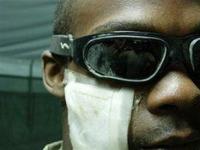
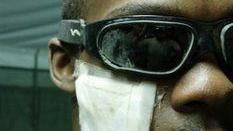
Army Pfc. Douglas K. Phillips a member of the 3rd Infantry Division’s Company A, 1st Battalion, 15th Infantry Regiment, deployed to Durai-ya, Iraq, in May 2007, shows the damage to his face and his eye protection from a small-arms attack. Phillips credits eye protection with saving his eye. - Credit: U.S. Army photo by Sgt. Natalie Loucks
Protecting the eyes is important, and the Departments of Defense and Veterans Affairs are playing a leading role in promoting research and efforts to prevent, diagnose and treat eye injuries and diseases.
The Department of Defense (DOD)/Department of Veterans Affairs (VA) Vision Center of Excellence (VCE) opened at Walter Reed National Military Medical Center (WRNMMC) last year with a mission of leading and advocating programs and initiatives to improve vision health, optimize readiness and enhance quality of life for service members and veterans, according to VCE officials.
In 2012, improvised explosive device (IED) blasts in Afghanistan caused 78 percent of all battlefield injuries. In Iraq, the same blasts caused 84 percent of all eye injuries, the VCE reports. They add, “Serious eye trauma from Operation Iraqi Freedom and Operation Enduring Freedom is the second most common combat injury and follows only hearing loss, with 16 percent of all casualties suffering eye damage ranging from distorted vision to blindness,” according to the DOD’s Armed Forces Health Surveillance Center.
July was Eye Injury Prevention Month, and service members aren’t the only individuals who need to protect their eyes, which is why August is observed as Children’s Eye Health and Safety Month and Cataract Awareness Month and September is Sports and Home Eye Safety Month.
The U.S. Department of Health and Human Services reports that in the United States, more than 2,000 eye injuries occur every day. One hundred of these result in one or more days of lost work, according to the Centers for Disease Control and Prevention (CDC). The U.S. Department of Labor, Bureau of Labor Statistics, adds that more than 90 percent of eye injuries are preventable with proper precautions and effective eye protection.
Army Maj. (Dr.) Marcus Colyer, a staff ophthalmologist at WRNMMC, said protection is the best way to prevent eye injuries, in addition to avoiding risky activities.“Wear eye protection and avoid high risk activities that predispose you to eye injury, [such as] playing with fireworks, hammering metal on metal, etc.,” he said.
He also said exposure to the sun’s UV (ultraviolet) rays can cause damage to the eyes.
“The cornea and lens of the eye have natural UV protection, but chronic UV exposure can increase the risk of cancers of the ocular surface, such as squamous cell carcinoma, as well as skin growths, called pterygium,” Colyer explained.
“Macular degeneration, the most common cause of blindness in Americans over the age of 65, is probably due in part to UV higher wavelength as well as genetics,” he added.
For the outdoors, doctors recommend using eyewear that provides as close to 100 percent eye protection from UV exposure as possible. The tint of the lens has nothing to do with the UV protection of the lenses, they add. A clear lens with 100 percent protection is better for your eyes than a dark, tinted pair without UV protection. In fact, dark lenses without UV protection can be even worse for your eyes because they allow more UV light to get into your eyes due to your pupils being larger. There are many safety glasses on the market that protect eyes from UV exposure, and all Military Combat Eye Protection, even with the clear lenses in place, block 99.9 percent of all UVA and UVB light, according to Michael D. Pattison, Occupational Vision Optometrist at the U.S. Army Public Health Command.
Cataract formation is another condition due in part to UV exposure.
According to Colyer, cataracts are a normal aging process in the eye. The average age a patient might require cataract surgery, the most commonly performed surgery in the United States, is 75. There are approximately 50 cases performed at WRNMMC each month, added Coyler.
“Factors that increase the rate of cataract formation include genetics, environmental conditions and trauma,” he said.
In addition to proper safety eyewear, early detection and treatment of eye disease and other eye conditions is essential to maintaining good vision throughout life, Coyler explained.
He said some of the signs and symptoms of eye damage and disease include diminished vision, blurriness or distorted vision.
“Blurriness of vision is usually a sign of changing eyeglasses prescription, but lost vision (areas of splotchy or missing vision), distorted vision (a doorway looks crooked in a spot), or darkened vision are all signs of potentially serious eye disease and require evaluation,” the doctor explained.
According to the American Academy of Ophthalmology‘s website, staring at your computer screen, smart phone, video game or other digital devices for long periods won’t cause permanent eye damage, but can cause eyestrain.
“Normally, humans blink about 18 times a minute, but studies show we blink half that often while using computers and other digital screen devices, whether for work or play,” according to American Academy of Ophthalmology officials.
They recommend sitting about 25 inches from the screen, reducing the monitor’s glare, and periodically shifting your eyes to look at an object 20 feet away, for 20 seconds every 20 minutes. They call it the “20-20-20 Rule.”
In regards to children’s eye health, the American Optometric Association recommends eye examinations for infants and children at six months and 3 years of age. For school age children, eye examination is recommended before first grade and every two years thereafter. Infants at higher risks, for example from family history, should have an examination as soon as medically practicable. Similarly, children with symptoms or higher risks should also be examined more frequently.
For more information about the DOD/VA Vision Center of Excellence, visit http://vce.health.mil/.