
Navy Lifts Moratoriums on recovery of submerged large artifacts; permitting regime still applies
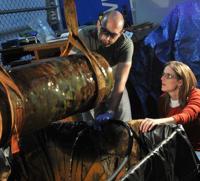
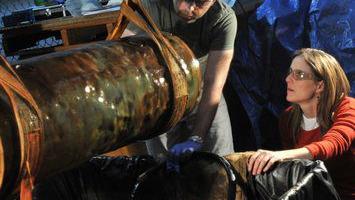
Paul Mardikian and Claudia Chemello, from Terra Mare Conservation, document the state of a Howell Torpedo at a Naval History and Heritage Command warehouse to develop a conservation plan for the artifact in 2013. The Navy has eased its moratoriums on recovery of submerged macro artifacts and aircraft. The decision takes into account the care of the irreplaceable cultural resources. While the moratoriums are lifted, existing state and federal requirements, including the prohibitions contained in the Sunken Military Craft Act and associated permitting regimes, remain in place. - Credit: U.S. Navy photo by Mass Communication Specialist 1st Class Gina K. Danals
The Navy has eased its moratoriums on recovery of submerged macro artifacts and aircraft, officials with the Naval History and Heritage Command announced July 8.
While the moratoriums are lifted, existing state and federal requirements, including the prohibitions contained in the Sunken Military Craft Act and associated permitting regimes, remain in place.
“I have determined that such a blanket prohibition is untenable and too inflexible given our responsibility to the public. I am lifting the standing prohibitions put in place earlier,” said Samuel Cox, the director of NHHC, who arrived in his new post in late December 2015.
“My primary consideration will be to maintain the sanctity of any wrecks that constitute the last resting site of American Sailors who made the ultimate sacrifice. For wreck sites that fall short of those criteria, the educational value to the American public of recovering the wreck must be of such great significance as to outweigh the disturbance to the historic and archaeological record of leaving the wrecks in place; this will be a high bar. Any recovery must also involve negligible cost to the U.S. Navy, and must be with the legal consent of all appropriate federal, state and local government organizations responsible for environmental and historic preservation,” said Cox.
Cox met with Navy leaders, industry members and curatorial staff members before coming to his decision. His determination to proceed cautiously takes into account the care of the irreplaceable cultural resources.
The moratorium was installed in mid-2014 by the previous NHHC Director, who wanted to verify that reliable, systemic conservation and preservation process measures were in place and adhered to. Those process measures included sufficient resourcing and planning assurance. Previously recovered artifacts still await preservation, conservation, or restoration. Further, one of the responsibilities of the command remains to balance the need to respect cultural heritage and the need to tangibly convey the Navy’s contributions and sacrifices to the American people.
For more detailed guidelines, please visit http://www.history.navy.mil/content/dam/nhhc/about-us/services-and-policies/pdf/Guidelines%20for%20Archaeological%20Research%20Permit%20Application.pdf