
Hail to the Chiefs: April 1 Marks 120th Anniversary of Chief Petty Officer
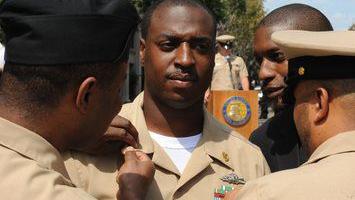
A Naval District Washington chief petty officer is pinned by shipmates at the Navy Memorial in September 2012. This year marks the 120th anniversary of the rank of chief petty officer. - Credit: U.S. Navy photo by MC2 David Giorda
Ask the Chief. Those three simple words give voice to the high level of respect accorded those select few men and women who’ve earned the right to “wear the anchors.”
Chiefs, Senior Chiefs and Master Chiefs must consistently demonstrate leadership, composure, confidence, critical thinking, competency, fitness and knowledge.
They must be subject matter experts in their technical field and communicate Navy standards and information, including its traditions, history and heritage.
They train Sailors-enlisted and junior officers-and they bridge the gap between enlisted personnel and commissioned officers.
“Good Chiefs, like ours, remember their roots as junior Sailors,” said NAS Patuxent River Executive Officer Capt. Ben Shevchuk. “We can trust them to coach us so that we relay a leadership message to that big group of our workforce in a way that’s effective with them. The Chiefs are always able to add that reality check to what we’re trying to accomplish.”
Ask any Chief what they believe is their top job priority and they’ll immediately tell you, it’s taking care of their Sailors by giving them every tool they need to personally and professionally grow and accomplish their mission.
“Taking care of my Sailors means going above and beyond training them in their field,” said Naval Test Wing Atlantic Command Master Chief Tim McKinley. “It includes learning what makes them tick and knowing how their home life is. If you care about your Sailors from a human perspective as well as a leadership perspective, they’ll perform better for you and there’s no end to what they can do; no obstacle they can’t overcome.”
McKinley recalls a time when he was a junior Sailor and how his Chief stepped in to help him.
Unable to correct an administrative payroll error that left him with a zero sum paycheck, McKinley said his Chief pulled $400 out of his own pocket and paid McKinley’s rent that month.
“It took me a while to scrape together that money, and when I went to pay him back, he wouldn’t take it,” McKinley said. “He told me I needed it more than he did and that I should just remember to do the same for someone else someday when I was in a position to do so.”
McKinley made good on that promise years later when he himself, as a Senior Chief, bought a couple hundred dollars worth of groceries for a young Sailor in his charge who found himself down on his luck.
“I told him the same thing my Chief had told me years ago-pay it forward for someone else,” McKinley said. “I felt like a Chief that day.”
Aviation Machinist Mate 2nd Class David Ursua knows firsthand what a difference a Chief can make in the life of a Sailor.
Just out of Afghanistan, Ursua arrived at Pax River in 2012 expecting to be discharged for high-year tenure. He had missed promotion to petty officer second class by only two points on a recent advancement exam and Chief Aviation Electrician Mate Evaristo Bonilla, deciding to take a closer look, uncovered an oversight in Ursua’s final multiple calculation.
With a little effort, the situation was rectified and the Sailor’s final score was raised, earning him the promotion. Today, Ursua is with Test and Evaluation Squadron (VX) 1.
“Chief Bonilla saved my career,” said Ursua, who has a wife and a child. “I don’t know what I would’ve been doing if I left the Navy. I look up to him and want to be like him when I make Chief myself one day.”
Bonilla doesn’t take much credit. Instead, he believes he was just doing his job.
“I may not always be able to help,” he said, “but I want my Sailors to know I tried. Having gotten to this level is personally rewarding. I look at my job differently and feel compelled to impact the careers of others.”
In fact, all of the Chiefs interviewed for this article credit former Chiefs in their own careers with setting them on the right course.
Naval Test Wing Atlantic Chief Navy Career Counselor Ryan Marlatt entered the Navy after 9/11. He had already graduated from college and just wanted to serve; but had no intention to stay.
“The Chiefs I had in my leadership saw things in me I didn’t see in myself,” Marlatt said. “They nudged responsibility in my direction and let me run with it.”
Marlatt made Chief in just eight years.
“Making Chief for me was a tribute to them,” he said. “My goal now is to give others the same chance I had. Others believed in me and I want to take that and keep going with it.”
Chiefs know they’re not alone-from their Sailors who do the “heavy lifting,” to their mentors and leaders who instill the drive and confidence they need to be successful; but, especially because of their Navywide fellowship of Chiefs, poised and willing to help at a moment’s notice.
“Wherever I am, whatever I need, I can pick up a phone, talk to a Chief and get help,” said NAS Pax River Command Master Chief William Lloyd-Owen. “No one does it by themselves. We know we can always rely on each other.”
Senior Chief Air Traffic Controller Joseph Stone knew that back in 2004 when he placed a call to Chief Hospital Corpsman Kevin Campbell, while serving aboard NAS Joint Reserve Base in Ft. Worth, Texas.
Campbell was an independent duty corpsman assigned to the base clinic and Stone had a Sailor with a medical condition that required surgery sooner than normal channels were allowing. Without the surgery, the condition would’ve led to serious back complications, forcing the Sailor out of the Navy.
“Chief Campbell took care of it,” Stone said. “He diagnosed her, recommended surgery, walked down the hallway and explained the situation to the TRICARE [representative] himself, and that Sailor had the surgery she needed within one month instead of six months. All with one phone call.”
Today, the Sailor is a petty officer first class, successful in air traffic control, Stone said; and Campbell is a Master Chief with, no doubt, a few stories of his own to tell.
Becoming a Chief Petty Officer involves a two-phased yearlong development and training process, known as CPO365 that tests prospective chief petty officers mentally, physically and professionally.
After passing an advancement exam, new chief petty officers are selected by a board process and those selectees enter phase two of CPO365. Upon completion, they receive their anchors at the Chief Petty Officer Frocking Ceremony, a tradition unique to the Navy.
During this Navywide ceremony, held each year on or near Sept. 16, family members and friends pin the gold-foiled anchor insignia onto the uniform of each new Chief.
Senior Chief Aviation Electronics Technician Alan Gregorio has been in the Navy for 24 years, one of five in his family to have served. The only one still on active duty, Gregorio was the second to make Chief, but the only one to make Senior Chief.
He still remembers his pinning ceremony which took place on USS New Jersey.
“Because people trusted me and gave me the training and guidance I needed, I was able to switch from that blue shirt to khaki,” he said. “It was the best day of my naval career.”
Chiefs are an uncommon breed of Sailor.
Master Chiefs account for only one percent of Navy personnel and Senior/Master Chief combined cannot exceed three percent.
It is estimated that, in total, the entire Chief community accounts for no more than 10 percent of the Navy’s more than 300,000 population.
“There’s a reason why the Chief selection is so discerning,” Shevchuk said. “The Navy only wants those who have demonstrated that they can successfully transition from workforce to a level of management.”
Happy 120th anniversary, Chiefs. Well done, and well deserved.