
#FlashbackFriday World War II Ends on September 2, 1945
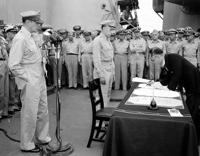
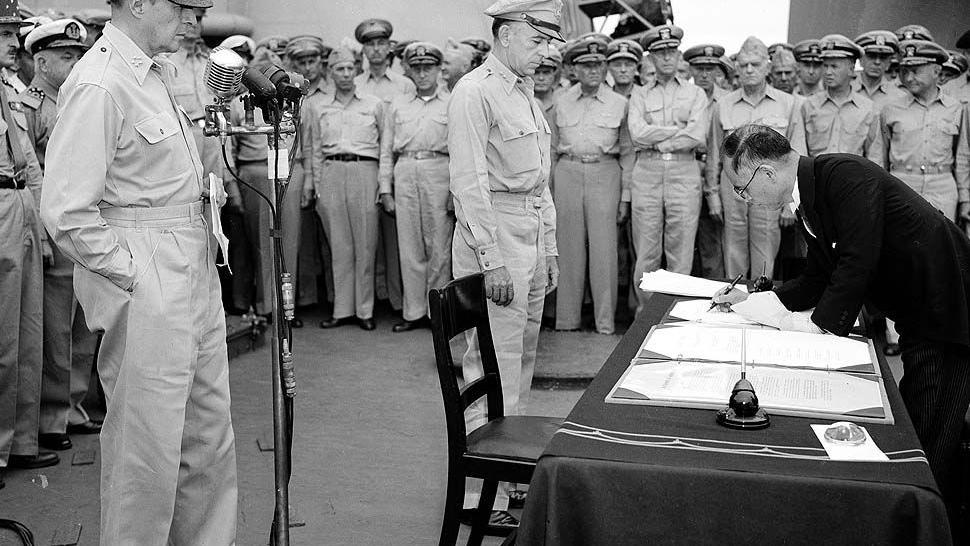
Gen. Douglas MacArthur watches as Japanese Foreign Minister Mamoru Shigemitsu signs the surrender document ending World War II on the deck of the USS Missouri, Sept. 2, 1945.
Following the surrender of Germany in May 1945, the defeat of Japan became increasingly clear as the summer wore on. The Japanese navy and air force were destroyed, the main islands of Japan were under heaving bombing and a naval blockade, and Okinawa was secured by the U.S. troops. The capture of his key island now meant the Allies could launch an invasion of the main Japanese home islands.
Gen. Douglas MacArthur was named as the commander for invasion, planned for November 1945, and given the code name “Operation Olympic.” Planners were hard at work in July and it was forecast that taking the Japanese main islands would cost more than 10 times the casualties then the Allies suffered on the beaches of Normandy.
Then, on July 16, the United States secretly detonated the world’s first atomic bomb in the New Mexico desert, followed by the Potsdam Declaration, demanding the “unconditional surrender of all the Japanese armed forces” on July 26. The allies stated that failure to comply would mean “the inevitable and complete destruction of the Japanese armed forces and just as inevitable the utter devastation of the Japanese homeland.” Japanese government officials ignored the declaration, and on Aug. 6, 1945, a B-29 bomber named the Enola Gay dropped and atomic bomb on Hiroshima, killing approximately 80,000 Japanese, with scores more fatally wounded. Two days later the Soviet Union declared war on Japan, attacking Manchuria on August 9, while the U.S. dropped another atom bomb, this time on the city of Nagasaki.
That night, Japanese Emperor Hirohito called for a supreme war council. After hours of debate the emperor supported a proposal by Prime Minister Kantaro Suzuki in which Japan would consent to the Potsdam Declaration, “with the understanding that said Declaration does not compromise any demand that prejudices the prerogatives of His Majesty as the sovereign ruler.” This message was transmitted to the United States, which replied on August 12 that, “the authority of the emperor and the Japanese government to rule the state shall be subject to the Supreme Commander of the Allied Powers.” Finally, on August 14, Hirohito declared peace was desirable to destruction for Japan.
On August 15 Hirohito addressed the Japanese people over the radio, many hearing his voice for the first time, and announced the surrender of Japan. President Harry Truman selected MacArthur to head the Allied occupation of Japan as Supreme Commander of the Allied Powers, and designated the battleship USS Missouri as the site where the surrender would be signed. MacArthur delayed the ceremony until September 2 to allow representatives from all the Allied nations to attend. That morning more than 250 Allied warships filled Tokyo Bay, and at 9 a.m. Tokyo time, Japanese Foreign Minister Mamoru Shigemitsu signed on behalf of the Japanese government, followed by Gen. Yoshijiro Umezu for the Japanese armed forces.
MacArthur signed on behalf of the United Nations, followed by 10 more signatures from the United States, China, Britain, the USSR, Australia, Canada, France, the Netherlands, and New Zealand. 20-minutes after it began, the ceremony ended, and with it the Second World War.