
First UAS Flight in National Airspace Over Dahlgren Supports Critical Fleet Requirement
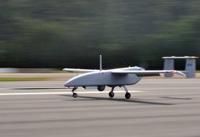
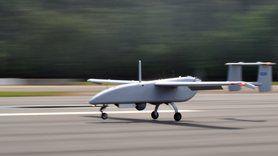
The Aerostar Unmanned Aerial System speeds along the runway at Naval Support Facility Dahlgren during a touch-and-go, part of a collaborative test May 22. - Credit: U.S. Navy photo by Andrew Revelos
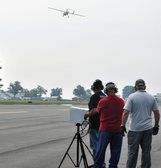
The Aerostar Unmanned Aerial System soars over test personnel and external pilots at Naval Support Facility Dahlgren’s runway May 22. - Credit: U.S. Navy photo by Andrew Revelos
The Naval Surface Warfare Center Dahlgren Division (NSWCDD) and the Naval Air Warfare Center Aircraft Division (NAWCAD), Unmanned Aerial Systems Test Directorate (UASTD) conducted combat systems testing May 22 that saw the first fixed-wing flight from Naval Support Facility (NSF) Dahlgren’s runway in more than a decade. The milestone testing came after close coordination among NSWCDD, NAWCAD, Naval Support Activity South Potomac (NSASP), Naval District Washington Air Operations and the Federal Aviation Administration (FAA).
Though NSWCDD has conducted extensive testing with smaller Group 1 and 2 (less than 50 pounds) Unmanned Aerial Systems (UAS) within the restricted airspace above the Potomac River Test Range and Explosive Experimental Area in recent years, this was the first UAS flight in the National Airspace over Dahlgren and its main runway. The flight was also the first testing at Dahlgren involving a large, Group 3 (greater than 50 pounds) UAS, as well as the first UAS collaboration between NSWCDD and NAWCAD assets from Naval Air Station (NAS) Patuxent River to meet a critical requirement in the operating forces.
UASTD operators flew the Israeli-manufactured Aerostar during the testing. The aircraft is 15 feet long and has a wing span of 21 feet. It can cruise at speeds up to 62 knots and has an endurance of nine hours.
“This series of flight tests was critical to proving out combat systems integrated with the unmanned aerial vehicle,” said Capt. Brian Durant, Naval Surface Warfare Center Dahlgren Division (NSWCDD) commander. “The Aerostar UAV was used to successfully verify system tracking capabilities. The coordination and teamwork required to successfully pull this off was no small feat. I applaud the team for their hard work and significant contribution to the success of our mission.”
After thunderstorms kept test operations grounded on May 21, the Aerostar sped north down Dahlgren’s runway just after 1000 hours the next morning and began a familiarization flight. Crews practiced touch-and-go maneuvers, communications checks, and process and procedure verifications before conducting additional tests in the restricted NSWCDD airspace.
“This overall test series is just one example of NSWCDD’s local Weapon System Integration (WSI) capability, providing the necessary crucial technical and programmatic risk mitigation prior to system deployment,” said Nelson Mills, senior engineer at NSWCDD.
The co-location of research, development, test and evaluation (RDT&E) assets at Dahlgren provides an ideal setting for innovating next-generation combat systems and overcoming technological obstacles for the fleet. Reopening the installation’s main runway increases the efficacy of those activities.
“The capability provided by the airfield being co-located with the test site and range facilities enabled UASTD to provide rapid and flexible test support and maximal on-station time that would not be possible operating at Dahlgren from other venues,” said James Kushner, operations officer for UASTD. “UASTD looks forward to future activities supporting NSWCDD and its customers as the opportunities arise.”
Navy RDT&E professionals say that coordinated efforts like the UAS combat systems testing can yield superior results for warfighters.
“As the Center of Excellence for Naval Aviation, it is our mission goal to continuously mature and contribute our manned and unmanned aircraft systems and expertise to develop weapon systems and tactics to ensure advantage to our warfighters,” said Gary Kessler, executive director of NAWCAD. “Through NAWCAD and NSWCDD collaboration and mutual cooperation, we are leveraging our combined intellectual capital, technological capabilities, and regional resources to foster multi-domain Naval integrated warfighting capability (IWC) advancements which guarantee those advantages are realized by our Sailors and Marines, and other services.”
“UASTD is extremely happy to support this project,” said Peter Heasley, technical director of UASTD. “One of the key strategies to promote Naval Integrated Warfighting Capability (IWC) is to build on nationally-unique, integrated, and interoperable test capabilities that can be found both within the Naval Air, and Naval Surface communities and bring them together. This test effort exemplifies just that-the crossing of the air and surface domains and the amazing IWC results that can be achieved for the warfighter when you find a way to combine the skill sets and capabilities of an air system team and [incorporate them] with the skill sets and capabilities that NSWCDD provides the surface community.”
Capt. Pete Nette, commanding officer of NSASP, praised members of the various organizations who worked together to make the testing possible. “The coordination and effort that led to this testing was outstanding,” he said. “Dahlgren has a unique historical pedigree when it comes to aviation. It’s great to see the main runway back in service as NSWCDD and UASTD work to give warfighters the technology they need to accomplish their missions.”