
Evolution of aircraft due to innovative technology
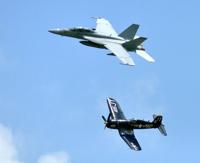
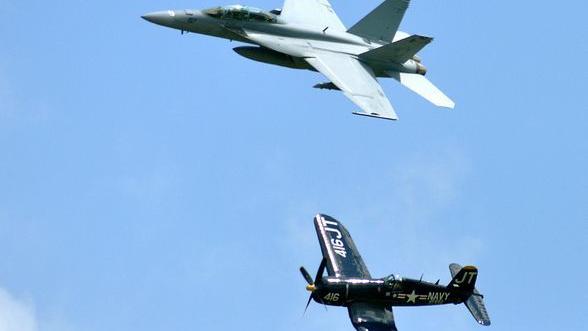
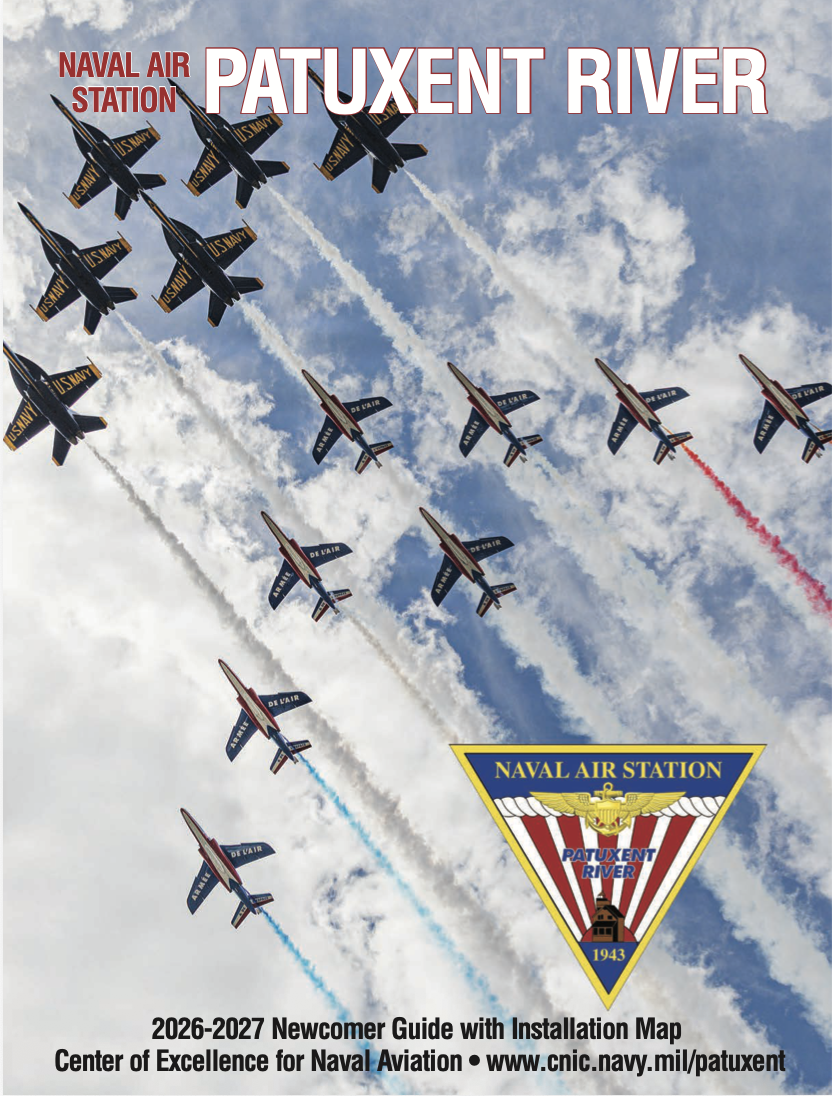
A replica of an F-4E Corsair aircraft flies alongside an F/A-18F Super Hornet during a Centennial of Naval Aviation tribute at the N�ƒ�awlins Air Show. The air show celebrated the Centennial of Naval Aviation and featured a performance by the U.S. Navy flight demonstration squadron, the Blue Angels.
- Credit: U.S. Navy photo by MC2 John P. Curtis
From the simple structure of the seaplane to the jets that break the speed of sound, technological innovations and design have shaped and propelled naval aircraft in its capability to project great power over land and sea.
"With design evolution, aircraft have been able to fly higher, farther and faster," said Hill Goodspeed, historian with the National Naval Aviation Museum at Naval Air Station Pensacola.
Between 1908 and 1910, Glenn Curtiss helped build a number of aircraft, and with the help of civilian pilot Eugene Ely, he was able to demonstrate the capability of a plane flying from the deck of a ship and landing thereafter. However, at the time the Navy was more interested in a plane that would be useful to the fleet at sea. So a lot of early aircraft were sea planes or float planes those that had the ability to take off and land from water.
"Seaplanes were going to be the key to aircraft being integrated with the Navy," he said. "It was on the wings of the seaplane."
The Navy ordered its first aircraft on May 8, 1911, a Curtiss pusher. Designated the A-1 Triad, the aircraft was flown by Lt. Theodore G. Ellyson, the Navy's first aviator, on July 1, 1911. The A-1 Triad was a general purpose aircraft that performed a variety of missions/functions, including training. It was the Navy’s first trainer aircraft.
The A-1 a seaplane was a 28-foot-long biplane with an empty weight of 1,065 pounds. It had a wing span of 37 feet, was about nine feet high, and it was powered by a Curtiss 75-horsepower, eight-cylinder engine with a 7-foot, 9-inch wooden propeller behind the pilot. It was also equipped with partial dual controls and had a bench seat to accommodate the pilot.
These early machines had no instruments and flew at 55 to 60 mph. The whole point of training was to teach the student how to get the plane into the air, keep it aloft and under control, and finally, land it safely.
Early aircraft, used for scouting and observation, were almost entirely made of wood and fabric, with the wings held by wire to keep the plane's structure. They were powered by pusher engines, largely devoid of enclosed cockpits and did not have seatbelts until the first fatality in 1913, Goodspeed stated.
"A lot of craftsmanship went into these planes," he added.
While the biplane construction was maintained until after World War I, technological advancements were already taking place in aircraft. The radiator-type engines were moved to the front of the plane and replaced with air-cooled systems, which were developed after WWI and helped to make aircraft more dependable, lighter and lent to greater performance. Goodspeed noted it was also around WWI that there was more metal construction, as well as enclosed cockpits and more instruments inside them.
During the Korean War, the Vaught F4U-5NL Corsair was configured for cold weather, with deicing equipment for the aircraft's wings, tail, propeller and windshield.
Also with technological developments, aircraft were retrofitted with the capability to do more than just scout distance. Aircraft became a vital part of naval warfare, being able to attack and sink enemy ships by dropping bombs.
Jet engine technology appeared during WWII and changed how aircraft were used. It was also during WWII that the first helicopter immerged, which has proven to be a value operating in submarine warfare and attack, in humanitarian missions and transporting goods and soldiers.
"Jet engines and helicopters were two of the biggest technological inventions that lent to aviation transformation after WWII," Goodspeed said.
With the advancement of aircraft, so came the evolution of naval ships that were used for docking the aircraft carriers. Aircraft carriers were vessels with a straight deck, where the planes would land on the aft deck and take off from the bow. However, jet-engine planes approaching and taking off needed vessels that supported their movement. Planes land differently on aircraft, where they have to stay at high speeds incase their first attempt to catch the tailhook does not happen this way they are able to take off again.
"Carriers had to have a special sturdiness to them," Goodspeed said. "And so those operating from the ship influenced the design of carriers."
In the past few years, technology has moved rapidly, opening the door for new innovations in aircraft. As aircraft are developed, they undergo testing and evaluation, like the X-47B unmanned air system which will be launched from a carrier in 2013 and the F-35, Joint Strike Fighter, which is set to replace the F/A-18 and is being tested at Naval Air Station (NAS) Patuxent River.
"It's an amazing jump in technology. In 1919 there was a Navy aircraft, the NC-4, which flew across the Atlantic Ocean at the speed of 85 miles an hour. Fifty years later the first man walked on the moon," Goodspeed said. "That shows the progression in aviation in just 50 years. And the aircraft now can easily break the speed of sound."
As the Navy commemorates naval aviation, NAS Patuxent River will be the site for the Centennial Air Expo '11 Sept. 3-4. For more information about the upcoming air show, please visit www.p axairexpo.org/Centennial.html. Additional information about the Centennial of Naval Aviation can be found by visiting www.public.na vy.mil/airfor/centennial.