
AR 670-1 Brings Changes to Soldiers’ Appearance Standards
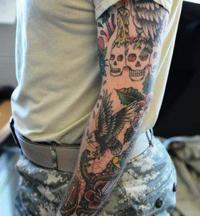

Tattoo sleeves below the elbow are no longer permitted under the updated AR 670-1, just one of several changes regarding Soldier appearance. Army photo
The March 31 update to Army Regulation 670-1, Wear and Appearance of Army Uniforms and Insignia, brings major changes to Soldiers serving in the U.S. Army today.
As the Army transitions away from more than a decade at war, the updated regulation pushes the Army towards a more professional image with clean-cut grooming expectations, strict tattoo policies and changes to uniform wear.
The updated regulation outlines more stringent requirements for Soldiers, according to Fort Detrick Garrison Command Sgt. Maj. Richard Jessup.
“As the Army becomes stricter with tattoo policy and grooming expectations, our Soldier’s will be a better representation of the Army values,” Jessup explained. “The updated regulation does not allow tattoos that are racist, gang affiliated, extremist, sexist, or indecent. Soldiers should be a picture-perfect example of the Army values—loyalty, duty, respect, selfless service, honor, integrity, and personal courage.”
Soldiers with tattoos larger than their hand are obligated to report the tattoo for inspection to their commander to ensure it is in compliance, according to the regulation. Tattoos not in compliance with AR 670-1 prior to the March update are grandfathered into the program.
However, Soldiers with tattoos not in compliance, including tattoos on the head, face, neck, wrists, hands or fingers, cannot request commissioning or appointment and could be subject to adverse administrative action or charges under the Uniformed Code of Military Justice.
“I got my tattoos when I was 18 years old, right after basic training,” said Spc. Greg Hawkins, chaplain operations clerk.
“I got them because I was proud of everything that I had accomplished. I can see how some tattoos would be considered distasteful. We do have a professional image we need to keep.”
Jessup explained that it is the responsibility of company commanders and first sergeants to identify and upload Soldier’s tattoos to the Personnel Electronic Records Management System. Some of the challenges with the updated regulation include identifying which Soldiers have tattoos, knowing which Soldiers should be grandfathered into the program because they came into the military sooner than the regulation, and managing the perception of younger Soldiers who are not necessarily familiar with how the regulation works, according to Jessup.
“If we have a Soldier with a non-compliant tattoo that has been grandfathered into the new regulation, a younger Soldier might not understand why that Soldier isn’t being held to the same standards as the rest,” Jessup said. “My job, as well as all other Noncommissioned Officers, is to make sure that our Soldiers understand the requirements of this regulation and are meeting those requirements.”
For more information about AR-670-1, visit: http://www.apd.army.mil/pdffiles/r670_1.pdf.