
A Call to Arms: Mobilizing America for World War II
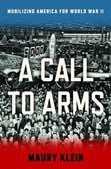
A Call to Arms: Mobilizing America for World War II by Maury Klein. Published by Bloomsbury Press, New York, 2013. 912 pages.
The least glamorous aspects of warfare and yet the most vital are the economic, the logistical, and the supply features. The organization of the mass mobilization of America’s resources during World War II is crucial to understanding the centrality of leadership at the home front. Maury Klein of the University of Rhode Island published an important work for any American wanting to understand the mechanics of the contribution of the United States to World War II. Behind the Battles in Europe and Asia stood a formidable mobilization of resources that out-produced the Axis. Klein tells the complex and contentious story of how the United States mobilized the materials, labor, and troop requirements for World War II. He opens by reminding the reader that slogans such as “The Greatest Generation,” mask the real fight over balancing capital, profits, taxes, and the use of scarce materials in wartime production. This is a volume about executives who wanted to continue dedicating assembly lines for commercial profit, and who accepted compensation of only one dollar to contribute their managerial skills to efficient military production lines.
The first hundred pages quickly give the reader an appreciation for the dozen rare earth materials needed for modern warfare such as rubber, tin, and high quality steel to make tanks, planes, and ships. Even the machinery used to stamp out parts were in short supply as the United States entered World War II. The reader will dive into the fight to break the monopoly of such aluminum conglomerates as ALCOA in order to free up production in the race to make more war planes. Klein also describes the unenviable task of convincing competitors in various industries to share knowledge, lines of production, and to simply produce the needed equipment for not only America’s troops, but for those of Britain and the Soviet Union, as well.
Klein delves into the many key personalities of the war. Among the examined is American industrialist Bernard Baruch, who played a crucial but often overlooked role. Baruch shared his wisdom of production lessons from World War I for the benefit of production in World War II. Whole cities tied to production plants formed in the United States tied to production plants, and many Americans who had been in poverty now had regular paychecks. The production aspect of the war is an extremely important one in the history of modern America, as it ushered in a new era where women were vital to the war effort, with many donning war posters exclaiming that women should find their place in the war production effort. There are simply too many personalities to cover in this review, but Klein does a magnificent job of introducing individuals whom many have never heard of but who had significant roles in the events of World War II.
This book provides immaculate detail on a broad scope of subjects, ranging from how the “arsenal of democracy,” came about in stages to the tens of thousands of parts needed to produce a single B-17 bomber or Liberty Ship. The reader will gain a respect for the interconnectivity of wartime production and the general competition for materials domestically and internationally that impede these efforts. Klein also discusses the economics of inflation, price controls, and raising revenue, as well as the integration of women and minorities into the workforce. Klein blends together the important and understated facets of WWII seamlessly while providing enough detail and context to engross the reader. This book is simply an education!
Editor’s Note: Commander Aboul-Enein’s third book “The Secret War for the Middle East: Axis and Allied Intelligence Operations in World War II,” will be published by Naval Institute Press this fall. He teaches part-time at the National Defense University’s Eisenhower School for National Security and Resource Strategy. Commander Aboul-Enein wishes to thank Ms. Dorothy Corley, a Boston University Graduate and former Teaching Assistant, for her edits that enhanced this book column.