


Constant back pain from an injury suffered years ago in combat still troubles Staff Sgt. Ryan Garrison. It wakes him up at night when his medication wears off. It triggers his depression and anxiety – leading to angry outbursts.
“The smallest thing would set me off,” Garrison said. “I didn’t know a healthy way to deal with it.”
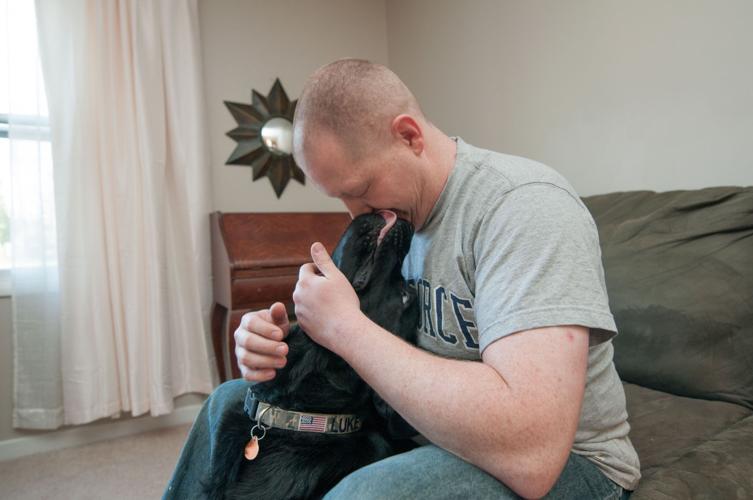
Several prescriptions and mental health visits didn’t effectively assist with his emotional state. The 39-year-old defense courier then met Luke, a pitch-black Labrador.
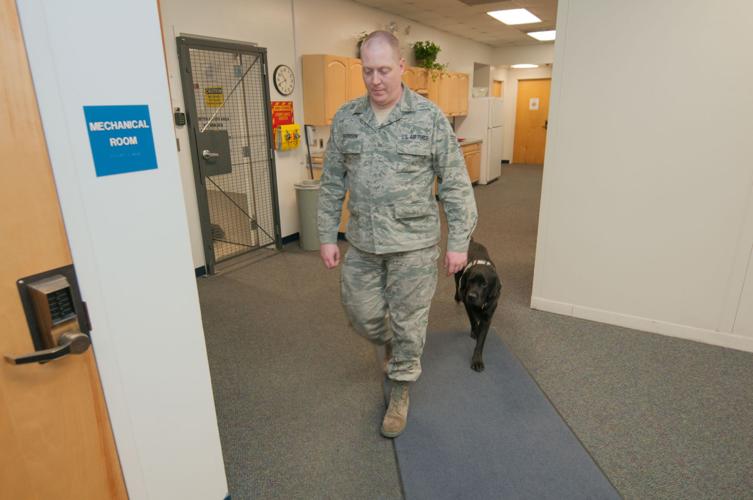
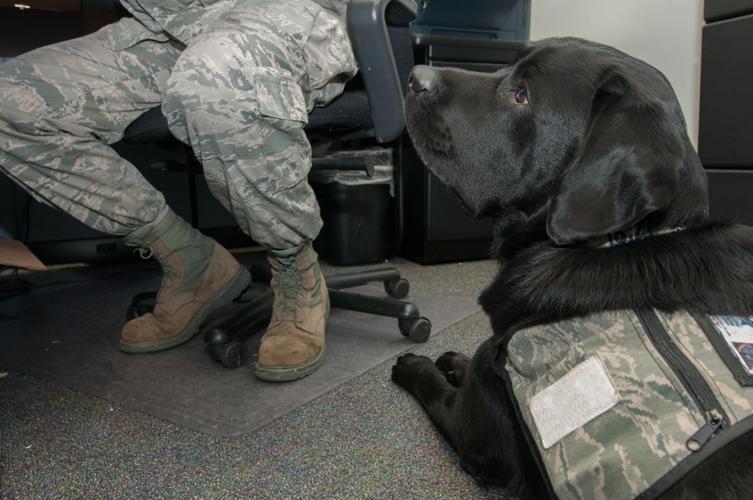
Always at his side, the skilled service dog can sense anxious feelings in Garrison and will nudge his leg with his snout to trip up the negative thoughts.
“You get your mind off what was causing the anxiety,” Garrison, who has since medically retired after serving 14 years, said. “You realize it before it becomes a full-blown panic attack.”
With these cues, he said his panic attacks have dropped by half since he’s received Luke from Warrior Canine Connection, a nonprofit in Brookeville that trains dogs for wounded military members.
“Dogs have been shown to be able to detect trace amounts of chemicals,” Rick Yount, the group’s executive director, said. “Human emotions are chemically driven. Obviously, medications wouldn’t work if that wasn’t true.”
A decade after his combat-related injury, Garrison is reaping the benefits of Luke’s intuition. The four-legged helper even wears a harness that Garrison can clutch, giving him leverage that pulls him up when the dog walks forward – a less painful way for the Airman to stand up due to a torn disc in his back. The torn disc stems from an RPG thrusting him backward across a railing while on deployment in 2006.
Garrison noted he rarely uses a cane now, too.
The injury nagged him for years and led to sleep disturbances and mental health problems.
“You try to fake it for so many years that you finally realize that you need to see somebody,” Garrison said.
Garrison was prescribed medications initially, but found little relief and many side effects.
Many service dog groups across the country are gaining popularity as more veterans seek treatment, Garrison said.
Dealing with two recent wars, the Department of Veterans Affairs has seen disability recipient numbers grow from 2.3 to 3.7 million between 2000 and 2013. A steady stream of disabled vets will likely continue, as the post-9/11 veteran population is set to climb by more than 50 percent from 2013-2018, according to VA’s latest data.
“We have so many veterans with traumatic brain injury or Post Traumatic Stress Disorder that they just can’t provide enough dogs to take care of all our vets,” retired Maj. Gen. Kevin Pottinger said of service dog groups.
It can take up to two years before a dog is permanently placed with a veteran, Pottinger added.
Garrison heard of the natural healing approach when his wife, Julie, a music therapist, saw the service dogs at Walter Reed. She convinced him to look into it.
“I can now have my husband back,” Julie Garrison said. “Luke forces him to be in the present. The dog is trained to respond to his triggers before he explodes.”
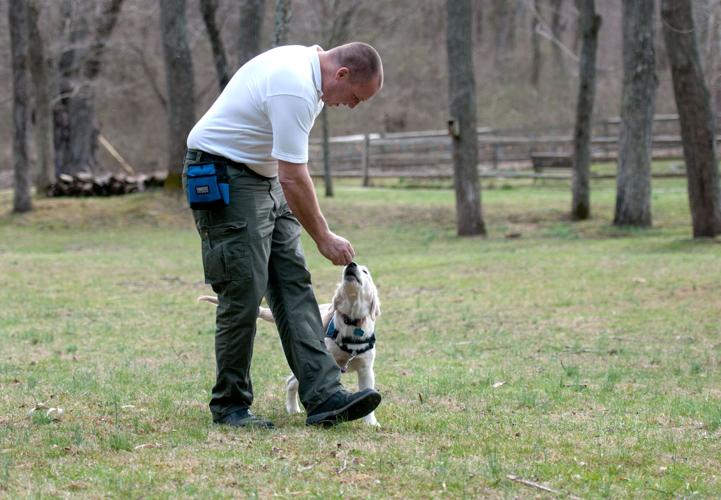
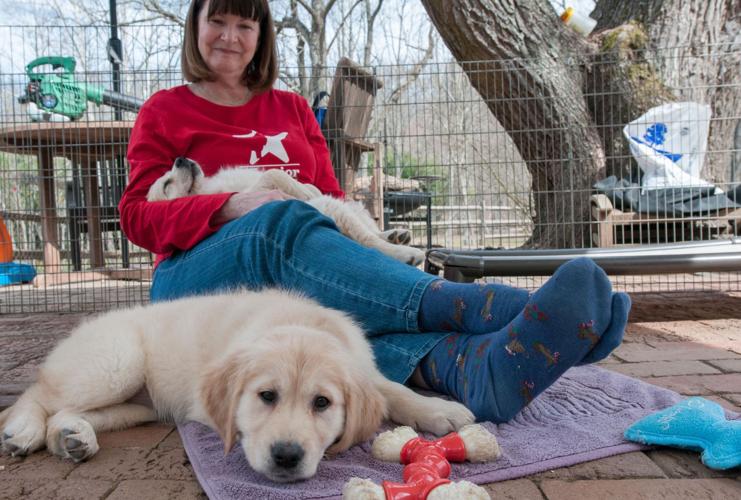
Golden and Labrador retriever puppies embark on a two-year regimen by the WCC to learn how to assist veterans when needed. During that time, the dogs are trained by wounded warriors and are taken to medical centers to interact with others.
Over the training period, the nonprofit estimates that one dog will reach at least 60 wounded warriors.
As playful creatures, dogs can even get reclusive PTSD sufferers, like Garrison, to open up.
“He’s an icebreaker in talking to people,” Garrison said of Luke. “I’ve always tried to avoid conversations out in public. But people now come up to me to pet him, and it forces me to be more social.”
Service dogs may help ease the symptoms of some ailments, but experts recommend that a dog be used to supplement other treatments.
Still, Yount said it’s hard to ignore the chemistry between these dogs and wounded warriors.
“I really do believe, based on the science, that it’s not magic and there’s something powerful happening here,” Yount said. “We’ve seen enough positive results now that this is offering important benefits and not showing side effects that we’re significantly concerned with.”
But there are at least two side effects: drool and fur.
Editor’s Note: November is Warrior Care Month, a time for the military community to reaffirm its commitment to the recovery and reintegration of the nation’s wounded, ill and injured service members.