
DoD Cord Blood Bank Improves Access To Care, Savings
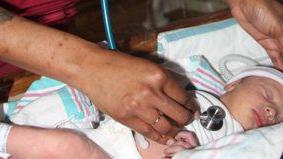
Often thrown away after birth, umbilical cord blood can help save lives. - Credit: Photo by Sharon Renee Taylor
Editor’s note: July is National Cord Blood Awareness Month.
Walter Reed National Military Medical Center (WRNMMC) became the first site to collect and bank patient specimens for a new Department of Defense (DOD) cord blood bank, in April.
The joint venture between Georgetown University (GU) and DOD will enable military and civilian mothers in Washington, D.C., and the greater metropolitan area to help save lives of patients worldwide with life-threatening diseases like blood cancers, sickle cell anemia, and other blood disorders.
The blood contained in the umbilical cord after the birth of a baby is usually thrown away, explained Army Col. (Dr.) Joseph Gobern, department chief of Obstetrics and Gynecology at WRNMMC.
“It can be collected, stored and used to replace blood cells in people who have blood diseases where those had to be eliminated through chemotherapy, or if they have abnormal bone marrow,” Gobern said.
Cord blood can be substituted for bone marrow transplant, a time-consuming and painful process, explained Gobern, who became interested in cord blood banking when his son, now a healthy 19-year-old college student, was treated for lymphoma seven years ago. The physician discovered although DOD had a bone marrow registry, it didn’t have a cord blood bank.
If the 12-year-old’s bone marrow had not withstood the 52-weeks of chemotherapy, transplant would’ve been an option. Gobern said if a bone marrow transplant had been necessary, finding a match would have been an ordeal.
“Even if one of our family members did match, the process for collecting bone marrow is both time consuming, and painful,” the father said. “To know that this alternative is available and can save lives is just tremendous.”
The department chief of Obstetrics and Gynecology estimated about 1,400 babies are delivered at WRNMMC each year.
Donating cord blood to the public DOD cord blood bank is painless for both baby and mother, safe, easy to do, and saves lives, explained Dr. Jennifer Ng, director of the GU DOD Cord Blood Bank housed at the C.W. Bill Young/DOD Marrow Donor Center in Rockville, Md. It’s also free — unlike private blood banks that charge for obtaining and storing cord blood reserved for years for an individual that may never use it. With private banking, individuals pay a fee for collection and one for storage which could amount to essentially paying “rent” for years.
“The GU DOD Cord Blood Bank is a public cord blood bank. The cord blood that is donated is not maintained for the specific use by the donor or their family,” like private cord blood banks, Ng said.
As a public blood cord bank, the DOD facility conforms to the guidelines set by the Food and Drug Administration, as well as the National Marrow Donor Program, the Foundation for the Accreditation of Cellular Therapy, the Maryland Department of Health and Mental Hygiene Office of Quality Management, and other agencies, she explained. Another quality control measure is the special training received by delivery staff who obtain the cord blood specimen at WRNMMC, according to Navy Cmdr. Alison Castro, department chief, Maternal Child Nursing.
The collection is done in the time between the delivery of a baby and the expulsion of the placenta, she explained. With additional samples obtained for the bank to screen, the blood is drawn from the umbilical cord, carefully packaged up, labelled, placed in a special designated cooler and awaits blood bank pick up. Castro added written consent and paperwork for the patient is completed prior to delivery. Preterm labor and infection disqualify donations.
Cord blood units collected and cryopreserved are stored in the DOD cord blood bank at -180 degrees Celsius. Units that have been frozen for 20 years have been thawed without significant loss of their viability, depending on the collection of those units, the freezing process, and how the units are frozen, Ng said.
The seemingly small units of umbilical cord blood pack a powerful punch. Rich in blood-making stem cells, a specimen from a single cord is enough to treat a child under the age of 18 (based on body weight), according to Air Force Col. (Dr.) Thomas C. Newton, chief of Pediatric Hematology/Oncology at Walter Reed Bethesda.
Because cord blood cells are more naïve or “immature,” a physician may choose a less closely-matched cord blood unit between donor and recipient than with bone marrow, Ng said. She explained physicians may also choose to treat with cord blood because once a match between recipient and donor is identified, the unit can be quickly obtained because the unit is cryopreserved.
“In the unrelated adult bone marrow or peripheral blood stem cells, the donor has to be located, tested and also available,” Ng said. “This takes time.”
Increasing the odds of finding a match is the biggest reason why establishing the DOD cord blood bank was so important, Newton said. Minorities and individuals of mixed race are among the hardest to find a bone marrow match for, the pediatric oncologist explained. Minority and mixed-race deliveries in the military that donate to the DOD cord blood bank could help reduce this deficit.
Any mother who delivers at Georgetown University Hospital or WRNMMC can choose to donate cord blood from their delivery to the cord blood bank. As a public bank, both civilian and military who need cord blood can use it, if a match is found.
“People choose to donate to our bank as an altruistic act, in an effort to help another person. They derive no benefit from the donation other than the knowledge that their gift may save the life of another individual,” Ng said.
Air Force wife Dana Sones is one mother who is grateful for the cord blood her daughter Karina received in 2006.
“It took 10 million [donors on a national registry] before Karina found a match,” said Sones.
She paused for a moment and silently sobbed before she expressed how grateful her family was for the cord blood a stranger donated to a cord bank in New York where Karina’s match was found. “It’s given her eight years,” said Sones. The thankful mother explained her faith-filled, tight-knit family of five looks forward to many more together.
Currently, mothers delivering at WRNMMC or Georgetown University Hospital with healthy births are potential candidates for cord blood donation to the DOD cord blood bank but Ng said discussions are underway with several other military hospitals around the country. Visit us on Facebook at http://on.fb.me/14KgLCS to meet Karina and learn more about cord blood collection. For more information about the DOD Cord Blood Bank, go to www.salutetolife.org/cordblood.html.