
SAR revives tradition of swimming across the Patuxent
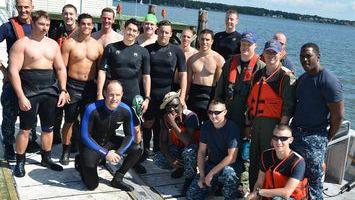
Naval Air Station Patuxent River Search and Rescue members stand with some of the Boat House crew who supported them during their swim across the Patuxent River, Sept. 20. The naval aviation rescue swimmers completed the 1.67-mile distance in little more than an hour’s time. - Credit: U.S. Navy photo by Donna Cipolloni
If your idea of camaraderie involves traversing the width of the Patuxent River, then you’re probably a naval aviation rescue swimmer.
Harking back to a practice that hadn’t taken place here for at least 10 years, a group of rescue swimmers from Naval Air Station Patuxent River Search and Rescue gathered, Sept. 20, to revive the former tradition of swimming across the river — beginning at the West Basin and ending at the Solomons Research Pier on the opposite side.
“We’d all heard of the guys who used to do this before,” said Naval Aircrewman 2nd Class John Conant, SAR petty officer, “and when I took over the program, I wondered why it hadn’t been done lately.”
Conant described the event as a motivational swim that “brings the shop together” as well as a fitness gauge for the swimmers to measure their performance in open water.
Clothed in wet suits, the SAR team met at the Boat House for a mandatory safety briefing before heading off, under clear blue skies, to the beach that served as their starting point. The swim had originally been scheduled a week earlier, but was canceled because of brisk winds and a small craft advisory.
Conant gave the swimmers no more than an hour and a half to complete the 1.67 mile distance in 73-degree water.
“We had done two miles in the training pool at the Drill Hall and that took our slowest guy an hour and 10 minutes, so [the river] shouldn’t take any longer than an hour and a half, even figuring in the current,” he said. “We all completed it under that time.”
In addition to receiving clearance through the Coast Guard Sector Baltimore, which would frequently broadcast details of the swim over Martime 16 — a channel listened to by most recreational boaters — the swimmers were also accompanied by three boats from port operations.
“The swim would not have happened without the Boat House crew and the support they provide us,” Conant said, “not only on that day, but during our open water training sessions as well.”
One boat was in the lead, keeping watch and carrying a safety swimmer and medical corpsman in case of emergency; the second boat trailed behind the swimmers; and the third kept the area safe by notifying other approaching boats of the activity in the water.
At Pax River, SAR comprises 12 service members with varied naval backgrounds plus three corpsmen. Their main client is the F-35 Joint Strike Fighter program.
“Right now, we have guys standing alert while they test over the Atlantic,” Conant said. “In case of an accident, we’re there to pull them out of the water.”
Serving at Pax is considered shore duty, Conant explained, and while the swimmers may have different backgrounds — aircrewmen, submarine hunters, carrier-based — all have gone through the Navy Rescue Swimmers School.
“When you come to Pax River, you take out all other missions and focus only on SAR,” Conant said. “Here, everyone is a swimmer and that’s your only job.”
With duties that might include jumping out of a helicopter into extreme conditions to rescue downed pilots, rigorous training that tests the swimmers, both physically and mentally, is paramount. As the SAR petty officer, Conant is responsible for overseeing the standardization program, making sure the swimmers complete their ongoing training requirements and administering annual evaluations to ensure that everyone is qualified.
As for continuing to swim the Patuxent River, Conant and team have plans to do it again next year; same time, same place.
“It’s a good time of year,” he said. “When you’re swimming that far, your body heats up and the cool water feels nice — plus, the jellyfish are gone.”