
Celebrating Women’s History Month A look at life for first class of women at Naval Academy
It literally took an act of Congress for women to gain access to the hallowed halls of the United States’ military service academies when in October 1975, President Gerald Ford signed Public Law 94-106, which mandated the admission of women in the fall of 1976.
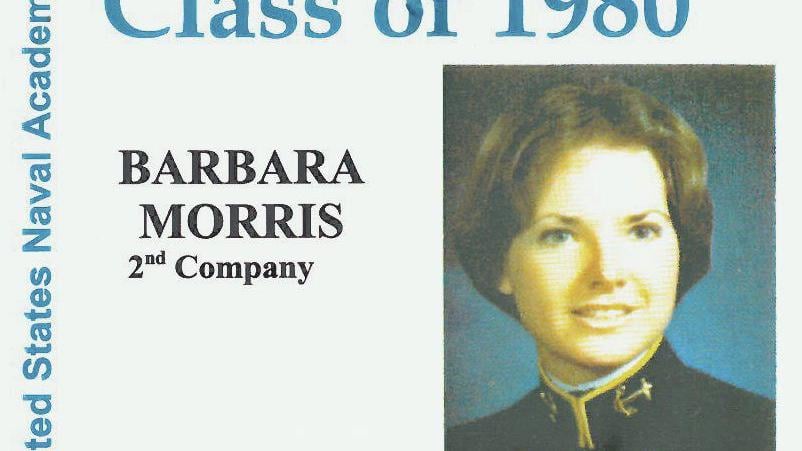
As the nation celebrated its bicentennial, the male- only policy of the U.S. Naval Academy ended, and Barbara Ives—then known as Barbara Arlene Morris—took full advantage of the historic change.
“I grew up listening to my uncles talking about their experiences in the Navy,” explained Ives, wife of July 2006-May 2008 NAS Patuxent River Commanding Officer Glen Ives. “They had adventures and told great stories. I wanted to share in that.”
Wanting to be involved with ROTC in college, it was an easy transition for Ives when her high school counselor suggested she consider attending the Naval Academy, where candidates not only apply directly, but must also obtain a nomination from a member of Congress.
A resident of Bucks County, Pa., Ives was what she referred to as “low man on the totem pole” when her name was submitted by Republican Congressman, Edward G. Biester Jr.
“I was the fourth alternate on a list of five names,” she said. She was also the only female; but fate prevailed, and Ives was accepted.
Eighteen years old when she arrived at USNA, and one of only 81 women among several thousand men, Ives never second-guessed her decision to become a midshipman. “Sometimes I think it’s easier to accept the unexpected when you don’t really know what to expect,” she said.
Not everyone accepted them willingly.
“I think our male classmates, being used to attending co-ed high schools, didn’t find it odd having women in their classes,” Ives said, “but the upperclassmen, who were used to having men-only, had a much harder time.”
The media didn’t help.
“From the moment we arrived, the media singled us out, and it increased animosity,” she explained. “The media always wanted to do interviews and take our photos.”
After some of their own classmates began to get annoyed with the special attention they were receiving, the women decided to stop granting the media access. “We just wanted to blend in,” Ives said.
Just as they struggled to fit in, the Navy struggled with how to fit them in.
Women were already serving in the Navy in administrative and support roles, and with the nurse corps; and the female midshipmen were assigned the fleet’s full dress uniform that included white skirts, stockings and heels.
“That was our drill uniform, if you can picture that” Ives said. “We wore a skirt with stockings and heels and carried our marching rifle. Our heels dug into the muddy fields and our hose were always splattered.”
The Navy’s first solution to the problem was to cut off the heels of their shoes, resulting in an increase in foot-related medical problems. Finally, by their second year, the women were issued proper flat shoes and a uniform known as white works, which included bellbottom pants.
Other adaptations came in the area of physical requirements.
High school sports were limited for girls in the 1970s, and the female plebes were ill-prepared to meet the physical challenges required on the obstacle course. Ives said she and her roommate would practice for hours on Sundays climbing walls and ropes.
“We were the experimental group,” she said. “Throughout that first year, physical fitness requirements more appropriate for women were put into place. Today’s women are much better prepared when they enter the academy.”
While Ives said that most of her instructors remained impartial and were careful not to single out the women in any way, they were not always so fortunate when it came to their fellow midshipmen.
Harassment was commonplace as some believed the women were stealing men’s jobs, were unable to do the job, or were there only to find husbands. Quite often, even the girlfriends of other midshipmen would mistreat them in social situations.
“We had to maintain our decorum and live with it all,” Ives said. “Although I know a few women classmates who had such a bad time, they have never returned since graduation.”
Ives, who studied oceanography and meteorology, received her commission on May 28, 1980, one of 52 graduates from the original 81 women who entered USNA with her.
In 1981, she served for one year aboard USS Harkness, an oceanographic vessel supporting the Trident submarine program, as one of only two women on the 300-member ship and was part of the piloted Women at Sea program. That’s where she met her husband, a lieutenant junior-grade helicopter pilot.
Ives went on to serve at NAS Keflavik in Iceland and at the Navy Operations Base in Norfolk, Va. She married in 1982 and by 1985 wanted to start a family. She then decided to transfer to the Navy Reserve to continue her career.
In 2007, she retired after 26 years of service as a Navy captain.
The progress made in the 1970s laid the foundation for unimagined opportunities for women to serve and attain leadership roles in the Navy.
“I believe in equality for women, I believe women should receive equal pay for equal work, and I believe women should serve in combat,” Ives stated. “The military is truly an equitable organization—there is no gender distinction. Promotion is based on performance. I enjoyed my Navy career, the wonderful people I met and had the opportunity to work alongside, and the opportunity to serve my country.”