
Naval Proving Grounds Historic District
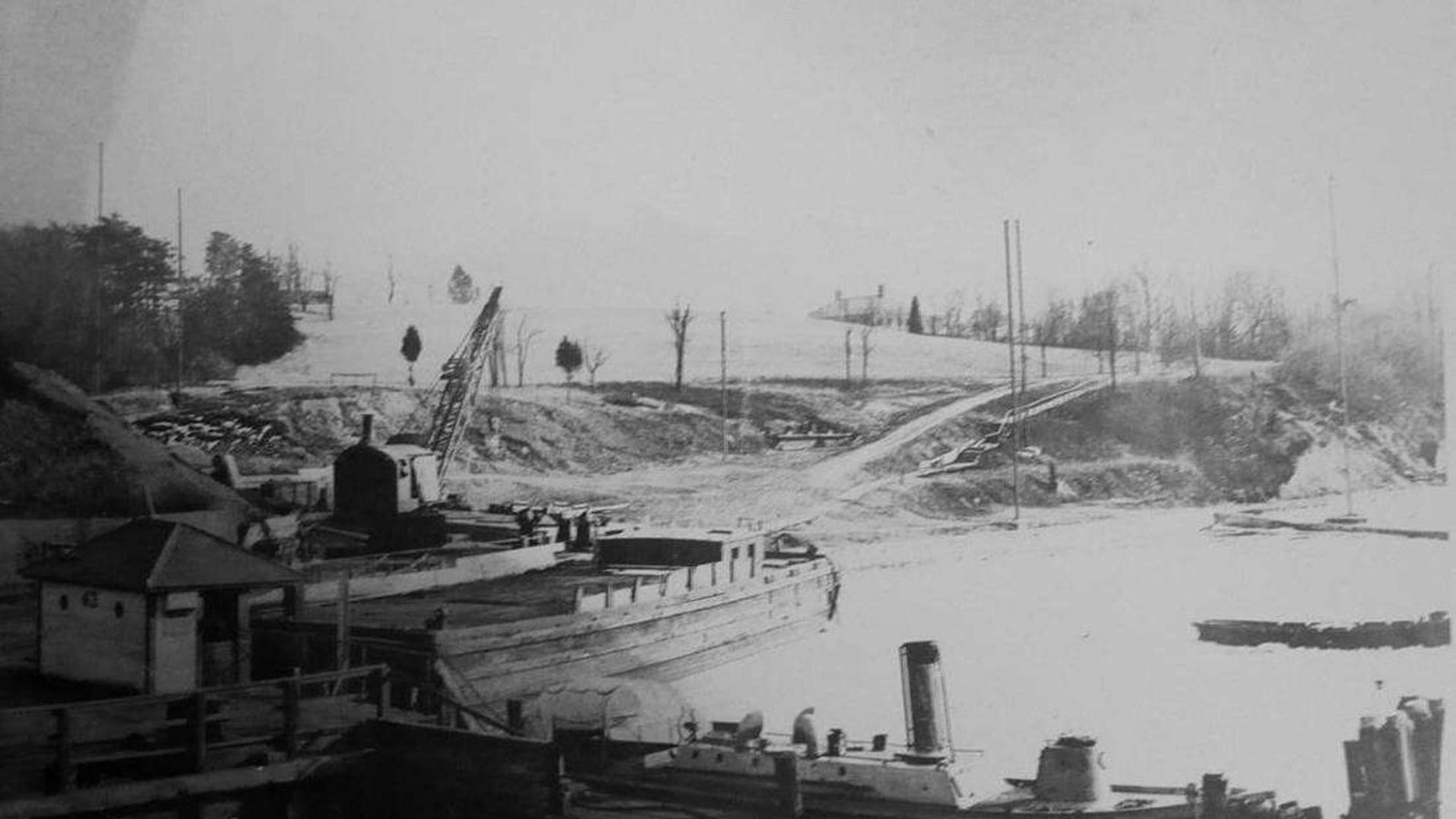
An early photograph shows the dock at the Indian Head Naval Proving Ground site on the Potomac River. The view is looking south from where the current-day Dashiell Marina is located. The road climbing the hill is the present-day N. Dashiell Rd.
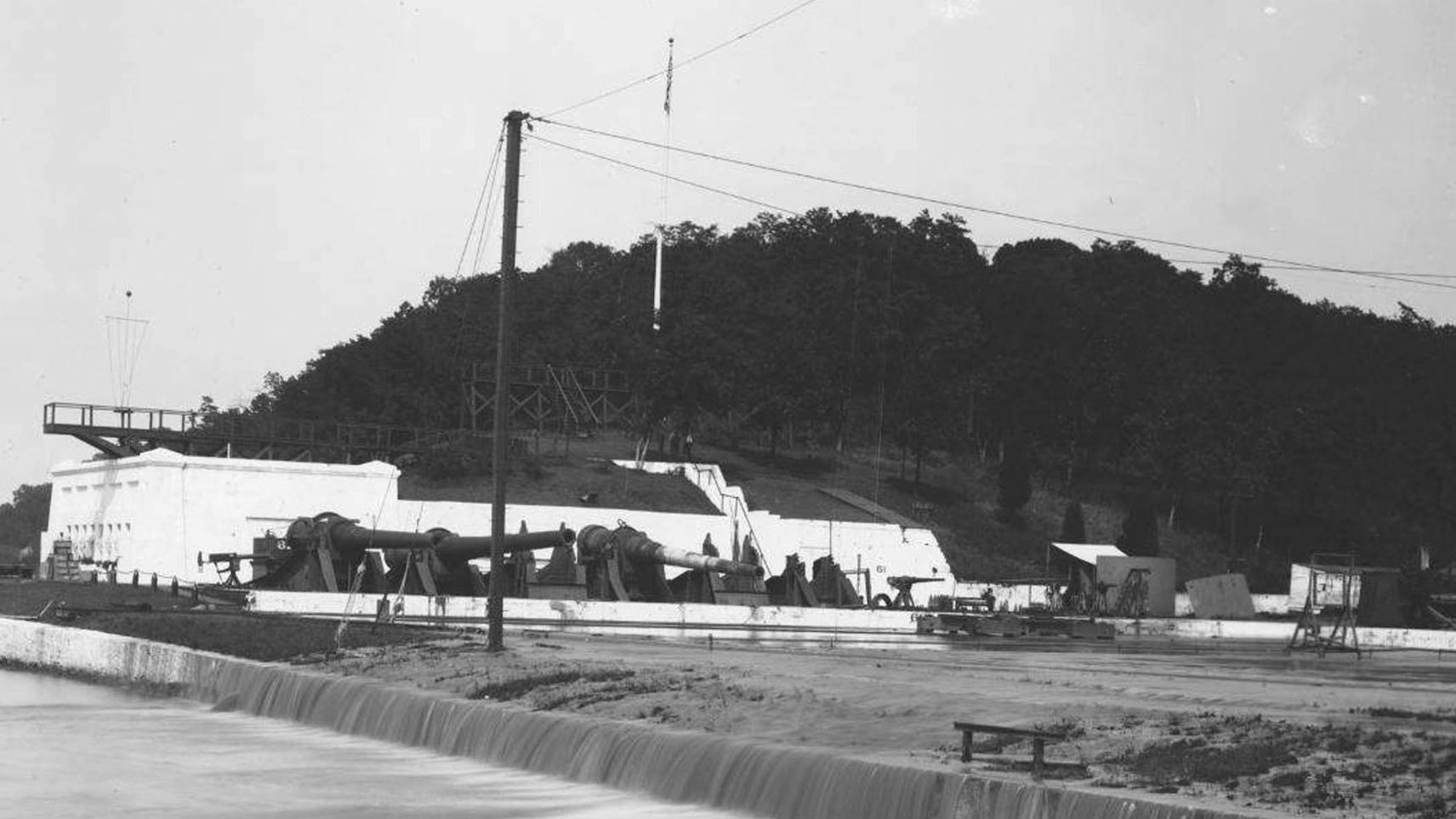
Floodwaters pour over a bulkhead into the Potomac River in front of the bomb proof facility and gun mounts at the Indian Head Naval Proving Ground. In recent history, the bomb proof was converted into the Building 62 conference center.
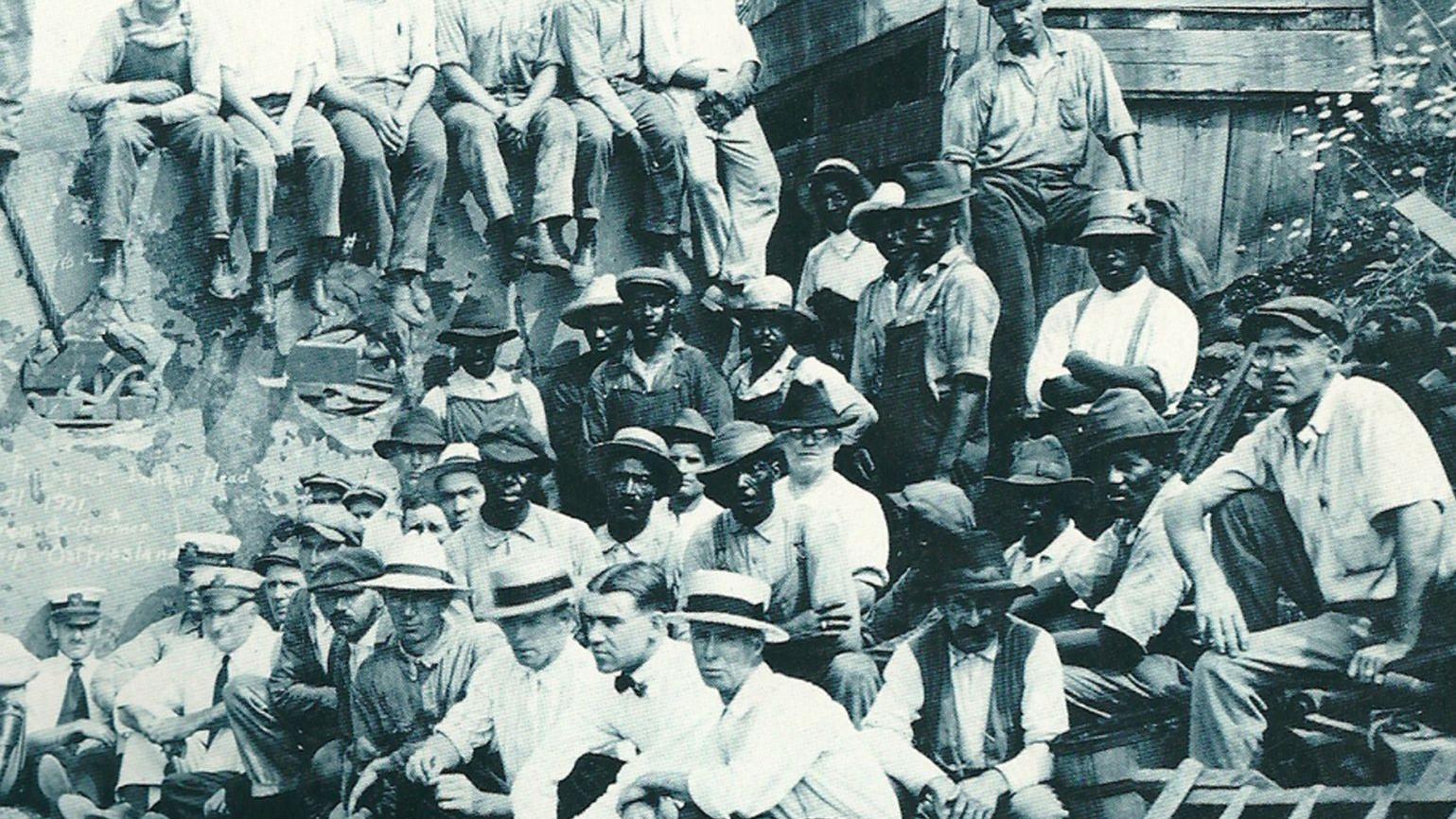
Indian Head workers pause for a group photo on July 21, 1921 to commemorate the last armor plate firing at the base before gun-proofing activities were relocated to Dahlgren. The casement plate is from the German battleship Ostfriesland.
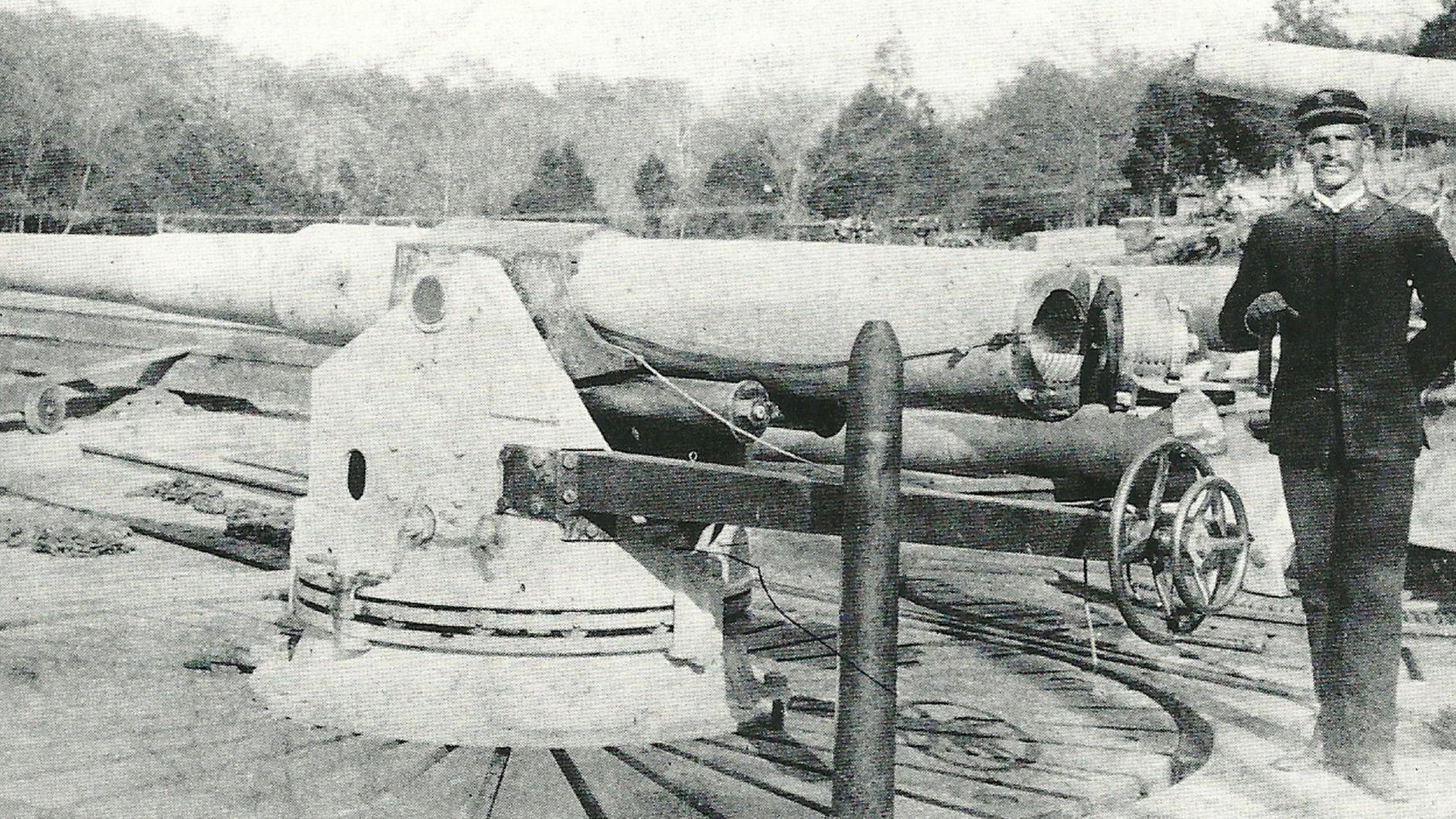
Ensign Robert Dashiell poses at the open breech of a large gun at the Indian Head Naval Proving Ground while serving as the installation�s first commanding officer from 1890-1893.
Editor’s Note: This is the second article in a series devoted to reviewing the rich history of Naval Support Facility Indian Head in relationship to the installation’s multiple historic districts - how they came to be and the unique missions and accomplishments realized by the Navy through the technical facilities and community that became one of the Navy’s earliest bases.
By Thomas Wright Cultural Resources Officer
Naval Support Facility (NSF) Indian Head has been a naval installation since 1890 when the Navy first established the Naval Proving Ground (NPG). The installation served as the Navy’s main testing and evaluation center for new guns that were produced at the Washington Navy Yard.
Due to the Indian Head Naval Proving Ground’s unique contribution associated with energetic, explosives, research and development and production of these materials, the Naval Proving Ground is eligible for listing on the National Register of Historic Places. It was developed by the Navy in 1890 to replace the proving ground located at Annapolis, Md.
Its relocation to Indian Head was due in part to the increasing river traffic on the Severn River by Annapolis. The increasing range of naval guns also forced the Navy to seek an alternate location to proof naval guns being produced at the Washington Navy Yard. Locating the new proving ground at Indian Head also provided a more efficient means of transporting guns for proofing by using the Potomac River to barge the material from the Navy Yard to Indian Head, conduct the test, and ship it back to the Navy Yard within one day if necessary.
The Indian Head Naval Proving Ground tested its first gun in January 1890. Gun proofing and explosives testing activities continued until 1921 after proving ground activities were relocated to a new site in Virginia, at first designated as the Lower Station of the Indian Head Naval Proving Ground and later renamed Dahlgren.
Isolation required self-sufficiency
The proving ground mission at Indian Head was to provide an isolated location for testing guns, ammunition and armor plates for Navy ships. Not only were new guns proofed, the facility also proofed powder, projectiles, gun mounts and cartridge cases, as well as conducted experimental work. Scientists studied naval gun ballistics, armor plate penetration, fuses, explosives, gun mechanism and anti-aircraft guns. Famous ships whose armor, turrets and guns were tested at Indian Head included the battleships USS Iowa, USS Maine and USS Indiana.
The Indian Head proving ground was located in the “valley” of 659 acres initially purchased land. This area encompasses the valley from NSF Indian Head’s present-day sewage treatment plant down the valley extending to Building 62. To prepare the site, the officer in charge, Ensign Robert B. Dashiell, directed a team of 40 men to clear the land, drain the marshes and erect a dock where barges from the Washington gun factory could unload and load weapons, ordnance material and support personnel.
As the work increased, so did the need for manpower. The labor force nearly tripled in sized, from 40 in 1890 to 110 in 1891. These men were responsible for all of the construction at the site. Construction projects included housing, gun platforms, magazines, storehouses, railroad tracks between the wharf and the batteries, and a chronograph building.
Due to the cost of transportation, all of the bricks used in building the facility were produced locally at a brickyard established at the Indian Head proving ground. Further land was cleared, with the lumber primarily used mainly for range backstops. The cleared land was then used for growing much of the corn, maize and hay, as well as the raising beef cattle in order to the support the installation. However, in the 1950s, significant erosion issues forced the installation to develop a reforestation plan for the station.
Ens. Dashiell, always persistent in trying to obtain material and equipment required for the installation, spent three years requesting in his reports to the Chief of Ordnance for the “erection of cheap dwellings for the leading men and boat crews... for it is impossible to keep skilled labor here unless they have somewhere to live.” It was not until 1896 that those first brick houses were built from natural resources, obtained from the installation. For the next 24 years, efforts were made to meet the requirements of the growing installation needs. In 1920 the housing needs of the installation were finally fully satisfied when the construction of the Village Green was completed.
Fire suppression system first conceived
As it is now, fire was also a concern. Dashiell noted that the station water supply was not sufficient to meet either the domestic or mission needs. He reported in 1893 that all buildings were equipped with “full rain barrels, grenades and extinguishers and the station force has been organized and exercised as a fire brigade” but that the water supply was “utterly inadequate should a large fire get headway.”
The idea of fitting all buildings with a fire suppression system was conceived under Dashiell. He recommended that an “artisan well be sunk to 200 feet and be fitted with a wind generator, make a supply tank and run a system of water lines to all buildings for fire purposes.”
This laid the ground work for future fire suppression systems.
In 1897, the first “electric light plant” was built with a 22.5-kilowatt Westinghouse dynamo, and was installed in 1896. A larger plant was built to provide steam and power in 1900. This advancement supplied the installation with electricity and removed the risk of using kerosene lanterns, which proved to be a significant reduction in fire risk.
In 1897, the Naval Proving Ground began firing down the Potomac River. It was soon realized that the Navy needed to purchase the land at Stump Neck in order to reduce the hazards presented to the civilian population nearby. There were several incidents where shells landed nearby or on civilian homes. In one instance, for example, the Irwin Farm was purchased to prevent the complaints of projectiles falling on private property on Cornwallis Neck, known today as the main installation. In the 1900 report to the Chief of the Bureau of Ordnance, Lt.
Strauss identified the need for obtaining land down range. Lt. Strauss reported “it would be advisable to purchase ... the property to obviate the annoyance to people residing in the vicinity when shells pass close to this point.”
As with any military testing facility, there has to be a complaint that involves a cow. There was an incident when the proving ground fired a shell over the river to Virginia. A week later, a letter from the Skinner farm arrived complaining that the shell that landed in Virginia adversely affected her cow. It seems that the cow would no longer give milk.
After a visit from Dr. and Mrs. Peterson, Capt. Lackey and the Peterson children, the Navy agreed to pay $30 for the sickly cow. The cow, known as Molly, was barged over from the Skinner farm and lived out her life on the installation, never once producing milk.
Smokeless powder factory expands mission
The first gun fired at the proving Ground was a 7-inch rifle in January 1890 with not only dignitaries but also the general public in attendance. Guns were first tested by firing up river (Potomac) into the large hill. Once the capability of the range was reached, testing moved to fire up the valley, then across the Potomac, and finally down river.
With the range of the ordnance ever-increasing (up to 13,000 yards), the Navy found it necessary to buy the property at Stump Neck in 1900. This property also encompassed the small community of Winthorp, Md.
As the Navy moved from black powder to smokeless powder in the 1890s, the Navy faced production shortages. Private industry was hesitant to move toward the new technology. This left the Navy with only one alternative: to produce it on its own. As research advanced for the development of smokeless powder, much of the testing was conducted at the Indian Head Naval Proving Ground.
In 1900, the Navy opened the first government-owned facility to produce smokeless powder at Indian Head. This was a major leap forward in warfare technology with less smoke being produced from a shell. It was quicker and easier to determine where the shell hit, and therefore faster and easier to adjust the gun sights. In combination with the new breech mechanism that Ens. Dashiell patented, this doubled the cycle times between loadings. The combination of these two new technologies advanced American naval power and dominance for generations.
The role of the Naval Proving Ground lead to significant advancements in explosive, energetic, and research and development of systems associated with American naval needs. Based upon the unique contribution to Navy history, the Naval Proving Ground earned a significant place in both Naval and American history by advancing the development of more efficient manufacturing processes and new armament technology, much of which is foundational to today’s weapon systems and future weapon technology.