
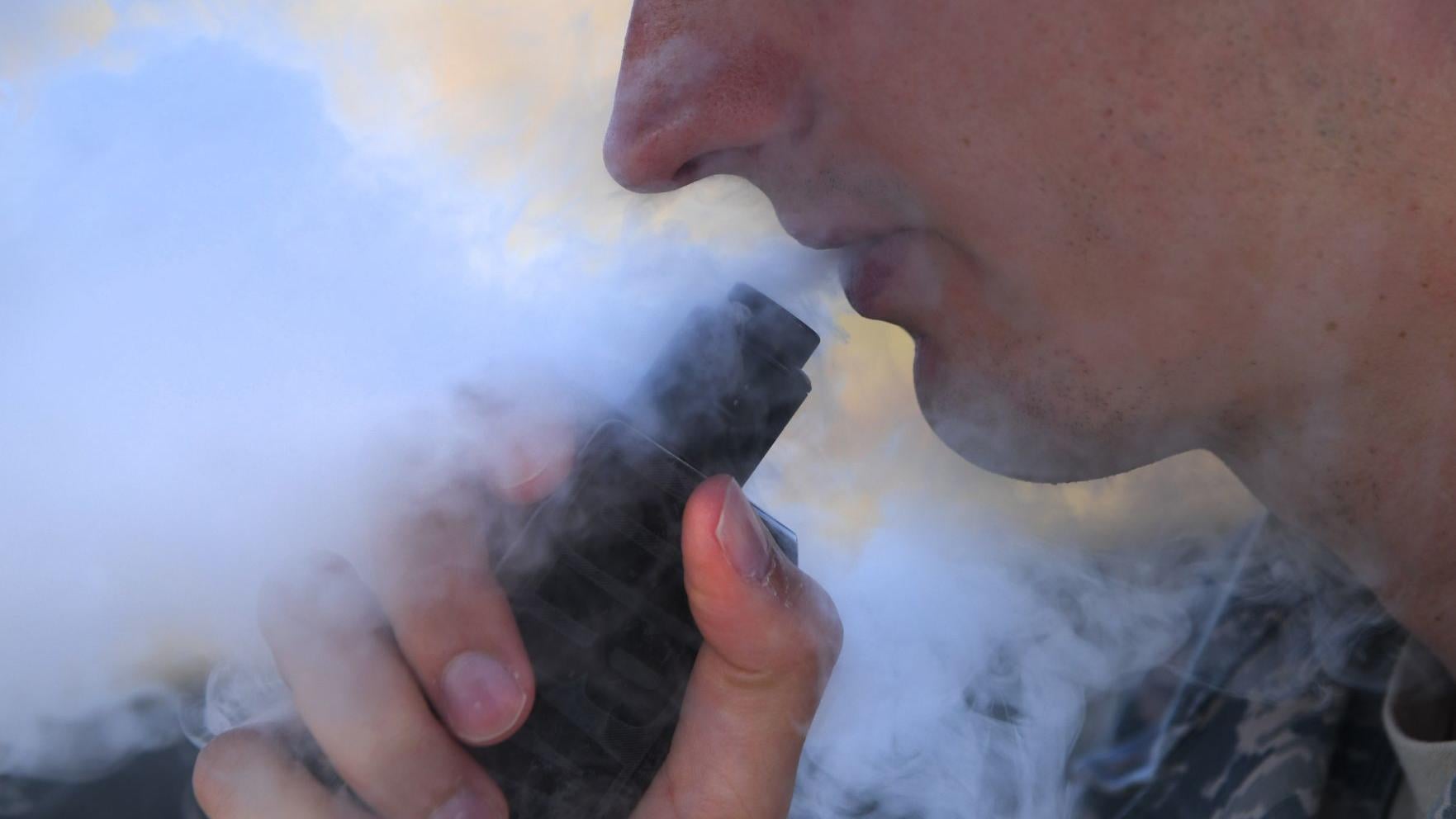
The only safe vaping is no vaping
The Centers for Disease Control and Prevention reported a public health outbreak involving 42 deaths and more than 2,000 confirmed cases of e-cigarette or vaping product use-associated lung injury since August 2019.
Public Health Educator
Sailors at NAS Patuxent River are at risk for severe lung injury and potential death related to vaping via e-cigarette product use.
The Centers for Disease Control and Prevention reported a public health outbreak involving 42 deaths and more than 2,000 confirmed cases of e-cigarette or vaping product use-associated lung injury since August 2019.
“In addition to lung injury, young recruits who vape are 2.5 times more likely to smoke or chew tobacco than expected, according to one study in October 2016,” noted Capt. Harlan Dorey, chief medical officer of Naval Health Clinic Patuxent River (NHCPR). “The data doesn’t support this as a ‘healthy’ substitute for tobacco; quite the opposite.”
So is it safe to inhale if vaping is nicotine-free? An electronic nicotine delivery system – also known as e-cigarettes, vapes, e-hookahs, vape pens, mods and tank systems – contain flavorings with unknown and known substances forming a “vape juice.” When heated and inhaled, the vape juice sparks an aerosol of particles and produces a toxic chemical reaction. These inhaled juice concoctions are currently unregulated and not inspected by the Food and Drug Administration for content and impurities. Oh, and that vape juice contains nicotine, even when labeled as nicotine-free in order to get you hooked.
Yabba Dabba–Do you think your fruity pebble flavor is just water vapor?
Propylene glycol is a typical liquid synthetic substance found in vape juices that absorbs water and is used in a variety of products like aircraft de-icing agent, antifreeze, cosmetics, food flavors, polyesters, paints and plastics. When inhaled with glycerol and flavorings, propylene glycol forms formaldehyde, also known as the world’s “best” preservative. Vaping is not water vaping. And what about the dense plume produced from the variety of vape juices when exhaled? Is this considered secondhand vaping? Despite what you may find on the internet, there is no proof that vaping is safer than smoking.
Vaping is smoother than smoking, making it is easy to vape longer and believe that vaping is safe. In reality, more nicotine is packed in the pods to pull people into paying for yet another unsafe bad habit. Johns Hopkins reported a recent study in which those who intended to quit tobacco wound up using both cigarette and vaping products.
At 14.5% e-cigarette use, the Navy trails the Marines at 16.1%, according to the 2015 Defense Department Health Related Behaviors Survey. One in five junior enlisted, among all service branches, are e-cigarette users. These numbers are higher today. Service members are four times more likely to vape compared with civilians. So, while traditional smoking has decreased, vaping popularity has increased especially among young adults. In 2015, the U.S. Surgeon General reported a 900% e-cigarette increase among high school students. Almost half had never smoked tobacco before.
The new Tobacco 21 law in Maryland exempts military personnel. Eighteen-year-old Sailors may still buy vaping products. Military exchanges, however, have been mandated to pull vaping products by the new fiscal year, and both the Pax River NEX and Mini Mart have already pulled their vaping products.
November was Tobacco Free Living Month, and the naval health clinic is addressing the dangers of vaping and all tobacco product use by providing education to Sailors and their families.
Interested in quitting tobacco and/or vaping? TRICARE beneficiaries can enroll in a virtual online Tobacco Cessation course or join an in-person session with Angela Brochu, public health educator at the Naval Health Clinic PAX by calling 301-757-9469 or emailing angela.r.brochu.civ@mail.mil. Tobacco Cessation classes are also available with St. Mary’s County Health Department by calling 301-475-4330.
Call 1-800-QUIT-NOW. Try TEXTing programs at https://smokefree.gov/tools-tips/text-programs or CHAT live at https://www.ycq2.org/live-chat/