
Fire Scout breaks endurance records while deployed on USS Klakring
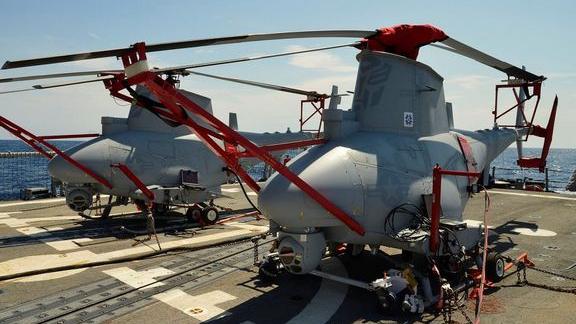
An upgrade to the MQ-8B Fire Scout, the MQ-8C will improve the earlier variant's performance by replacing the existing air frame with one that will increase endurance, range and payload capabilities.
The MQ-8C Fire Scout is an autonomous, four-blade, single-engine unmanned helicopter. Like the MQ-8B, it will carry reconnaissance, surveillance and target acquisition sensors to support warfighters' demands for increased situational awareness.
Initial operating capability for the MQ-8C is planned for 2016, with a potential for early deployment in 2013. Five to six aircraft will be delivered beginning in 2013 for a total of 28 aircraft by 2016.
T he Navy's fourth Fire Scout detachment returned to Mayport, Fla., on Dec. 1 after achieving several milestones during its five-month deployment aboard USS Klakring (FFG 42).
The Fire Scout unmanned helicopter detachment logged more than 500 flight hours in the U.S. Africa Command Area of Responsibility supporting anti-piracy operations and providing real-time intelligence, surveillance and reconnaissance support to combatant commanders.
"In today's environment of ever increasing demands for ISR support, we have proven that a ship with a multi-vehicle Fire Scout detachment can provide the same support to the operational commander as that which would otherwise require multiple land-based ISR assets," said Cmdr. Darrell Canady, USS Klakring commanding officer. "Our team perfected the art of managing maintenance requirements and crew rest in proving that 12 hour-a-day operations could be sustained almost indefinitely."
With a record number of unmanned helicopters aboard Klakring, Fire Scout regularly maintained 12-hour days on station, regularly switching aircraft to provide continuous and thorough support. The system accomplished a new single-day endurance record, providing continuous ISR support for an entire 24-hour period. For the first time ever, Helicopter Anti-submarine Squadron Light (HSL) 42 conducted dual air-vehicle operations, allowing the ship's commander to keep a constant watch on targets of interest.
"The real achievement on this deployment was a surge we executed to provide just over 24 continuous hours of ISR coverage in late September," said Lt. Cmdr. Jay Lambert, HSL-42 detachment officer-in-charge. "Completing this milestone required ten separate flights, refueling aircraft eight times, and having the ship setting flight quarters for launch or recovery twenty times. It took everyone on the air detachment and ship working together to make it happen and we are extremely proud of what we accomplished."
Since 2006, the Northrop Grumman-built Fire Scout system has flown more than 5,000 flight hourswith more than half of the flight hours performing real-world operational tasking during ship-based and land-based deployments within the past 18 months.
"The Fire Scout team of USS Klakring and HSL-42 Det Two successfully demonstrated the potential of Fire Scout with their consistent performance in providing vital information to combatant commanders," said Capt. Patrick Smith, Fire Scout program manager at NAS Patuxent River. "There is a tremendous amount of interest shown for maritime-based ISR and Fire Scout continues to demonstrate its capabilities and potential in the operational environment. Congratulations to USS Klakring and HSL-42 on a job well done!"