
Battle of the Bulge Army veteran recounts personal experiences
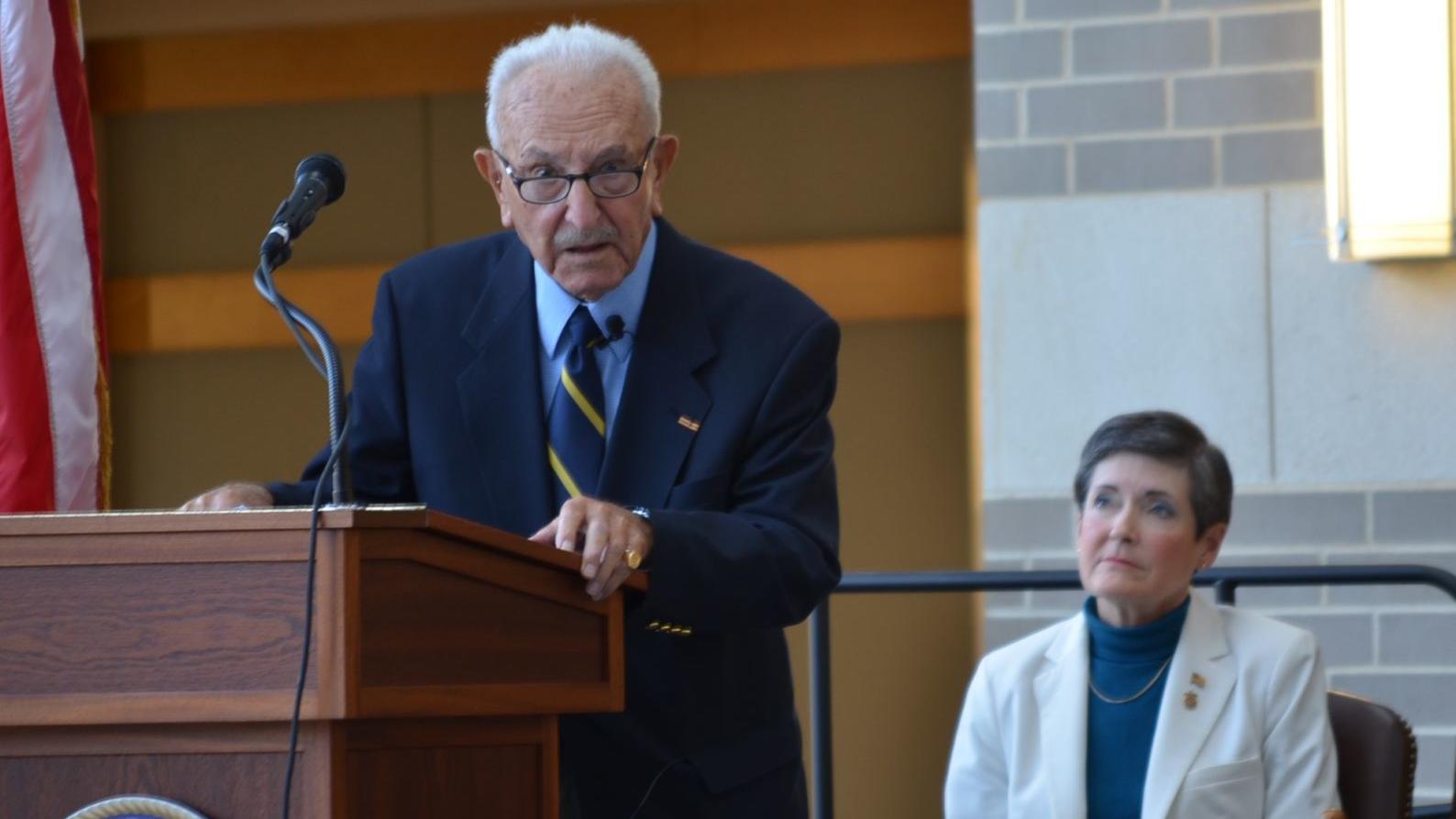
Retired Army Lt. Col. Ruth Hamilton, commander-in-chief of The Military Order of the World Wars, looks on as 99-year-old retired Army Lt. Col. Alfred Shehab recounts firsthand experiences from the Battle of the Bulge at a Veterans Day event held Nov. 8 at the Rear Adm. William A. Moffett Building.
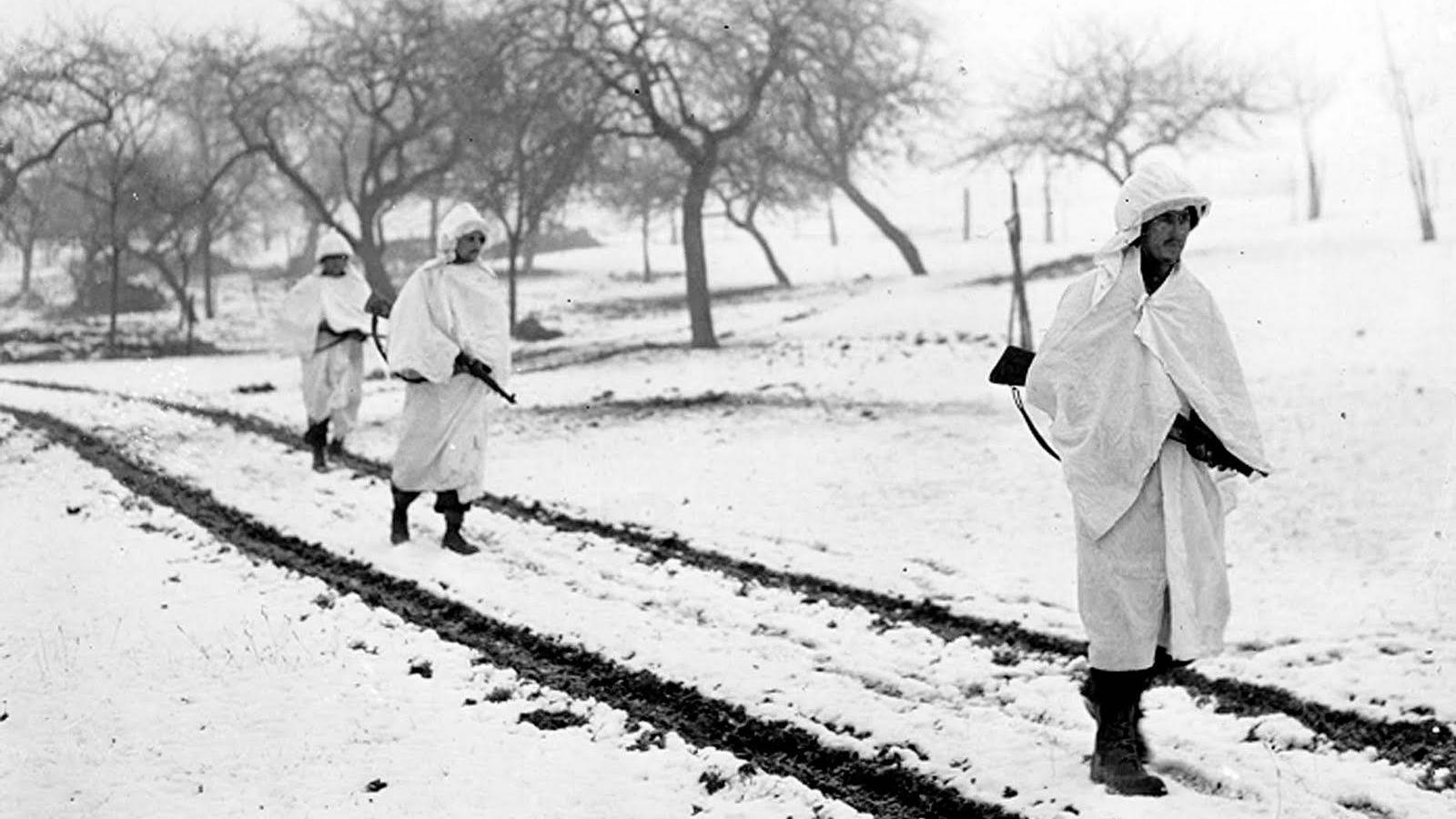
During the Battle of the Bulge, three members of an American patrol cross a snow-covered field on a scouting mission in Lellig, Luxembourg, Dec. 30, 1944. White bedsheets camouflage them in the snow.
Retired Army Lt. Col. Alfred Shehab doesn’t just talk about the Battle of the Bulge, he lived it.
Shehab, 99, was invited by NAVAIR to speak about his personal experiences at a Veterans Day event held Nov. 8 in the atrium of the Rear Adm. William A. Moffett Building.
Before Shehab addressed the standing-room only crowd, an archival newsreel was shown that included footage from captured German cameras because, as Shehab explained, it gave the audience a feel for what conditions were like for troops on the front lines that winter.
Introduced by retired Army Lt. Col. Ruth Hamilton, commander-in-chief of The Military Order of the World Wars, Shehab recounted stories from the infamous battle that Winston Churchill proclaimed was “undoubtedly the greatest American battle of the war and will, I believe, be regarded as an ever-famous American victory.”
The battle, which lasted from Dec. 16, 1944 to Jan. 25, 1945, ensued when Adolf Hitler ordered German troops to attack Allied forces in a last-ditch effort to turn the tide of the war back in his favor after the successful D-Day invasion of Normandy the previous June.
According to the U.S. Army Center of Military History website, the Germans struck in the Ardennes Forest in Belgium, a 75-mile stretch of the Western Front characterized by dense woods and few roads, and held by four inexperienced and battle-worn American divisions stationed there for rest and seasoning.
The battle stretched on for weeks and the lines of communication were broken. Weary American Soldiers, isolated and unaware of the overall picture, continued to put up fierce resistance in the face of sometimes devastating fire, slowing Nazi advancement and buying time for reinforcements to arrive.
“The German 88 was the best canon any army had,” Shehab said. “It was supposed to be anti-aircraft, but they fired it at us like a machine gun.”
Before long, Lt. Gen. George Patton’s Third Army had relieved Bastogne, and to the north, the 2nd U.S. Armored Division stopped enemy tanks short of the Meuse River on Christmas. Through January, American troops, often wading through deep snow drifts, attacked the sides of the shrinking German bulge until they had restored the front and set the stage for the final drive to victory.
Shehab, a second lieutenant at the time of the battle, told a number of personal stories, such as how the troops supplemented their rations by grabbing chickens, and even cows, from nearby farmland; or how they would find chateaus in the area and take them over as barracks. He also described one very sobering event – the first time he had to kill a German soldier.
“I didn’t think about it; my training kicked in, and I pulled the trigger,” he said. “Afterward, I searched his pockets and pulled out the photo of a woman and two little girls. I’ve never been able to forget it.”
The Battle of the Bulge is said to be, above all, the story of American Soldiers. Shehab noted that there were 81,000 American casualties and 100,000 German casualties in just one month.
“I don’t understand why we have wars; we’re supposed to be intelligent people,” he said. “But we do have wars and we have to serve.”
Master Chief Navy Counselor Chris Mandeville, who helped coordinate the event, was pleased to have Shehab visit the installation. He noted that NAS Patuxent River has a diverse workforce of active duty, retirees and civilian personnel, but that we all have one thing in common.
“We’re patriots of this country or we wouldn’t be doing what we’re doing,” Mandeville said. “And as patriots, it’s important for us to pause [for Veterans Day] and remember those who’ve gone before us and that’s why we invited Shehab to come. To have a World War II veteran survive that period and still be on his game and be able to come talk to us is pretty amazing. It’s special.”